
Math Topics
Learning Support
Professional

 One reason why students do poorly in mathematics problem solving
tasks and on achievement tests is a lack of good reading,
comprehension, and writing skills.
One reason why students do poorly in mathematics problem solving
tasks and on achievement tests is a lack of good reading,
comprehension, and writing skills.
Therefore, Assisting Readers is designed to provide resources that should help you, if your K-12 students are struggling with reading and language arts, or if you'd just like to better connect math to reading.
Instructional Strategies Resources for Reading and Writing, including resources linking math and literature
The Common Core Standards require changes in approaches to instruction for English Language Arts and Literacy, as well as for mathematics. "Across the English language arts and mathematics standards, skills critical to each content area are emphasized. In particular, problem-solving, collaboration, communication, and critical-thinking skills are interwoven into the standards" (About the Standards, FAQ section, p. 6). Research has shown the link between reading skills and students' problem-solving abilities.
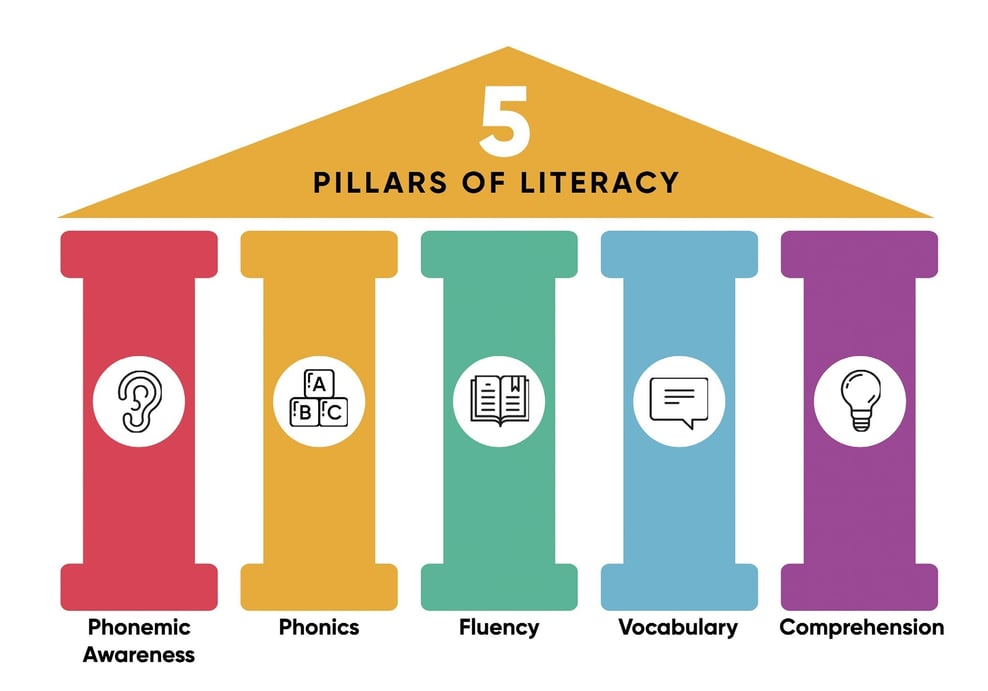
According to Sally Shaywitz and Bennett Shaywitz (2007), "Effective reading instruction and intervention programs provide children with systematic instruction in each of the five crucial components of reading," which are phonemic awareness, phonics, fluency, vocabulary, and comprehension strategies (p. 75). These five components make up the pillars of literacy.
As G. Reid Lyon (2003) noted:
On the basis of a thorough evidence-based review of the reading research that met rigorous scientific standards, the National Reading Panel (NRP), convened by the NICHD [National Institute of Child Health & Human Development] and the Department of Education, found that instructional programs that provided systematic instruction in phonemic awareness, phonics, guided repeated reading to improve reading fluency, and direct instruction in vocabulary and reading comprehension strategies were significantly more effective than approaches that were less explicit and less focused on the reading skills to be taught (e.g., approaches that emphasize incidental learning of basic reading skills). The NRP found that children as young as four years of age benefited from instruction in phonemic awareness and the alphabetic principle when the instruction was presented in an interesting and entertaining, albeit systematic manner. (p. 3)
The University of Oregon has posted the 5 Big Ideas in Beginning Reading, along with resources for addressing each: phonetic awareness, the alphabetic principle, fluency with text, vocabulary, and comprehension. There is a summary of findings from the National Reading Panel.
In A Synthesis of Quantitative Research on Reading Programs for Secondary Students, Baye, Lake, Inns, and Slavin (2018) noted other approaches for reading used with middle and high school learners, which they grouped into 10 categories. Per Table 1 (p. 59) overall weighted outcomes (ES, effect sizes) were as follows for those categories: tutoring (ES=+0.24), cooperative learning (ES=+0.10), whole school approaches (ES=+0.06), writing-focused approaches (ES=+0.13), content-focused approaches (ES=+0.08), vocabulary-focused approaches (ES=+.06), strategy-focused instruction (ES=+0.09), personalization approaches (ES=+.13), group/personalization rotation approaches (ES=+0.09), and intensive approaches (ES=0.00). The intensive "category of approaches [was] uniquely focused on the needs of students lacking key skills that should have been learned in elementary school, especially decoding" (p. 18). Their findings also suggested, "secondary readers benefit more from socially and cognitively engaging instruction than from additional reading periods or technology" (p. 2).
According to the International Literacy Association (2019) research has clearly shown that phonics instruction is essential for students' reading and writing development. "Although phonics can be taught in different ways, research supports instruction that is explicit and systematic. Explicit means that the initial introduction of a letter–sound relationship, or phonics skill, is directly stated to students. ... Being systematic means that we follow a continuum from easy to more complex skills, slowly introducing each new skill. Systematic instruction includes a review and repetition cycle to achieve mastery and goes from the known to the new in a way that makes the new learning more obvious and easier for students to grasp" (p. 3).
The Orton-Gillingham Method For Teaching Reading "places a strong emphasis on systematically teaching phonics so that students understand the hows and whys behind reading." It "breaks reading and spelling down into smaller skills involving letters and sounds and then builds on these skills over time." It "was the first approach to use explicit, direct, sequential, systematic, multi-sensory instruction to teach reading, which is effective for all students and essential for teaching students with dyslexia." Multisensory learning combines sight, hearing, touch, and movement (Approach section).
In Teaching Children to Read, Gregory Camilli, Sadako Vargas, and Michele Yurecko (2003) concluded, "Systematic phonics instruction when combined with language activities and individual tutoring may triple the effect of phonics alone" (Abstract section). In their review of research on reading programs, Robert Slavin (2009) and his colleagues at Johns Hopkins University found that for struggling readers, phonics instruction is particularly important; however not sufficient. What works best includes:
Valerie Chrisman (2005), who conducted a study of California's primary and secondary reform program schools, reported on the benefits of teaching academic English to students learning English as a second language and for those who were academically below grade level. Teachers in successful schools "presented instruction that directly reinforced the students' understanding of how the English language works instead of teaching students conversational English" (p. 19). They taught students how to use root words, suffixes, prefixes, and verb endings and believed this focus on academic English gave all their students an advantage on the state test.
The technique that Chrisman (2005) noted is called morphology. In What is the Science of Reading? Kristina Ordetx (2021) stated that morphology is the "the study of meaningful units within words. Students are able to expand their vocabulary when they are directly exposed to the study of root words, prefixes, and suffixes." The Institute of Education Sciences (Vaughn, Gersten, Dimino, et al., 2022) practice guide, Providing Reading Interventions for Students in Grades 4-9), includes practice activities that can build students' automaticity with multisyllabic word reading (example 1.3) and includes a list of common prefixes and suffixes to help with this endeavor (resources 3A.1 and 3A.2, pp. 30-31).
What causes phonics instruction to fail?
The International Literacy Association (2019) listed and elaborated upon the following 10 most common causes for phonics instructional failure, all of which teachers have some degree of control over.
In Common Core Standards: Starting Now, David Liben and Meredith Liben (2012) provided strategies and resources related to implementing the ELA-literacy standards, beginning with a recommendation to read the standards themselves. Anchor standards for reading include the role of text complexity, in which they noted that syntax plays a role in understanding complex text. "A solid academic vocabulary is essential not only to reading complex text successfully, but also to becoming proficient at writing, speaking, and listening" (Academic Vocabulary section). Students will need to expand the scope of their reading to include more informational texts.
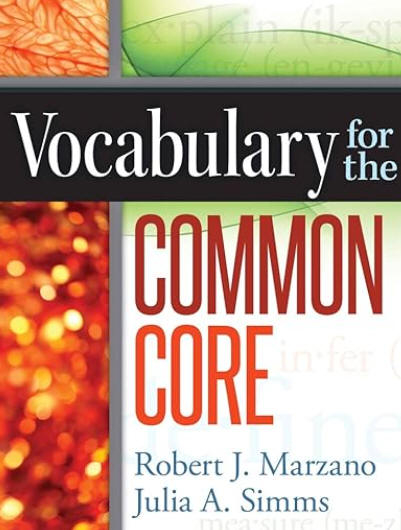 For teaching vocabulary, Robert Marzano (2009) provided a six-step
process to better instruction, which he and Julie Simms elaborated upon in
Vocabulary for the Common Core
(2013). The first three steps can be used when introducing new terms.
Steps 4-6 can be done in any order and are for reviewing and reinforcing
new terms:
For teaching vocabulary, Robert Marzano (2009) provided a six-step
process to better instruction, which he and Julie Simms elaborated upon in
Vocabulary for the Common Core
(2013). The first three steps can be used when introducing new terms.
Steps 4-6 can be done in any order and are for reviewing and reinforcing
new terms:
 If students do not know the meaning of words within test items, they cannot complete the problems successfully.
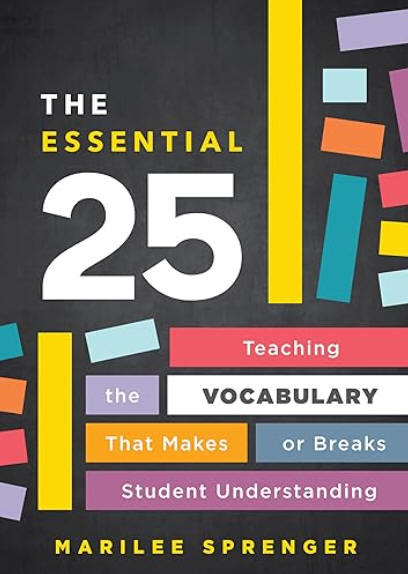
In The essential 25: Teaching the vocabulary that
makes or breaks student understanding Marilee Sprenger (2021)
shared her "list of 25 essential high-frequency words that are used in standardized
assessments and other academic contexts across states and grade levels."
They Include: "analyze, cite, compare, contrast, demonstrate,
describe, details, determine, develop, distinguish, evaluate, evidence, explain,
infer, interpret, main idea, paraphrase, persuade, point of view, relevant,
structure, summarize, support, theme, and trace" (Introduction section).
Such words are not typical of everyday speech.
If students do not know the meaning of words within test items, they cannot complete the problems successfully.
In The essential 25: Teaching the vocabulary that
makes or breaks student understanding Marilee Sprenger (2021)
shared her "list of 25 essential high-frequency words that are used in standardized
assessments and other academic contexts across states and grade levels."
They Include: "analyze, cite, compare, contrast, demonstrate,
describe, details, determine, develop, distinguish, evaluate, evidence, explain,
infer, interpret, main idea, paraphrase, persuade, point of view, relevant,
structure, summarize, support, theme, and trace" (Introduction section).
Such words are not typical of everyday speech.
Per Clare Heidema (2009), effective readers, including mathematics readers and mathematics problem solvers, have the following characteristics. They can:
- Locate key information
- Distinguish between main ideas and supporting details
- Modify their reading behaviors when faced with difficulty
- Ask questions before, during, and after reading
- Construct meaning as they read by monitoring comprehension, evaluating new information, connecting new information with existing ideas, and organizing information in ways that make sense. (para. 2)
George Polya's Problem-Solving Techniques contain details of his four principles that have become a classic for math problem-solving: understand the problem, devise a plan, carry out the plan, and look back. Heidema (2009) noted several reading and writing strategies for problem solving associated with Polya's techniques. Teachers should introduce each one at a time, model them, and provide for whole-class practice followed by independent practice. Math strategies include:
K-N-W-S: Students create a four-column chart for the word problem in which they identify "what facts they know (K), what information is not relevant (N), what the problem wants them to find out (W), and what strategy can be used to solve the problem (S)."
SQRQCQ: This acronym stands for survey, question, read, question, compute or construct, question. Students begin by skimming the problem to get a general idea as to its nature. They ask what the problem is about and what information is needed to solve it. They read the problem again to highlight details needed to solve it. They question again what is needed to solve it (e.g., what operations, with what numbers, units needed, strategies). They then compute the answer, set up and solve an equation, or construct any needed graphs, tables, diagrams, and so on. Finally, they question again about the correctness and reasonableness of their answer.
Three-level guide: This is a graphic organizer with three parts. Early-on the teacher creates this, but later as students become familiar with the strategy they might create it and share with others. It addresses literal, interpretive, and applied comprehension. In part 1, there is a set of true-false facts suggested by information given in the problem. Part 2 has the math concepts, ideas, or rules that might apply to the problem. Part 3 contains specific calculations/methods that might be used to solve the problem. In each part, students decide which element(s) in the list can help solve the problem.
Word Problem Roulette: This is a collaborative strategy in which groups of three to four students solve a word problem jointly. Then each takes a turn to write the steps in words for its solution. The first member writes a step, then passes the group solution paper to the next member of the group who writes the next step, and so on. Groups then present their solution to the class. As a group member reads the words, another puts the math symbols on the board. When all groups who tackled the same problem have presented, methods and solutions can be compared.
Process Logs: Students write about their thinking during the problem-solving process answering question prompts found on a writing-math worksheet, which guides them through the process. They can use ordinary language and math language.
Note that the RAFT method is also useful for formative assessment. You'll find examples within our Math Methodology: Assessment Essay.
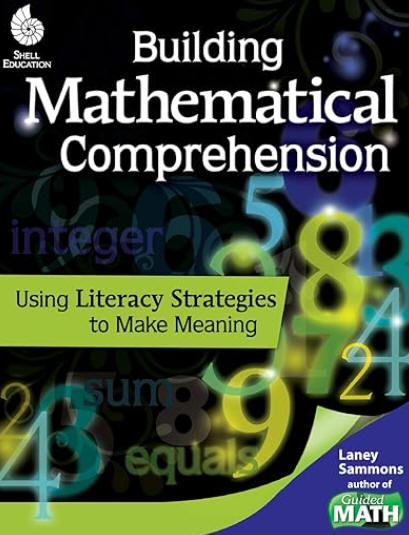 In
Building Mathematical Comprehension: Using Literacy Strategies to Make Meaning
Laney Sammons (2011) applies reading comprehension strategies and research into
mathematics instruction to help in building students' mathematics comprehension.
Chapters address comprehension strategies for mathematics, recognizing and
understanding mathematics vocabulary, making mathematical connections,
increasing comprehension by asking questions, the importance of visualizing
mathematics ideas, making inferences and predictions, determining importance,
synthesizing information, monitoring mathematical comprehension, and the guided
math classroom.
In
Building Mathematical Comprehension: Using Literacy Strategies to Make Meaning
Laney Sammons (2011) applies reading comprehension strategies and research into
mathematics instruction to help in building students' mathematics comprehension.
Chapters address comprehension strategies for mathematics, recognizing and
understanding mathematics vocabulary, making mathematical connections,
increasing comprehension by asking questions, the importance of visualizing
mathematics ideas, making inferences and predictions, determining importance,
synthesizing information, monitoring mathematical comprehension, and the guided
math classroom.
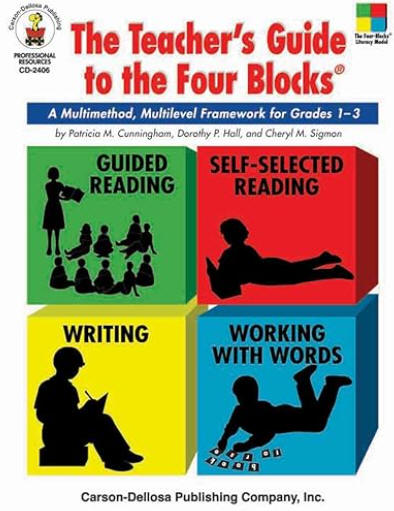 The Four-Blocks Literacy Model was designed primarily for learners in lower elementary grades.
Districts might consider the model and The
Teacher's Guide to the Four Blocks, Grades 1-3, which incorporates
four different approaches to teach children how to become better readers,
writers, and spellers: guided reading (comprehension), self-selected reading,
word study, and writing.
The Four-Blocks Literacy Model was designed primarily for learners in lower elementary grades.
Districts might consider the model and The
Teacher's Guide to the Four Blocks, Grades 1-3, which incorporates
four different approaches to teach children how to become better readers,
writers, and spellers: guided reading (comprehension), self-selected reading,
word study, and writing.
Canton City Schools in Ohio adopted this model for curriculum alignment for reading instruction, and tied Ohio's academic content standards closely in classroom instruction. They used technology for whole class instruction, and adopted the engaging, adaptive technology content of Riverdeep's Destination Success (Reading and Math) program, all of which contributed to a substantial increase (124%) among grade 3 learners in passing the Ohio Achievement Test for Reading at one of its elementary schools (Eaton, 2005). [Readers should note that Riverdeep merged with Houghton Mifflin in 2006 and the company later became known as Houghton Mifflin Harcourt.] Dr. Andy Johnson provided a brief overview of the Four Blocks Literacy model in his YouTube video.
Four Blocks, however, has been criticized. In her report, Whole-Language High Jinks: How to Tell When “Scientifically-Based Reading Instruction” Isn’t, Louisa Moats (2007) strongly stated:
"Four Blocks is the best example of a whole-language program masquerading as an SBRR program, because its authors—a college professor and a first-grade teacher—claim that it does incorporate the essential components of science-based instruction. In reality, it does nothing of the sort. Four Blocks provides a loose framework for dividing instructional time into guided reading, independent reading, writers’ workshop, and word work. But the program is a half-empty toolbox. “Wordwork” 25 is pseudophonics. It consists of some word games that merely entertain children who are already good at reading and that fail to instruct children explicitly, systematically, or cumulatively about the relationship between speech and print. Four Blocks is particularly insidious because it appears to be a “balanced” framework but does not require a teacher to know very much about language or reading. Incidental, nonsystematic teaching can prevail in each of its four components. Too little direction is provided for teachers who should have very specific guidance about what to do and when. Four Blocks, moreover, lacks any independent scientific validation for its methods or any credible demonstration of its effectiveness with students at risk." (pp. 17-18)
Richard Allington (2007), past president of the International Reading Association, shared another view on assisting struggling readers. He proposed intervention all day long, as new hope for struggling readers, rather than the current situation in many schools where struggling readers are provided 30–60 minutes of appropriate supplemental reading instruction with a reading specialist. Students "then spend the remaining five hours a day sitting in classrooms with texts they cannot read, and that cannot contribute to learning to read, let alone contribute to the learning of science or social studies" (p. 7), and, I would add, any other content area.
Allington (2007) noted that "too often, the texts in students’ hands are appropriate for the highest achieving half of the students" and "only the best readers have books in their hands that they can read accurately, fluently, and with understanding. All students need texts of an appropriate level of complexity all day long to thrive in school. Once we have a more differentiated set of curriculum materials, then we might expect a better balance of whole-class, small-group, and side-by-side lessons. While all students benefit from small group and side-by-side teaching, it is the struggling readers who seem to benefit most, perhaps because they have the greatest need for explicit teaching and scaffolded, personalized instruction" (p. 13).
For a three-tiered response to intervention program for reading in the primary grades, Gersten et al. (2009) made the following recommendations:
Resources:
Evaluation of Response to Intervention (RtI) Practices for Elementary School Reading by Rekha Balu, Pei Zhu, Fred Doolittle, Ellen Schiller, Joseph Jenkins, and Russell Gersten (2015). Per the Executive Summary: "This report provides new information on the prevalence of RtI practices in elementary schools, illustrates the implementation of RtI practices for groups of students at different reading levels, and provides evidence on effects of one key element of RtI: assigning students to receive reading intervention services." Among findings for the school year 2011-2012, "For those students just below the school-determined eligibility cut point in Grade 1, assignment to receive reading interventions did not improve reading outcomes; it produced negative impacts" (p. ES-1).
Putting Scientific Evidence to Work in Reading Instruction is a 16-page whitepaper by D. Ray Reitzel (2022). He clarifies topics in the science of reading, choosing an evidence-based reading curriculum, how people learn to read, the difference between the science of reading and the science of reading instruction, what works in teaching reading, and more. Dr. Reitzel has written numerous articles on reading, early literacy, and early childhood eduction. He is also an advisor for i-Ready Reading from Curricululm Associates. There's an extensive list of references to support the content.
 Several websites provide reading resources for learners with
dyslexia. It can be difficult to help such learners to
read and write, if you have no experience with this disability.
When reading, words and letters can jump around on the page, as
seen in this
realistic simulation of reading with dyslexia (Ritschel, 2017).
Several websites provide reading resources for learners with
dyslexia. It can be difficult to help such learners to
read and write, if you have no experience with this disability.
When reading, words and letters can jump around on the page, as
seen in this
realistic simulation of reading with dyslexia (Ritschel, 2017).
MAP Reading Fluency from NWEA "is an adaptive universal screening and progress monitoring assessment for grades pre-K to 5" per the site description. The benchmark assessment takes about 20 minutes. The universal screening can uncover students at risk for reading difficulty, including those with characteristics of dyslexia. Areas covered include oral reading fluency, literal compehension, and foundational reading skills. Languages include English and Spanish.
NWEA has an ebook called How to Support Students with Dyslexia (2021). It "explores the ins and outs of dyslexia, along with emerging research and best practices for supporting early learners as they learn to read."
Miciak, J., & Fletcher, J. M. (2020). The Critical Role of Instructional Response for Identifying Dyslexia and Other Learning Disabilities. Journal of learning disabilities, 53(5), 343–353. https://journals.sagepub.com/doi/10.1177/0022219420906801 Also see full text at https://www.ncbi.nlm.nih.gov/pmc/articles/PMC7560958/
Per the Abstract, "This article addresses the nature of dyslexia and best practices for identification and treatment within the context of multitier systems of support (MTSS)."
Snowling, M. J., Hulme, C., & Nation, K. (2020). Defining and understanding dyslexia: past, present and future. Oxford Review of Education, 46(4), 501–513. https://www.ncbi.nlm.nih.gov/pmc/articles/PMC7455053/
This article includes sections on Dyslexia--the discrepany definition; Putting learning into the definition of dyslexia and the phonological deficit hypothesis; Comorbidities of dyslexia; Dyslexia diagnosis and treatment; and Conclusions: when is dyslexia a disability.
Note: Citing research in regard to comorbidity, the authors noted that "Rates of comorbidity between reading disorder and other neurodevelopmental disorders vary widely but, on average, about 40% of the children with a reading disorder/dyslexia will have another disorder as well." For example, the same individual might have a reading disorder and mathematics disorder, or a reading disorder combined with behavioral and emotional disorders.
 Educators should be aware of research that has found reading comprehension to
be higher when using print-based text over digital content, whether it be on a
computer screen or tablet. For example,
Delgado, Vargas, Ackerman, and Salmeró (2018) found a significant effect
size of +.21 in their meta-analysis of 54 studies from 2000-2017 on the reading
of comparable texts on paper and on digital devices. Two significant influencing factors
were "(1)
time frame: the paper-based reading advantage increased in time-constrained
reading compared to self-paced reading; (2) text genre: the paper-based reading
advantage was consistent across studies using informational texts, or a mix of
informational and narrative texts, but not on those using only narrative texts"
(Abstract section). Comprehension might also be affected by the type of
digital device used and the need for scrolling through text, the latter of which
might increase cognitive load on readers "by making spatial orientation to the
text more difficult for readers than learning from printed text" (p. 35). Nevertheless, reading digital content has become integral
to education. Such factors should be considered in design of instruction,
testing, and tasks that learners will do.
Educators should be aware of research that has found reading comprehension to
be higher when using print-based text over digital content, whether it be on a
computer screen or tablet. For example,
Delgado, Vargas, Ackerman, and Salmeró (2018) found a significant effect
size of +.21 in their meta-analysis of 54 studies from 2000-2017 on the reading
of comparable texts on paper and on digital devices. Two significant influencing factors
were "(1)
time frame: the paper-based reading advantage increased in time-constrained
reading compared to self-paced reading; (2) text genre: the paper-based reading
advantage was consistent across studies using informational texts, or a mix of
informational and narrative texts, but not on those using only narrative texts"
(Abstract section). Comprehension might also be affected by the type of
digital device used and the need for scrolling through text, the latter of which
might increase cognitive load on readers "by making spatial orientation to the
text more difficult for readers than learning from printed text" (p. 35). Nevertheless, reading digital content has become integral
to education. Such factors should be considered in design of instruction,
testing, and tasks that learners will do.
The issue of teaching reading is compounded when reading digital content as it "introduces nonlinear options for proceeding through texts," according to Gina Biancarosa (2012, p. 25). Elaborating on this issue for struggling readers, she stated:
On one hand, it gives readers access to background knowledge, definitions of unfamiliar terms, efficient location of relevant information through the use of search tools, and motivating choices for personal inquiry. On the other hand, gaining proficiency in digital reading is no means automatic. (pp. 25-26)
As grade 3 is thought to be a transition grade between learning to read and reading to learn, Biancarosa (2012) recommended "reading instruction after 3rd grade should target skills, strategies, and behaviors that research has identified as central to reading in digital environments" (p. 26). Such skills would include teaching search strategies and text structures of informational websites so that learners can find their own background information on a topic rather than relying on the teacher to provide it, how to gather relevant information from targeted reading, and how to gain efficiency when reading digital content, as reading online is slower than reading digitally for deep meaning and developing higher-level literacy.
The Online Reading Comprehension Assessment (ORCA) Project at the University of Connecticut, funded by the Institute of Education Sciences of the U.S. Department of Education, was designed to help educators with Understanding the New Literacies of Online Reading Comprehension. This latter document begins with the essential components of online reading:
A new literacies perspective of online reading comprehension frames online reading comprehension as a process of problem-based inquiry involving the new skills, strategies, dispositions, and social practices that take place as we use the Internet. One difference from earlier models of traditional print comprehension is that the new literacies of online reading comprehension are defined by a process of self-directed text construction with at least five processing practices required while reading on the Internet: (a) reading to identify important questions; (b) reading to locate information; (c) reading to critically evaluate information; (d) reading to synthesize information, and (e) reading and writing to communicate information (Leu, Kinzer, Coiro & Cammack, 2004). Within these five areas reside the skills, strategies, and dispositions that are distinctive to online reading comprehension as well as others that are important for offline reading comprehension. (para. 1)
Further, "online reading comprehension includes the online reading and communication skills required by texting, blogs, wikis, video, shared writing spaces (such as Google Docs), and social networks such as Nings" (para. 2).
There are apps available that allow annotation of digital materials, which have the potential to enhance comprehension. For example, Hypothesis is open-source software to annotate the web. It would be particularly useful for e-books or online articles to highlight content and add notes to it, just like one might do when reading print-based text. Imagine the teacher adding questions or comments to the text to consider as you read. It can be used by one person or groups to discuss, read socially, take personal notes, organize research, and more. See examples of its use in education. A similar product is NowComment.
Text-to-Speech (TTS) software has the potential to help comprehension of digital content. It can help those who struggle with reading, or learners with certain disabilities such as those who are blind or physically impaired. There are many options to choose from, but be sure to look for a free trial before making any purchase.
Optical character recognition (OCR) software can convert printed materials to digital format so that it can be read by TTS software.
Digital control technologies can also be helpful, which allow the user to control how text is displayed (e.g., text size and spacing, font, color).
Embedded dictionaries and thesauruses will help readers to understand vocabulary, as would embedded multimedia to elaborate on a concept presented within the digital material.
Consider the following TTS resources:
Reading Rockets contains a list of assistive technology tools for reading.
Understood also addresses assistive technology for reading.
In
E-Textbooks: Points to ponder on pixels and paper by Patricia Deubel (2006,
October 4) in THE Journal, you'll find features of an ideal e-textbook and concerns about using e-textbooks.
Read Print versus digital texts: understanding the experimental research and challenging the dichotomies by Bella Ross, Ekaterina Pechenkina, Carol Aeschliman, and Anne-Marie Chase (2017, November 3) in Research in Learning Technology. The authors elaborate on benefits of print-based texts, the importance of a reader's preference for print-based or digital text and use based on familiarity with a particular technology, the advantages of e-texts, and recommendations for impactful e-text learning.
In Digital Versus Paper Reading Processes and Links to Comprehension for Middle School Students, authors Amanda Goodwin, Sun-Joo Cho, Dan Reynolds, Katherind Brady, and Jorge Salas (2019) presented their study on "digital and paper reading processes and outcomes for 371 fifth to eighth graders completing a reading task similar to standardized testing. Results showed students highlighted and annotated more when reading the paper versus digital text. Also, reading on paper versus digitally was slightly supportive of reading comprehension for the longer section of text. For behaviors, digital highlighting and looking back at the paper text were supportive of reading comprehension, whereas paper highlighting was negatively related, likely because paper highlighting tended to occur often outside of important areas of the text. Paper and digital annotating, online dictionary use, and digital look-back did not link to comprehension, when controlling for other covariates." (Abstract section)
Furenes, M. I., Kucirkova, N., & Bus, A. G. (2021). A comparison of children’s reading on paper versus screen: A meta-analysis. Review of Educational Research. https://doi.org/10.3102/0034654321998074
Per the press release from the American Educational Research Association (2021, March 9), this analysis revealed that "Digital Picture Books Harm Young Children's Learning--Unless the Books Have the Right Enhancements." The authors' examined "the inconsistent findings across experimental studies that compared children’s learning outcomes with digital and paper books. [They] quantitatively reviewed 39 studies reported in 30 articles (n = 1,812 children) and compared children’s story comprehension and vocabulary learning in relation to medium (reading on paper versus on-screen), design enhancements in digital books, the presence of a dictionary, and adult support for children aged between 1 and 8 years. The comparison of digital versus paper books that only differed by digitization showed lower comprehension scores for digital books. Adults’ mediation during print books’ reading was more effective than the enhancements in digital books read by children independently. However, with story-congruent enhancements, digital books outperformed paper books. An embedded dictionary had no or negative effect on children’s story comprehension but positively affected children’s vocabulary learning. Findings are discussed in relation to the cognitive load theory and practical design implications." (Abstract section)
Salmerón, L., Altamura, L., Delgado, P., Karagiorgi, A., & Vargas, C. (2023). Reading comprehension on handheld devices versus on paper: A narrative review and meta-analysis of the medium effect and its moderators. Journal of Educational Psychology. https://psycnet.apa.org/doiLanding?doi=10.1037%2Fedu0000830
Salmerón and colleagues noted that, for the most part, prior reading studies compared reading print texts to reading on a computer screen, and not hand-held devices. Per their Abstract: "As handheld devices, such as tablets, become a common tool in schools, a critical and urgent question for the research community is to assess their potential impact on educational outcomes. Previous meta-analytic research has evidenced the “screen inferiority effect”: Readers tend to understand texts slightly worse when reading on-screen than when reading the same text in print. Most primary studies from those meta-analyses used computers as on-screen reading devices. Accordingly, the extent to which handheld devices, which provide a reading experience closer to books than computers, are affected by the screen inferiority effect remains an open question. To address this issue, [they] reviewed relevant literature regarding potential moderating factors for the screen inferiority effect through the lenses of the reading for understanding framework. [They] then performed two meta-analyses aimed at examining the differences in reading comprehension when reading on handheld devices, as compared to print. Results from the two multilevel random-effect meta-analyses, which included primary studies that used either between-participant (k = 38, g = −0.113) or within-participant (k = 21, g = −0.103) designs, consistently showed a significant small size effect favoring print text comprehension."
Salmerón commented on the larger implications of this research in an article by Erik Ofgang (2023, October 30). He stated, "First, printed texts should not be abandoned. Second, educators should consider the goals of the tasks when deciding which reading medium to use.” He [added], “Tablets may be well-suited for internet inquiry tasks, but paper should be preferred when promoting comprehension of long texts.”
 The
University of Oregon is home to the
Dynamic Indicators of Basic
Early Literacy Skills (DIBELS) to assess reading progress.
DIBELS is "a set of standardized, individually administered
measures of early literacy development. They are designed to be
short (one minute) fluency measures used to regularly monitor
the development of pre-reading and early reading skills."
Download the materials for free, along with instructions for
administering and scoring.
The
University of Oregon is home to the
Dynamic Indicators of Basic
Early Literacy Skills (DIBELS) to assess reading progress.
DIBELS is "a set of standardized, individually administered
measures of early literacy development. They are designed to be
short (one minute) fluency measures used to regularly monitor
the development of pre-reading and early reading skills."
Download the materials for free, along with instructions for
administering and scoring.
Common Sense
Education is designed to help preK-12 educators discover,
use, and share the best apps, games, websites, and digital curricula for
their students. Ratings are provided by
teachers. Multiple search options are available, such as by subject area, grade level, and price (free, free to try, paid),
platform, purpose, and skills. Common Sense includes multiple
resources for
reading apps.
HOT!: Writing in ASCD's Educational Leadership, Daniel Liou and Kelly Deits Cutler (2023, February) proposed A Framework for Resisting Book Bans. Their Critical Inclusivity Framework, includes "five concurrent leadership practices to reclaim contested curriculum materials: (1) research student and community voices, (2) read the books, (3) reinforce formal reviews and the law, (4) reemphasize relevancy, and (5) reaffirm expectations for inclusivity. This framework aims to prepare education leaders to handle ongoing book challenges and navigate the constant political pressures forcing schools to put curriculum about diversity, equity, inclusivity, and social justice on the back burner." This is an excellent research-based article with practical strategies, thoughts, and questions to consider.
Early Readers from the Pacific Regional Education Laboratory includes a set of early reader books for K-3, which can be downloaded or printed in any of nine Pacific languages and English. Some also include an audio version.
English Biz includes pages devoted to writing better essays and writing to inform, persuade, argue, describe, explain, review, and so on. Punctuation, grammar essentials, and better spelling are included. Parts of this site are devoted to English literature for secondary learners.
Florida Center for Reading Research "explores all aspects of reading research—basic research into literacy-related skills for typically developing readers and those who struggle, studies of effective prevention and intervention, and psychometric work on formative assessment." There is an extensive resource database, searchable by age levels preK-adults, audience, resource type, key words, and more.
Get Ready to Read from the National Center for Learning Disabilities contains free early literacy and early math resources for preschool children. Users will find early literacy games, webinars, checklists, and tips for parents. The site contains screening tools, a transitioning to kindergarten toolkit, skill-building activities, and early learning and childhood basics.
HOT: Hypothesis is a browser extention that enables users to annotate and highlight content on the web, including socially in groups. You can add comments (it's like writing in the margins) and collaborate with others who are reading that content. Images and videos can be integrated. Although anyone can use it, for education it is aimed at teachers and students in grades 6 and above. Resources in the education section include examples and tips for classroom use. The tool is free with a signup. There are no ads.
KidsAndReading from the UK contains numerous articles for helping children to learn and enjoy reading. Also find classroom methods, tools and techniques, reading games, printable puzzles, and more. The section on encouraging your child has suggestions for books for boys and girls and teens and helpful tips. A special concerns section deals with learning to read when learners have ADHD, autism or dyslexia, are struggling readers, have parents who cannot read, or have English as a second language.
Learning Ally contains 82,000 audiobooks for K-12 learners who struggle with reading, or are below grade-level, or have special education needs. The database includes curriculum-aligned texts, fiction and non-fiction, and literature and is searchable by grade level, subject, lexile level. Educators seeking to implement audiobooks will also benefit from a list of courses offered by Learning Ally. There's a K-12 blog that addresses multiple categories (e.g., assistive technology, blind or visually impaired, dyslexia, learning disabilities, reading strategies for K-12, and more) and a family blog.
Learning First Alliance is a partnership of 12 educational associations that have come together to improve student learning in America's public elementary and secondary schools. Through the website, visitors may download Every Child Reading: An Action Plan, and Every Child Reading: A Professional Development Guide, which provide reading tips for parents, teachers, and schools.
HOT!: LETRS (Language Essentials for Teachers of Reading and Spelling), available at Lexia Learning, is a professional development suite for K-12 developed by Dr. Louisa Moats, Dr. Carol Tolman,and Dr. Lucy Hart Paulson. It addresses the fundamentals of the science of reading instruction: phonological awareness, phonics, fluency, vocabulary, comprehension, writing, and language. Learn more about the LETRS curriculum as explained by Dr. Moats in her blog post.
Lexile Framework for Reading helps connect your students to books of interest based on the students' reading levels. "The Lexile Framework for Reading is a scientific approach to reading and text measurement. There are two Lexile measures: the Lexile reader measure and the Lexile text measure. A Lexile reader measure represents a person’s reading ability on the Lexile scale. A Lexile text measure represents a text’s difficulty level on the Lexile scale. When used together, they can help a reader choose a book or other reading material that is at an appropriate difficulty level. The Lexile reader measure can also be used to monitor a reader’s growth in reading ability over time." There is an extensive database, also with books for educators on mathematics teaching and learning.
Math and Reading Help for Kids is an American Library Association corporate member. While there are several sections at this site, the reading section "covers several age groups ranging from early childhood to high school. Topics range from building strong literary skills to suggested reading lists for all age groups."
Microsoft OneNote Learning Tools: Immersive Reader is a free tool designed to help learners of all ages improve comprehension. There are multiple accessibility features. Text can be read aloud. You can choose font and text size and line spacing, male or female voice, and background color. Color can be added to parts of speech, and words can be displayed in syllables. Language options are available. This is also a beneficial tool for learners with dyslexia or English language learners.
National Institute for Direct Instruction (NIFDI) has a comprehensive collection of information of direct instruction research. According to NIFDI, "Direct Instruction (DI) is a model for teaching that emphasizes well-developed and carefully planned lessons designed around small learning increments and clearly defined and prescribed teaching tasks. It is based on the theory that clear instruction eliminating misinterpretations can greatly improve and accelerate learning."
National Reading Panel Publications: One such document is Put Reading First: The Research Building Blocks for Teaching Children to Read, which includes the findings of the National Reading Panel Report. This booklet provides analysis and discussion in five areas of reading instruction: phonemic awareness, phonics, fluency, vocabulary and text comprehension. Each section suggests implications for classroom instruction.
Promoting Reading Strategies for Developmental Mathematics Textbooks by Anne E. Campbell, Ann Schlumberger, and Lou Ann Pate (1997) of Pima Community College includes three reading and study strategies designed to facilitate student comprehension of and learning from developmental mathematics textbooks. The discussion includes a preview, predict, read, and review reading strategy; concept cards; and a Question Answer Relationship technique. For example, concepts cards can include definitions, characteristics, examples, and nonexamples. Common kinds of concept cards in math include: (a) strategy cards for solving problems; (b) fact cards that include rules, laws, or theorems; and (c) cards for symbols and specialized vocabulary.
Quill.org provides free literacy activities to help build reading comprehension, writing, and language skills for K-12 students. For reading, students are provided students "nonfiction texts paired with AI-powered writing prompts, instead of multiple-choice questions, to enable deeper thinking."
Reading Resource.Net: Stephen Griffin and Katie Appel provide free resources and materials for teaching children with dyslexia or other reading difficulties to read. They say, "We can explain why children can't read and tell you what you can do to improve their reading skills. Whatever you are seeking, be it reading strategies, teacher resources, reading activities or just a better understanding of the causes of dyslexia and reading problems themselves..."
Reading is Fundamental contains resources for parents and educators, including articles on the latest reading research, books, activities, web resources, advice and tips.
Rewordify "helps with reading comprehension and vocabulary development by simplifying English to a lower reading level. It lets you reword a sentence or reword a paragraph. It will simplify English by reducing text complexity. It's a dictionary alternative that will improve comprehension and teach vocabulary. It's an important part of reading instruction and vocabulary instruction for ESL students, people with reading disabilities, people with a learning disability, or anyone who wants to improve reading skill" (Site Summary). The software creates the easier version and words changed are highlighted. Clicking on those words allows users to hear and learn the original harder words. This free site was developed by teacher Neil Goldman.
Scientifically-Based Reading Instruction and Intervention Resources compiled by the Indiana Department of Education and faculty at Indiana University include the following sections:
Sightwords includes free resources to help educators and parents teach sight words to kids from Pre-K to 4th Grade. Features include sight word games (e.g., Bingo, Go Fish) that can be customized and printed, customizable flash cards, and classroom-tested lessons with "how-to" videos. The Georgia Preschool Association is noted as a sponsor of this site.
SpellingCity: Along with learning to read and write well is the need for learning to spell. This site enables students to practice spelling with their own personalized lists, rather than just random spelling words. Students can see their list in flashcard format, hear them spoken by a real human voice, play games with the words, and even take practice spelling tests. The site also has a database of over 37,000 words and eight spelling games. It was selected for a Parents' Choice Recommended Award in 2008.
Waterford: Science of Reading includes free on-demand webinars addressing an overview of the science of reading, phonological awareness, phonics, fluency, vocabulary, language concepts, and communication.

HOT!: Scientific Advisory Committee, Knowledge Matters Campaign. (2023, March 28). Build your knowledge on knowledge and comprehension [Blog post]. https://www.ascd.org/blogs/build-your-knowledge-on-knowledge-and-comprehension
The above article includes a reading list of literacy research. It accompanies a four-part series of articles by the Scientific Advisory Committee "on how educators can support literacy by bringing knowledge-building into their classrooms." The 11 articles in the list and the entire series can be read for free.
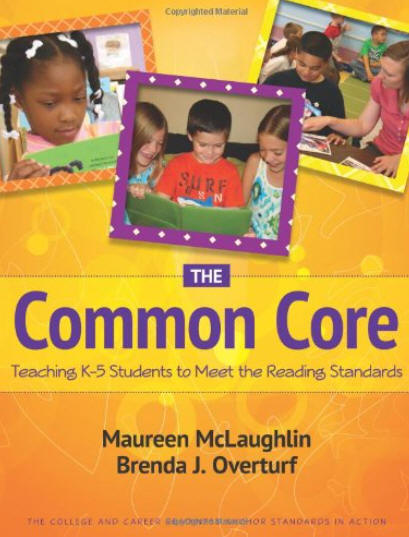 In
The Common Core:
Teaching K-5 Students to Meet the Reading Standards Maureen McLaughlin and Brenda Overturf (2012) explain the CCSS reading standards
and align them with appropriate research-based reading strategies. They
show how to use those and include classroom applications and student examples.
McLaughlin and Overturf have similarly written The Common Core:
Teaching Students in Grades 6-12 to Meet the Reading Standards (2013).
In
The Common Core:
Teaching K-5 Students to Meet the Reading Standards Maureen McLaughlin and Brenda Overturf (2012) explain the CCSS reading standards
and align them with appropriate research-based reading strategies. They
show how to use those and include classroom applications and student examples.
McLaughlin and Overturf have similarly written The Common Core:
Teaching Students in Grades 6-12 to Meet the Reading Standards (2013).
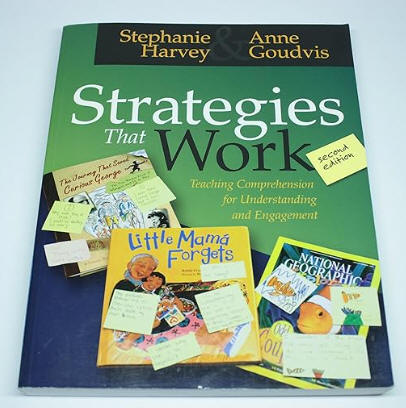 Strategies That Work:
Teaching Comprehension for Understanding and Engagement
(2nd ed.) by Stephanie Harvey and Anne Goudvis (2007) is written for those who wish to "explicitly
teach thinking strategies so that students become engaged, thoughtful,
independent readers." There are four parts. As described at the web site:
Strategies That Work:
Teaching Comprehension for Understanding and Engagement
(2nd ed.) by Stephanie Harvey and Anne Goudvis (2007) is written for those who wish to "explicitly
teach thinking strategies so that students become engaged, thoughtful,
independent readers." There are four parts. As described at the web site:
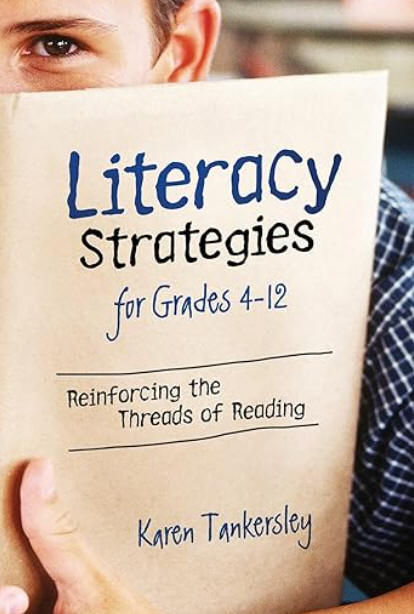 Literacy Strategies for Grades 4-12: Reinforcing the Threads of Reading
by Karen Tankersley (2005) includes five chapters. Chapter 1 is on Struggling Readers,
chapters 2-5 address Fluency, Vocabulary, Comprehension, and Higher Order Thinking.
There is also a study guide for this 202-page book.
Effective strategies for improving reading skills are provided, along with
suggestions for doing well on high stakes tests (see this latter in chapter 5).
Supporting Web site links for additional information are provided throughout.
The author's Web site is
https://threadsofreading.com. Threads of reading include phonetic
awareness, phonics, vocabulary, fluency, comprehension, and higher order
literacy (i.e., reading for analysis, synthesis, interpretation, and evaluation).
Literacy Strategies for Grades 4-12: Reinforcing the Threads of Reading
by Karen Tankersley (2005) includes five chapters. Chapter 1 is on Struggling Readers,
chapters 2-5 address Fluency, Vocabulary, Comprehension, and Higher Order Thinking.
There is also a study guide for this 202-page book.
Effective strategies for improving reading skills are provided, along with
suggestions for doing well on high stakes tests (see this latter in chapter 5).
Supporting Web site links for additional information are provided throughout.
The author's Web site is
https://threadsofreading.com. Threads of reading include phonetic
awareness, phonics, vocabulary, fluency, comprehension, and higher order
literacy (i.e., reading for analysis, synthesis, interpretation, and evaluation).
The following journals are useful, if you are looking for evidence to support adoption of particular programs or practices:

In his article, Using children’s literature to teach mathematics: An effective vehicle in a STEM world, Dr. Joseph Furner (2018) noted several benefits for doing so. The following are among those:
Furner (2018) also included an extensive list of children's literature books for teaching math concepts. These are organized by strand for primary and intermediate grades.
Here are some good resources on the WWW:
Adventures in Numbertown is a free online book for learners in grades 4-8 by Ihor Charischak. It's promoted as "An antidote for students who are allergic to fractions." Engaging "fraction" characters are used to help learners develop a conceptual understanding of fractions.
Chart of children's literature featured in the Math Solutions Publications series Math, Literature, and Nonfiction, listed with grade levels (K-8) and topics.
HOT!: Mathicalbooks.org features award-winning fiction and non-fiction books for kids aged 2-18, sure to inspire them to see math in the world around them and acquire a love of math. "Award-winning Mathical titles are selected by a nationwide committee of mathematicians, educators, librarians, early childhood experts, and others. Each year’s selections joins a growing list of stories ranging from picture books and graphic novels to chapter books and young adult literature." You can download a book list organized by grade bands: preK, K-2, 3-5, 6-8, and 9-12. Parents, librarians, educators, and anyone involved with kids will also appreciate the reading guides for selected books. Each guide includes math-centric and narrative activities to help start discussions and activities with kids.
 NRICH from the University
of Cambridge has compiled a list of recommended books for young people
interested in mathematics. They are grouped in the categories of
history of mathematics, recreational, and thinking mathematically.
Each has a lower age range to guide selection.
NRICH from the University
of Cambridge has compiled a list of recommended books for young people
interested in mathematics. They are grouped in the categories of
history of mathematics, recreational, and thinking mathematically.
Each has a lower age range to guide selection.
40 Children's Books that Foster a Love of Math posted at DREME (Development and Research in Early Mathematics Education) includes books arranged by category: Adding and Subtracting, Counting, Measurement and Size, Patterns and Algebra, Shape, Spatial Relations, and Taking Apart Numbers. DREME is an initiative of Stanford University that promotes early math development in children from birth to age 8, with an emphasis on preschool years (About section). There are resources for family math, teachers, teacher educators, and preK-3 alignment.
25 Engaging Picture Books About Math by Brittney Hallmark (2022, February 8) posted at Teaching Expertise.
Children's Books: Math Fiction is a list of popular books on Amazon to promote love of math.
 Best Evidence Encyclopedia, created by the Johns Hopkins University School of
Education's Center for Data-Driven Reform in Education, includes reviews
of research on reading in K-12 conducted by Robert Slavin and colleagues.
Reviews are grouped into five categories: elementary, effectivess of
technology, struggling readers, English language learners, and high school.
Best Evidence Encyclopedia, created by the Johns Hopkins University School of
Education's Center for Data-Driven Reform in Education, includes reviews
of research on reading in K-12 conducted by Robert Slavin and colleagues.
Reviews are grouped into five categories: elementary, effectivess of
technology, struggling readers, English language learners, and high school.
Additional research by Robert Slavin (2016) revealed at least 24 proven programs for elementary struggling readers that meet the new ESSA evidence standards. Of those 24, 14 met the "strong" ESSA criterion, eight met the "moderate" standard, and two met the "promising" standard.
In A Synthesis of Quantitative Research on Reading Programs for Secondary Students, middle and high school, Baye, Lake, Inns, and Slavin (2018) found 17 programs (see Table 12, p. 79) meeting ESSA evidence standards with strong (n=16) and moderate (n=1) ratings. These were grouped into categories: tutoring, cooperative learning, whole school approaches, writing-focused approaches, content-focused approaches, strategy instruction, personalization approaches, and group/personalization rotation approaches.
Slavin and his colleagues continued to investigate proven programs on reading achievement. In Could Proven Programs Eliminate Gaps in Reading Achievement? Slavin (2019) summarized the Synthesis of Quantitative Research on Programs for Struggling Readers in Elementary Schools, which he and colleagues reviewed. He listed several programs that work.
Evidence for ESSA is a free website from the Center for Research and Reform in Education at Johns Hopkins University, which began in 2017. It's purpose is to provide educators with the most up-to-date and reliable information regarding K-12 programs (e.g., in math and reading) that meet the strong, moderate, and promising evidence criteria per the Every Student Succeeds Act of 2015. See Evidenced-Based Reading Programs at the ESSA website.
Accelerated Reader from Renaissance Learning has research evidence for its effectiveness, such as that noted at What Works Clearinghouse and the National Center on Student Progress Monitoring. Students choose books at their reading level; this computer-managed program helps assign those readings, then provides quizzes to help monitor students' reading performance and vocabulary growth; immediate feedback is provided. Students do not work directly on the computer, however. Also see "What Kids are Reading," an annual report from Renaissance Learning of the top print and digital books in each grade level that students read. You can also create custom book lists for individual students or groups.
Amira Learning uses artificial intelligence to help K-3 learners develop reading skills. As a student reads aloud, Amira acts like a tutor and listens for mistakes and provides assistance from its toolkit of over 25 "micro interventions." The product supports response to intervention and provides intense help with phonics, decoding, and comprehension. It is accessed over the internet and works with PCs, iPads, and Chromebooks. It comes with a preloaded library, but teachers can also upload their own reading materials. After a practice session, comprehensive reports are generated on a student's level of vocabulary, comprehension, phonic awareness, and more. A dyslexia screener is available. Assessment includes audio and running recordings, metrics, and reports to review.
Book Adventure "is a FREE reading motivation program for children in grades K-8. Children create their own book lists from over 7,000 recommended titles, take multiple choice quizzes on the books they've read, and earn points and prizes for their literary successes. Book Adventure was created by and is maintained by Sylvan Learning," according to the website.
Curriculum Associates has evidence-based curriculum programs for reading instruction based on the science of reading. Among those are Phonics for Reading, an intervention program using explicit instruction for grades 3-12 with print books and digital files, and Magnetic Reading K-5 (print books), which connects the art of teaching to the science of reading.
Dreambox Reading for preK-12 uses adaptive learning technology to tailor reading to each learner's proficiency level. It includes interactive activities. The personalized foundational reading instruction for preK-2 "develops phonemic awareness, phonics, decoding, and fluency skills." The personalized silent reading instruction for grades 3-12 "targets instruction and scaffolding to improve silent reading fluency, comprehension, vocabulary, and motivation." it can be used by advanced learners, English language learners, special education students including those with dyslexia, and more.
Epic! includes a library of "over 40,000 picture books, early readers, chapter books, nonfiction, graphic novels, and learning videos" You'll find learning videos "about math, science, DIY, yoga, LEGO construction, and more." These are appropriate for learners in grade 6 and below. The library also includes "read-to-me and audio books." There are numerous books about math. Although subscription based, educators and their students have free access to over 20K books during the school day using their class code log in access.
Failure Free Reading, a research-based program, targets and is most effectively used with At-Risk and English as a Second Language Students, nonreaders, Special Education students with severe learning difficulties and others in the lowest 10% of the reading population.
Fast ForWord is a product of Scientific Learning designed for K-12 students who are reading below grade level. "The Fast ForWord program develops brain processing efficiency through intensive, adaptive exercises." The program is based on more than 30 years of neuroscience and cognitive research, and has been shown to also help learners with dyslexia improve a range of language, cognitive, and reading skills.
Five from Five provides free resources promoting evidence-based reading instruction.
From Phonics to Reading, authored by Wiley Blevins, is a collection of four print and digital programs for K-3 based on the Science of Reading, which are designed to develop foundational skills. The suite includes From Phonics to Reading, Interactive Assessments, Interactive Practice Bundle, and a Fluency Booster Practice Book. The host site, William H. Sadlier, Inc., also pairs this program with high impact tutoring.
Istation: Reading is a comprehensive internet based reading and intervention program that helps ensure students reach their reading potential through continuous progress monitoring and layered instruction and intervention. It is designed for students in grades preK-8, including English Language Learners and at-risk students. Istation also has a tool to screen students for reading difficulties, including dyslexia. Istation Math is also available, which "offers game-like computer-adaptive formative assessments appropriate for Pre-kindergarten to 8th grade students and adaptive online instruction appropriate for Pre-kindergarten to 5th grade" (Math section).
Lexia Reading Software: The What Works Clearinghouse rated this program from Lexia Learning in Concord (MA) as “potentially positive” for comprehension and alphabetics, based on data from three studies involving 314 students in kindergarten and 1st grade. See the WWC report for additional details. Lexia Core5 Reading for grades preK-5 is research based, aligned to standards, and addresses six areas of reading.
Mindplay software is for struggling readers, including mainstream students, ESL, ELL, and students with learning disabilities (e.g., dyslexia, ADD,and ADHD). It's award-winning and based on scientifically-based research.
National Library Service (NLS) at the Library of Congress "is a free braille and talking book library service for people with temporary or permanent low vision, blindness, or a physical, perceptual, or reading disability that prevents them from using regular print materials." Books in braille and audio format are offered to eligible individuals via a national network of cooperating libraries, "mailed to your door for free, or instantly downloadable" (FAQ section).
Read 180 from Houghton Mifflin Harcourt is a research-based intervention program for students in grades 3-12 whose reading level is below proficient. Students using Read 180 have shown gains at least double the equivalent control groups. For a discussion on the research for Read 180 see Slavin, Cheung, Groff, and Lake (2008). In its November 2016 update on Read 180, the What Works Clearinghouse stated, "READ 180 was found to have positive effects on comprehension and general literacy achievement, potentially positive effects on reading fluency, and no discernible effects on alphabetics for adolescent readers" (Evidence Snapshot section).
Reading A-Z has over 1000 leveled books in multiple genres spanned across 27 levels of difficulty. Books and resources are correlated to the Common Core Standards and primarily for K-6, although they can be used with a "range of grade levels in special education and special needs, remedial reading, ESL, and ELL" (About section). Guided reading lesson plans, worksheets, and assessments are available. There are resources for phonics, fluency, vocabulary, poetry, assessment, and the alphabet.
 Reading Bear, a WatchKnowLearn.org project, "is a fun way to learn to read."
You'll find over 1,200 vocabulary items and 50 presentations that cover all the main
phonics rules. Best of all--it's free.
Reading Bear, a WatchKnowLearn.org project, "is a fun way to learn to read."
You'll find over 1,200 vocabulary items and 50 presentations that cover all the main
phonics rules. Best of all--it's free.
Reading Horizons provides a systematic, explicit, sequential, and multi-sensory approach to teaching reading via the 42 sounds of the alphabet, 5 phonetic skills, and 2 decoding skills. Products are available for K-3 instruction, K-12 intervention, special education, ESL instruction, adult literacy, and home use. Interactive reading software helps differentiate instruction for each learner. Per its description, "scripted, non-consumable direct instruction materials make it possible to provide research-based, multisensory reading instruction that easily adapts to whole-class, small-group, and one-on-one instructional settings." Resources include articles on reading strategies, blended instruction, dyslexia, early literacy, and more. There's also a blog.
Reading Rockets offers strategies for kids who struggle, strategies for teaching reading, books, free reading guides, reading research, blogs about reading, PBS shows on reading, and so much more.
ReadWorks is a "FREE, research-based, and Common Core-aligned reading comprehension curriculum for grades K-6." ReadWorks delivers "lesson plans directly to teachers online" and "provides over 1,000 non-fiction reading passages with question sets to support reading activities."
Renaissance Learning:
Sora from OverDrive is a free digital reading app that can be used on Chromebooks, laptops, phones, tablets, desktops. Use it for ebooks and audiobooks. You can add notes and highlights, search local public libraries. The site indicates you can "Start with the no-cost collection that comes with every new Sora platform, then customize your school’s digital library with purchased titles to support curriculum and independent reading goals."
Starfall began in 2002 as a site to teach children how to read. Since then it has added a low cost membership that "expands the free content to include animated songs, mathematics, and reading activities spanning K-5."
Strategic Adolescent Reading Intervention (STARI) "is a literature-focused, Tier II intervention for students in grades 6-9 who read two or more years below grade level" per its description. This program from the SERP Institute received an ESSA Strong rating.
Success for All includes reading programs for preK-8. For example, The Reading Edge is the reading component of the Success for All middle school program. See Slavin, Cheung, Groff, and Lake (2008) for discussion on its effectiveness. You'll also find PowerTeaching: Mathematics for middle school at Success for All. This program is "an instructional approach that links Common Core, state standards and school curricula to research-proven instructional strategies and classroom resources that promote rigor and student engagement" (Overview section).
SuccessMaker from Savvas Learning Company is an adaptive and prescriptive scheduling intervention program delivering both reading and math curriculum for K-8. SuccessMaker for math met ESSA's "strong" evidence requirements in a 2009-2010 study.
Superkids Reading from Zaner-Blozer is primarily for grades K-2. It integrates learning to read, write, and spell and features explicit, systematic phonics and multimodal instruction. Studies of effectiveness have been conducted.
Text Project offers free, downloadable informational books for students with summer reads, a beginner series, talking points for kids, and read-aloud favorites.
Voyager Passport from Voyager Sopris Learning is a comprehensive K-5 reading intervention that meets the needs of all struggling readers. It was reviewed by Slavin, Cheung, Groff, and Lake (2008). Note: The latest version is aligned with Common Core standards.
95Percent Group includes reading resources for tiers 1, 2, and 3. You'll find products for assessments, phonics, phonological awareness, vocabulary, comprehensioni, and intensive intervention. Its 95 Phonics Core Program for Tier 1 received a "strong" ESSA rating and now supports grades K-5.
Allington, R. (2007, May). Intervention all day long: New hope for struggling readers. National Council of Teachers of English: Voices from the Middle, 14(4), 7-14. https://library.ncte.org/journals/vm/issues/v14-4?source=gs
Balu, R., Zhu, P., Doolittle, F., Schiller, E., Jenkins, J., & Gersten, R. (2015). Evaluation of response to intervention practices for elementary school reading (NCEE 2016-4000). Washington, DC: National Center for Education Evaluation and Regional Assistance, Institute of Education Sciences, U.S. Department of Education. https://www.mdrc.org/publication/evaluation-response-intervention-rti-practices-elementary-school-reading
Baye, A., Lake, C., Inns, A., & Slavin, R. (2018, January). A synthesis of quantitative research on reading programs for secondary students. Baltimore, MD: Johns Hopkins University, Center for Research and Reform in Education. https://bestevidence.org/category/reading/reading-secondary/
Biancarosa, G. (2012). Adolescent literacy: More than remediation. Educational Leadership, 69(6), 22-27. https://www.ascd.org/el/articles/adolescent-literacy-more-than-remediation
Camilli, G., Vargas, S., and Yurecko, M. (2003, May 8). Teaching children to read: The fragile link between science and federal education policy. Education Policy Analysis Archives, 11(15). https://epaa.asu.edu/index.php/epaa/article/view/243/369
Chrisman, V. (2005). How schools sustain success. Educational Leadership, 62(5), 16-20. https://www.ascd.org/el/articles/how-schools-sustain-success
Delgado, P., Vargas, C., Ackerman, R., & Salmeró, L. (2018, November). Don't throw away your printed books: A meta-analysis on the effects of reading media on reading comprehension. Educational Research Review, 25, 23-38. https://www.researchgate.net/publication/330854760_Don't_throw_away_your_printed_books_A_meta-analysis_on_the_effects_of_reading_media_on_reading_comprehension
Eaton, C. (2005). Sparking a revolution in teaching and learning. THE Journal, 32(13), 21-24. https://thejournal.com/articles/2005/08/01/sparking-a-revolution-in-teaching-and-learning.aspx
Furner, J. M. (2018). Using children’s literature to teach mathematics: An effective vehicle in a STEM world. European Journal of STEM Education, 3(3), 14. https://files.eric.ed.gov/fulltext/EJ1190705.pdf
Gersten, R., Compton, D., Connor, C. M., Dimino, J., Santoro, L., Linan-Thompson, S., & Tilly, W. D. (2009, February). Assisting students struggling with reading: Response to Intervention and multi-tier intervention for reading in the primary grades. A practice guide. (NCEE 2009-4045). Washington, DC: National Center for Education Evaluation and Regional Assistance, Institute of Education Sciences, U.S. Department of Education. https://ies.ed.gov/ncee/wwc/PracticeGuide/3
Heidema, C. (2009, February). Reading and writing to learn in mathematics: Strategies to improve problem solving. AdLIT: In Perspective. https://adurhamblog.files.wordpress.com/2014/12/math-reading-and-writing-strategies-1.pdf
International Literacy Association. (2019). Meeting the challenges of early literacy phonics instruction. https://www.literacyworldwide.org/docs/default-source/where-we-stand/ila-meeting-challenges-early-literacy-phonics-instruction.pdf
Liben, D., & Liben, M. (2012). The common core standards: Starting now. Educational Leadership, 70(4). https://www.ascd.org/el/articles/the-common-core-standards-starting-now Also available at http://web.archive.org/web/20210608225659/http://www.ascd.org/publications/educational-leadership/dec12/vol70/num04/The-Common-Core-Standards@-Starting-Now.aspx
Liou, D., & Deits Cutler, K. (2023). A framework for resisting book bans. Educational Leadership,80(5). https://www.ascd.org/el/articles/a-framework-for-resisting-book-bans
Lyon, G. R. (2003, Spring). Reading disabilities: Why do some children have difficulty learning to read. Perspectives: The International Dyslexia Association's Quarterly Periodical, 29(2). https://www.wrightslaw.com/info/read.disability.lyon.pdf
Marzano, R. (2009). Six steps to better vocabulary instruction. Educational Leadership, 67(1), 83-84. https://www.ascd.org/el/articles/six-steps-to-better-vocabulary-instruction
Moats, L. (2007). Whole-language high jinks: How to tell when “Scientifically-Based Reading Instruction” isn’t. Thomas B. Fordham Institute. https://files.eric.ed.gov/fulltext/ED498005.pdf
Ofgang, E. (2023, October 30). Study: Students who read print learn more than those who read tablets. Tech & Learning. https://www.techlearning.com/news/study-students-who-read-print-learn-more-than-those-who-read-tablets
Ordetx, K. (2021, January 14). What is the science of reading? Institute for Multisensory Education Journal. https://journal.imse.com/what-is-the-science-of-reading/
Ritschel, C. (2017, December 29). What is it like to read with dyslexia? Website shows reality of the condition. UK The Independent Life-Style. https://www.independent.co.uk/life-style/dyslexia-what-it-is-like-reading-demo-website-shows-a8134051.html
Shaywitz, S., & Shaywitz, B. (2007). What neuroscience really tells us about reading instruction: A response to Judy Willis. Educational Leadership, 64(5), 74-76. https://www.ascd.org/el/articles/what-neuroscience-really-tells-us-about-reading-instruction-a-response-to-judy-willis
Slavin, R. (2009, Spring). What works in teaching reading. Better: Evidence-based Education, 1(1),4-5. Baltimore, MD: John Hopkins University, Center for Research and Reform in Education. Available https://cupdf.com/document/better-reading.html
Slavin, R. (2016, September 15). Twenty-four proven programs for struggling readers. HuffPost. https://www.huffpost.com/entry/twenty-four-proven-progra_b_12030772
Slavin, R. (2019, April 25). Could proven programs eliminate gaps in reading achievement? Robert Slavin's Blog. https://robertslavinsblog.wordpress.com/2019/04/25/could-proven-programs-eliminate-gaps-in-elementary-reading-achievement/
Sprenger, M. (2021). The essential 25: Teaching the vocabulary that makes or breaks student understanding. Alexandria, VA: ASCD. Available: https://amzn.to/3ADdKZe
Vaughn, S., Gersten, R., Dimino, J., Taylor, M. J., Newman-Gonchar, R., Krowka, S., Kieffer, M. J., McKeown, M., Reed, D., Sanchez, M., St. Martin, K., Wexler, J., Morgan, S., Yañez, A., & Jayanthi, M. (2022). Providing Reading Interventions for Students in Grades 4–9 (WWC 2022007). Washington, DC: National Center for Education Evaluation and Regional Assistance (NCEE), Institute of Education Sciences, U.S. Department of Education. https://ies.ed.gov/ncee/wwc/practiceguide/29
 Comments?
Are you finding resources at CT4ME of value?
Comments?
Are you finding resources at CT4ME of value?
Contact Dr. Patricia Deubel: pdeubel@ct4me.net
To cite this page, use the following format:
Deubel, P. (year from last revised). Assisting K-12 readers. Computing Technology for Math Excellence. Retrieved Month, Day, Year, from https://www.ct4me.net/reading.htm
CT4ME Author: Dr. Patricia Deubel
Copyright © 2001-2024 [CT4ME.net]. All rights reserved.