
Math Topics
Learning Support
Professional



Test prep is always an issue requiring constant attention for teachers and students. Don't wait until the last minute to prepare. Standardized Test Preparation and Tips for Success includes two pages of resources:
 Test
Prep Resources (Page 1):
Test
Prep Resources (Page 1):Standardized testing in your state released test items and practice tests
 See CT4ME's Common Core
Resources for high school learners. Use these all year
long to address each of the domains within the Common Core math
standards.
See CT4ME's Common Core
Resources for high school learners. Use these all year
long to address each of the domains within the Common Core math
standards.
From basic skills to specific subjects, our extensive collection of math resources for elementary, middle, and high school are also beneficial to help learners master concepts within state standards.
CT4ME developed a free Test-Prep KWL Chart for students to use to help them monitor their test preparation progress.
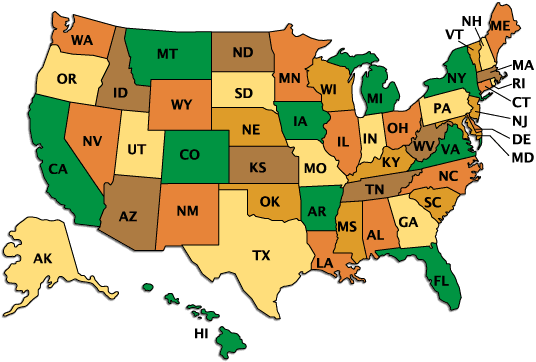

Become a Smart Learner--Raise your Skills! Many states provide educators with benchmark assessments or item banks linked to their state standards. Learn more about standardized tests in your state, and the National Assessment of Educational Progress (NAEP) using resources in this section.
 You can find out by
using Benchmark Now! from Naiku for Grades
2-High School. It "combines the assessment delivery, auto-scoring, and intuitive
standards-based reporting features of Naiku with professionally
developed end-of-year summative assessments that include a variety
of question item types – including technology enhanced – tied to the Common
Core State Standards in ELA and Math."
You can find out by
using Benchmark Now! from Naiku for Grades
2-High School. It "combines the assessment delivery, auto-scoring, and intuitive
standards-based reporting features of Naiku with professionally
developed end-of-year summative assessments that include a variety
of question item types – including technology enhanced – tied to the Common
Core State Standards in ELA and Math."
Read Dr. Patricia Deubel's commentary, Are We Ready for Testing under Common Core State Standards?, featured September 15, 2010, in THE Journal. Learn about the rise of online testing and concerns for educators preparing students for Common Core State Standards assessments.
Most states release summative test items and CT4ME has links to those from this site.
In 2017 New Meridian took over management of PARCC's testing business and has a special site with resources. Of interest are its Released Items and Math Test Design. In the latter New Meridian includes test specifications, performance-level descriptors, evidence statements including calculator designations, and a Mathematics High Level Blueprint that "defines the total number of tasks and/or items for any given grade/course assessment, the item types, and the point values for each. These are intended to help the "general public better understand the design of the state summative assessments."
SBAC Practice and Training Tests include sets of assessment questions for grades 3–8 and high school in both English language arts/literacy and mathematics.
SBAC Tools for Teachers is an online collection of classroom resources with "Educator-created lessons, activities, strategies, and professional development to help tailor instruction and boost learning."
For English Language Learners:
For Learners with Cognitive Disabilities:
Read more on K-12 Student Assessment Programs at the Educational Testing Service: K-12 Center.

National Assessment of Educational Progress has released numerous questions from past NAEP assessments, along with data about student performance on specific questions. The NAEP mathematics assessment is given every two years to students at grades 4 and 8, and approximately every four years at grade 12. An overview of NAEP and major findings from past assessments are included. NAEP reports that the tools featured in Explore NAEP Questions "can be used to supplement classroom instruction, provide additional insight into the content of the assessment, and show what students nationally or in your state or district know and can do."
Readers should consider, however, that the NAEP is not considered a high stakes test. The test does not measure any one particular student's performance, rather it provides a composite assessment. Gerald Bracey (2009) reported on characteristics that make it a poor accountability tool. For example, no student ever takes the entire test, nor do districts, schools, or individual students find out how they performed. Thus, students might not take NAEP as seriously as they would the ACT or SAT or their state high stakes tests (p. 33).
Programme for International Student Assessment (PISA) from the Organisation for Economic Co-Operation and Development surveys "15-year-olds in the principal industrialised countries. Every three years, it assesses how far students near the end of compulsory education have acquired some of the knowledge and skills essential for full participation in society." The U.S. is among participating countries. Sample questions are available.
Gerald Bracey (2009) noted that PISA is not a high stakes test and points out flaws in using results as a measure of the quality of U.S. schools. Chief among those is comparing results of a nation with a diverse population of over 300-million people to results of small "homogeneous city-states like Hong Kong and Singapore." Formal schooling differs among nations as to when students start school, policies differ in relation to repeating grades, and schools might not be serving the entire population, particularly those from low-income families. The design of test items also fall into question when one considers difficulty in translating questions into several languages, and keeping those questions free of culture bias (p. 34).
Alabama: Alabama Department of Education: Assessment includes information about its state tests. Note that the Alabama Math, Science, and Technology Initiative includes a Math Assessment Item Bank "that can be used as bell-ringers, formative assessments, summative assessments, and more; organized by 2019 Alabama Mathematics Course of Study Standards." It's organized by K-12 grade levels.
Alaska: Assessments
Arizona: Assessment section. Also see the AzM2 Portal for Sample Tests.
Arkansas: Arkansas Department of Education Public School Accountability: Assessment iincludes Practice/Training Tests to help students become familiar with layout and item types on assessments.
California: California Department of Education Testing Resources: Smarter Balanced Practice Tests
Colorado: Colorado Assessment Division Colorado also includes practice resources.
Connecticut: Connecticut State Department of Education: Comprehensive Assessment Program Portal includes practice and training tests.
Delaware: Delaware Mathematics Assessment. Delaware's testing program uses the Smarter Balanced Assessment System.
Florida: Florida K-12 Student Assessment at the Florida Department of Education. Get released test questions and Florida practice tests for math grades 3-8, algebra 1, and geometry. Note: the Florida Department of Education, the National Science Foundation, and FCR-STEM have provided funding for the CPALMS (Collaborate, Plan, Align, Learn, Motivate, Share) initiative whose mission is to provide instructional resources vetted by peers and experts and professional development for implementation of the standards. You'll find curriculum, activity, and general resources and an extensive collection of lesson plans, and more. "CPALMS instructional and educational resources are available FREE of charge to all Florida's public school teachers" (About section). Paid membership plans are available for other individuals, schools and districts.
Georgia: Georgia Department of Education Milestone Assessment System Milestone Resources include experience with online testing. Also see the Mathematics section at GeorgiaStandards.org for additional resources.
Hawaii: Hawaii Statewide Assessment Program Portal
Idaho: Idaho Department of Education: ELA/Literacy and Math Assessment includes practice and training tests. Math sample items are listed for grades 3-8 and high school in their portal: https://idaho.portal.cambiumast.com/
Illinois: Illinois State Board of Education: Assessment includes assessment resources.
Indiana: Indiana Department of Education has resources and sample test items in its assessment portal.
Iowa: Iowa Department of Education: Student Assessment. See the Math Practice Tests for grades 3-11.
Kansas: Kansas Assessment Program Note: See the Kansas State Department of Education Assessment Literacy Project available online with 21 modules appropriate for all educators. W. James Popham provided the introductions to these modules. Modules provide video lessons and activities, and address four main questions:
Kentucky: Kentucky Department of Education released test items for end of course and K-PREP.
Louisiana: The Louisiana Department of Education: Assessments: Measuring Results includes an assessment library.
Maine: Maine's Comprehensive Assessment System
Maryland: Maryland State Department of Education See practice tests for mathematics in grades 3-8, algebra I, geometry, and algebra II.
Massachusetts: Massachusetts State Department of Education released test questions and practice tests from its comprehensive assessment system
Michigan: Michigan Department of Education Student Assessment Program includes sample questions at the website.
Minnesota: Minnesota Department of Education includes testing resources, including MCA Mathematics Item Samplers on the PearsonAccess Next website. You can also see questions from past exams at Released MCA (Minnesota Comprehensive Assessment) Questions.
Mississippi: Mississippi Department of Education Office of Student Assessment
Missouri: Assessment Resources
Montana: Montana Office of Public Instruction: Statewide Testing
Nebraska: Nebraska Statewide Assessment contains sampler items for math for grades 3-8. Also see practice tests for grades 3-8 at the Nebraska Student Center Assessment System. Nebraska uses the ACT exam for high school learners and has an ACT exam prep site.
Nevada: Nevada Department of Education Standards and Assessments--Nevada uses SBAC and its practice tests in grades 3-8 and ACT and its practice tests in grade 11. Note: The Southern Nevada Regional Professional Development Program includes math resources for elementary, middle, and high school. These latter contain content units with notes (many indicating alignments with Common Core math standards), worksheets, quizzes, practice tests.
New Hampshire: New Hampshire Statewide Assessment System includes its practice and training tests.
New Jersey: New Jersey Department of Education: Assessment
New Mexico: New Mexico Standards Based Assessments
New York:
North Carolina: North Carolina Public Schools released test forms for grades 3-8 and high school.
North Dakota: North Dakota State Assessment Program
Ohio:
Oklahoma: Oklahoma Department of Education: Office of Assessments Assessment materials for grades 3-8 and "end of instruction" secondary tests include a set of representative released items. High school math includes algebra l, algebra II, and geometry items.
Oregon: Oregon Department of Education Student Assessment includes sample items and training tests for math.
Pennsylvania: Pensylvania Department of Education Standards Aligned System (SAS) contains an Assessment section with options such as: Project-based assessment, the state's Keystone Exams with high school sample questions in algebra 1, algebra 2, and geometry, an Assessment Creator, Reference Materials (e.g., formative assessment), and more.
Rhode Island: Rhode Island Department of Education: Instruction & Assessment: Mathematics contains released items and practice tests.
South Carolina: South Carolina State Department of Education The section on Assessment Information includes Quick Links for Teachers with sample test items for math in grades 3-8 and algebra 1.
South Dakota: South Dakota Department of Education: Assessment has information on its state testing program, including a student practice site.
Tennessee: Student Assessment in Tennessee You'll find pdf files of released test items for TCAP (Tennessee Comprehensive Assessment Program).
Texas: Texas Education Agency: Student Assessment and STAAR Released Test Questions
Utah: Utah State Office of Education: Assessment.
Vermont: The Vermont Agency of Education includes an assessment section within Student Learning with a portal to Smarter Balanced.
Virginia: Released Tests and Item Sets are available in mathematics for grades 3-8, algebra I, algebra II, and geometry.
Washington: Washington State Testing. Practice and training tests related to Smarter Balanced Assessments are available.
West Virginia: WV Department of Education: Assessment includes assessment resources.
Wisconsin: Wisconsin Department of Public Instruction assessment resources include sample items from various tests given by the state, including for the Wisconsin Forward Exam.
Wyoming: Wyoming Department of Education Statewide Assessment System includes portals for practice tests and other resources.
Quick tips for standardized test preparation: Read Nell Duke and Ron Ritchhart's article No Pain, High Gain: Test Prep Tips for Reading Comprehension and Math from Scholastic. They discuss strategies for reading comprehension, mathematics, reducing test-taking stress (e.g., Don't skimp on practice tests), and teaching format fundamentals. In mathematics, for example:
ACT provides online test prep for this exam and tips for success.
CollegeAtlas.org: Study Skills Guides for College Students. While meant for college, this site has tips beneficial for all students, regardless of level. You'll find sections devoted to general study skills, reading and writing, test taking and preparation for a variety of test types, time management, memory techniques, and subject specific study skills that also include for math.
College Board offers test preparation materials, tips for success, and other information related to its tests: SAT, PSAT/NMSQT, the Advanced Placement program (AP Central), and College Level Examination Program (CLEP). Khan Academy has a Digital SAT test-prep site designed to help learners prepare for the test. The College Board indicated that SAT and PSAT/NMSQT are now digital. It also offers Digital SAT Practice and Preparation
Cuesta College: Math Study Skills includes multiple pages of academic support devoted to math study skills and test taking skills, referenced from Winning at Math, a 1997 work by Paul D. Nolting, Ph.D. Of particular value are the 10 steps to better test-taking.
Dr. Roger's Math Neighborhood on YouTube includes video solutions to past SAT questions to help students prepare for this exam, including from SAT practice tests offered by the College Board. Of value is that there are playlists grouped by topic, such as geometry, systems of equations, probability and statistics. You'll also find a series of video solutions to Math Level 1 and Math Level 2 questions.
HOT for AP Students: Fiveable provides free test prep resources for students taking AP courses. AP Calculus AB/BC and AP Statistics are among those. Resources include study plans, live streams, study guides, free response help, practice questions. You'll find information on the upcoming exam--what's on it, how it will be graded, and what to focus on in your test prep. Of value is that students can practice with others who will take the exam.
HOT for CCSS: Illustrative Mathematics was founded in 2011 at the University of Arizona. Since then the project has yielded "a comprehensive suite of math curricula, designed to encourage engaging mathematical discussion, supported by tasks, lesson plans, and professional learning." Tasks align with the Common Core State Standards for Mathematics. Illustrative tasks are available for the K-8 and High School standards. The project is an initiative of the Institute for Mathematics and Education at the University of Arizona and the Bill & Melinda Gates Foundation.
Internet4Classrooms: Access activities on specific concepts within mathematics strands for grades 1-8 and an extensive list of standardized testing practice sites.
Intervention Central provides intervention ideas in the areas of general academic strategies, reading, writing, math, behavior modification, studying and organization, classroom management, and making rewards work. This site is brought to you by J. Wright, a school psychologist in Syracuse, New York.
IXL Math from IXL Learning is a math practice site, which has problem sets for preK-8, algebra 1, algebra 2, geometry, precalculus, and calculus. The site provides a colorful, engaging environment for mastering skills. The service is subscription based, but there is a free trial for teachers. Full benefits (e.g., student progress tracking and reports; and an awards system for learners who reach their goals) are gained with membership. IXL includes a diagnostic for six strands in math and also for a working math grade level.
Khan Academy Digital SAT test-prep site: The College Board has teamed up with Khan Academy for free SAT Test Prep materials. There are hundreds of questions to help prepare for this exam.
Mastery Formative Assessment Item Bank at Instructure includes assessment coverage for K-12 Math, English Language Arts, Science, and Social Studies. Assessments are aligned to state, Next Generation Science Standards, and Common Core standards. Item types include multiple choice, constructed response with rubrics, writing prompts with rubrics, and technology-enhanced items.
MathDrills by Elias Saab will help students to prepare for Mathcounts, SAT and ACT math problems. In addition, the basic skills sections can be used by students in upper elementary through high school settings. Answers and hints are provided. Sections include problems on distance, speed, and time; problems on job completion, roots of polynomials, factoring polynomials, percentage word problems, arithmetic and fraction attack (+, -, x, /), bases, linear equation drills, prime factorization, and LCM and GCD. Elias Saab also maintains The Online Test Page.
New Meridian includes released test items for grades 3-8 math and high school algebra 1, algebra 2, geometry, and integrated math among its resources. New Meridian indicates its item banks are aligned to the Common Core State Standards and compatible standards.
Progress Learning is a site created by the merger of USATestprep and Education Galaxy. It's a subscription based online product to help prepare high school, middle school, and elementary students for standardized testing. Users select their state to access resources aligned to the state's standards. Resources include:
A program called Liftoff Adaptive Intervention is also available to help struggling and at-risk learners in math and reading in grades 2-8. It provides Tier 2 and Tier 3 intervention. The site also offers national test prep for SAT, PSAT, ACT, advanced placement, and General Common Core. The product integrates with Google Classroom, Clever, ClassLink, and NWEA.
Shmoop offers fee-based test prep for multiple tests (e.g., SAT, ACT, AP exams, Common Core, PARCC, Smarter Balanced, GED). Some learning resources are free, including study guides and videos for math--well worth examining.
SparkNotes: Math Study Guides include review explanations and problem sets for pre-algebra, algebra 1 and 2; geometry 1,2, and 3; trigonometry, pre-calculus, and advanced placement calculus levels AB, BC1, and BC2. Other subjects are also included at this site.
Study.com has a series of video lessons to help prepare learners for standardized tests. Among those are GED Math; AP Calculus Exam Prep; PSAT: Practice & Study Guide; SAT: Practice & Study Guide; and ACT: Practice & Study Guide.
Study Island is a standards-based formative assessment and practice program in your state for elementary, middle, and high school grade levels and exit exams or end of course exams--whatever your state requires. It includes 12 technology enhanced item types. Study Island is a product of Edmentum, which stated "Students can work through questions using a standard test format, an interactive game format, printable worksheets, or a classroom response system." Pricing is available for the home, and schools/districts.
Test-Guide.com has free ACT practice tests. The site developers have gathered or written over 5,000 practice questions the for ACT. The practice tests are automatically scored and come with answer explanations. You'll also find official practice tests from ACT. Additional resources for study tips, subject-specific strategies and more are also available. Test-Guide also provides test prep resources for other major standardized tests.
That Quiz is a real find. K-12 students can select practice tests (customized for their needs) with varying degrees of difficulty using integers, fractions, concepts (time, money, measurement, place value, graphs), geometry, algebra, calculus, probability, and more. Some are interactive and offer manipulatives (e.g., ruler, protractor). Select to view in Spanish, if needed.
 Trends
in International Mathematics and Science Study Test your mathematics and
science knowledge in the Kids' Zone by completing TIMSS items in the
Dare to Compare challenge!
TIMSS provides reliable and timely data on the mathematics and science
achievement of U.S. students compared to that of students in other countries. See
how well your students stack up. Answers are provided as feedback.
Trends
in International Mathematics and Science Study Test your mathematics and
science knowledge in the Kids' Zone by completing TIMSS items in the
Dare to Compare challenge!
TIMSS provides reliable and timely data on the mathematics and science
achievement of U.S. students compared to that of students in other countries. See
how well your students stack up. Answers are provided as feedback.
UWorld | College Readiness includes learning tools for AP courses. Math includes AP Calculus AB, AP Calculus BC, and AP Statistics. Test-prep questions are aligned to the College Board AP exams and include detailed feedback explaining solutions.
Varsity Tutors: Practice Tests is a free section of the Varsity Tutors website where you will find practice test questions and flashcards in multiple subject areas. When viewing math tests, for example, learners can select the concept to practice. Explanations for answers are included. Among K-12 math practice tests are grades K-8, basic geometry, algebra 1, algebra 2, trigonometry, precalculus, calculus (including AP), and more. You'll also find math related to the ACT, GED, CLEP, GMAT, GRE, HSPT, ISEE, and SAT exams.
 According to W. James Popham (2016), we need to acknowledge that
"validity depends on the purpose for which a test is to be used" (p. 46).
There are three primary purposes of tests:
According to W. James Popham (2016), we need to acknowledge that
"validity depends on the purpose for which a test is to be used" (p. 46).
There are three primary purposes of tests:
There are two phrases describing tests of student achievement that are discussed in the literature: norm-referenced and criterion-referenced. Mark O'Shea (2005) provided a difference between the two:
Although O'Shea (2005) noted two kinds of standardized tests, Popham (2014) indicated: "Although test developers may build tests they believe will provide accurate norm-referenced or criterion-referenced inferences, a test itself should never be characterized as norm-referenced or criterion referenced" (p. 64). It's a common misconception. "What's criterion referenced or norm-referenced is the inference about, or the interpretation of a test taker's score" (p. 64). This clarification is important if one is using precise language. To emphasize, "it's score-based inferences--not tests--that are criterion-referenced or norm-referenced" (p. 64). Thus, educators should know how test results will be interpreted. According to Popham, "To support actionable instructional decisions about how best to teach students, norm referenced inferences simply don't cut it" (p. 64).
Per Popham (2016), "the primary purpose of a particular educational test ... should dominate the decision making of those who are building the test as well as those who are evaluating it. Currently, emphasis on purpose is absent from U.S. educational testing" (p. 49).
The following will help you to better understand terms associated with standardized testing: Glossary of Testing, Measurement, and Statistical Terms posted at Riverside Insights.
Students with special needs such as those with disabilities, limited English language and English language learners also are subject to taking large-scale assessments, including standardized tests. Data Recognition Corporation (2017) developed Guidelines to Inclusive Test Administration to help educators use appropriate test accommodations and then make valid and useful interpretations for both criterion- and norm-referenced test scores. Guidelines fall within three categories:
Category 1. "Category 1 accommodations are not expected to influence student performance in a way that alters the standard interpretation of either criterion- or norm-referenced test scores. Individual student scores obtained using Category 1 accommodations should be interpreted in the same way as the scores of other students who take the test under default conditions. These students’ scores should be included in summaries of results without notation of accommodation(s)" (p. 5). Examples: Students take the test alone or in a study carrel, or have directions read aloud or recorded. ELL might need bilingual directions. Some students might need to give responses to a scribe or use sign language.
Category 2. "Category 2 accommodations may have an effect on student performance that should be considered when interpreting individual criterion- and norm-referenced test scores" (p. 6). Examples: Students are given extra time to complete a timed test. ELL are given audiotaped test items provided in native language version or a side-by-side bilingual test or translated version provided for content other than Reading and Writing.
Category 3. "Category 3 accommodations are likely to change what is being measured and have an effect that alters the interpretation of individual criterion- and norm-referenced scores. This occurs when the accommodation is strongly related to the knowledge, skill, or ability being measured (e.g., the use of a Braille test where not all items in the non-Braille version are administered in Braille)" (p. 7). Example: Students are permitted to use calculators or tables on a math computation test when the intention is to measure computation skills without calculator use.
The National Center for Educational Outcomes provides links to states for their information related to Accessibility and Accomodations for Students with Disabilities.
The Metropolitan Center for Research on Equity and the Transformation of Schools has developed Bilingual Glossaries and Cognates, which "provide permitted testing accomodations for ELL/MLL students." They include key terms in ELA, math, science, and social studies translated into multiple languages. These serve as accommodations for learners who need them for testing and should be used in instruction throughout the year. The bilingual glossaries are an expected test accommodation in New York, for example. Math glossaries include elementary school, middle school, high school integrated algebra, high school geometry, high school algebra 2, high school calculus, an addenda for high school Common Core math terms, and supplementary math glossaries. They can be downloaded, printed, and disseminated to educators, learners, and parents.
The Smarter Balanced Assessment Consortium (SBAC) assessments include summative assessments for accountability purposes and optional interim assessments for instructional use and will use computer adaptive testing to the greatest extent possible. Assessments go beyond multiple choice questions to include extended response and technology enhanced items, as well as performance tasks that allow students to demonstrate critical-thinking and problem-solving skills.
Read SBAC updates for Accessibility and Accommodations that outline the kinds of testing supports and tools that will be made available to all students, and particularly those with disabilities and English-language learners for the Common Core assessments.
Back to top | Test Prep Resources: Page 1 | 2
Bracey, G. (2009). The big tests: What ends do they serve? Educational Leadership, 67(3), 32-37. https://www.ascd.org/el/articles/the-big-tests-what-ends-do-they-serve
Data Recognition Corporation. (2017). Guidelines to inclusive test administration. Maple Grove, MN: Author. http://tabetest.com/PDFs/TABE_Guidelines_to_Inclusive_Testing_2017.pdf
Herman, J. L., & Baker, E. L. (2005). Making benchmark testing work. Educational Leadership, 63(3), 48-54. https://www.ascd.org/el/articles/making-benchmark-testing-work
O'Shea, M. (2005). From standards to success. Alexandria, VA: ASCD. Available: https://amzn.to/3RutQNZ
Popham, W. J. (2014). Criterion-referenced measurement: Half a century wasted? Educational Leadership, 71(6), 62-66. https://www.ascd.org/el/articles/criterion-referenced-measurement-half-a-century-wasted
Popham, W. J. (2016). Standardized tests: Purpose is the point. Educational Leadership, 73(7), 44-49. https://www.ascd.org/el/articles/standardized-tests-purpose-is-the-point
Back to top | Test Prep Resources: Page 1 | 2
 See
related topics: Math Resources and
Math Manipulatives.
See
related topics: Math Resources and
Math Manipulatives.
 Comments?
Are you finding resources at CT4ME of value?
Comments?
Are you finding resources at CT4ME of value?
Send us your favorite math resources, math apps, and tips for success.
Contact Dr. Patricia Deubel: pdeubel@ct4me.net
To cite this page, use the following format:
Deubel, P. (year from last revised). State and national standardized test preparation resources and tips for success. Computing Technology for Math Excellence. Retrieved Month, Day, Year, from https://www.ct4me.net/standardized_test_preparation.htm
CT4ME Author: Dr. Patricia Deubel
Copyright © 2001-2026 [CT4ME.net]. All rights reserved.