
Math Topics
Learning Support
Professional

 Computing Technology for Math Excellence is devoted to
providing resources for teaching
and learning mathematics (K-12 and calculus), technology integration, and the standards movement in
education. CT4ME's major ongoing project is to identify Common Core math
resources for teaching and learning.
Computing Technology for Math Excellence is devoted to
providing resources for teaching
and learning mathematics (K-12 and calculus), technology integration, and the standards movement in
education. CT4ME's major ongoing project is to identify Common Core math
resources for teaching and learning.
Our resources include links to sites for basic skills mastery, specific upper level subject resources, problem solving and critical thinking, using data, homework assistance, games, simulations, virtual math manipulatives, project-based learning, field trips for math, standardized testing, and more. Resources for teaching mathematics to learners with special needs are provided, including help for struggling readers. Accessibility resources are addressed. An extensive list of software products with potential to raise student achievement is included.
Read about education and technology news, and research on topics in math education, implementing standards, and standardized testing. Educators will appreciate the resources on technology integration, multimedia in projects, web design, national math initiatives, math methodology, and professional development. Our section on Associations includes professional organizations. Within Technology Integration is also a section with grant resources to fund technology.
CT4ME's major objectives are:
Dr. Laurence Peters (2000) stated that a Third Millennial Challenge is to harness the power of educational technology to advance the standards movement. We should be assisting the entire nation's teachers to identify and use high quality materials on behalf of the standards-based reform. A more systemic approach to technology selection helps save time and effort in ensuring quality control, and frees teachers to spend more time teaching. CT4ME strives to provide this assistance to teachers.
According to the U.S. Department of Education (2000), "The latest research and evaluation studies demonstrate that school improvement programs that employ technology for teaching and learning yield positive results for students and teachers" (Executive Summary, para. 3). Two of the five National Technology Education Goals stand out. These are:
To reach goal 2, teachers need professional development as one key element. Goal 5 requires that high quality digital materials that motivate and inspire students be easy to find and use, and be accessible to individuals with disabilities.
 CT4ME has accepted the challenge to help educators locate and use the best
resources associated with the standards movement, including the Common Core
Standards Initiative, professional development,
technology integration, and with excellence in mathematics education.
CT4ME has accepted the challenge to help educators locate and use the best
resources associated with the standards movement, including the Common Core
Standards Initiative, professional development,
technology integration, and with excellence in mathematics education.
It all began with results from a 1999 national survey by Education Week (Fatemi, 1999, 2017) of how teachers used digital content in their instruction. Only 12% of teachers reported that their state or district provided lists of software titles that match curriculum standards. It appeared that software selection was placed upon teachers. Many still do not know where to turn to find out which digital content is aligned with their curricula, nor do they have time or the expertise to do so. The situation seems unacceptable in an age where technology use and national standards testing are at the forefront of education.
Then, as of 2001, 49 states required public schools to administer standardized tests, and 39 had plans to use test results to inform decisions for promotion, graduation, or teacher salaries (Salpeter, 2002). Unfortunately, when standardized tests are given, particularly those that students must pass as part of high school graduation requirements, research has shown that mathematics has often been the one area in which students have the most difficulty. My experience as an educator for over 40 years confirms that point.
Education Week's (2001) survey revealed that:
While technology access has improved over the years within our public schools, the demands on teachers have increased, pulling them in two directions: standardized test prep and preparing students for life in the 21st Century beyond the test. The situation has escalated with the adoption of the Common Core State Standards (2010) in mathematics and English language arts, which has led to a need to change how both are taught.
 Technology
use has the potential to revolutionize teaching and learning of
mathematics, and other content areas. Emerging technologies have changed
the way people learn, work, and communicate. As a work in progress, CT4ME
shares the vision of public education for the 21st Century as voiced by the
Learning First Alliance (2008). That vision pivots around five points:
Technology
use has the potential to revolutionize teaching and learning of
mathematics, and other content areas. Emerging technologies have changed
the way people learn, work, and communicate. As a work in progress, CT4ME
shares the vision of public education for the 21st Century as voiced by the
Learning First Alliance (2008). That vision pivots around five points:
Every student counts. Educators aim to tailor instruction and give each student individual attention they need to succeed. They are using new technologies and techniques to promote students’ academic and social progress. That's why CT4ME provides:
Standards in math and reading are key, to be sure, but people don't want schools to ignore or diminish other subject areas such as science, social studies, English, languages, and the arts. What’s more, the curricula should not only reflect the standards, but also engage students’ minds. There is a future of student-centered learning as opposed to teacher-centered instruction with fewer lectures and more ways students can learn and apply their knowledge to solving problems.
We can't skip tests. Tests are important, and everyone wants them to accurately and fairly measure what students know and can do. And we want results to provide the kind of information that can help teachers help students quickly. However, we don't want standardized tests to be the sole indicator of achievement. Business and education leaders believe students must learn other skills that prepare them for the real-world, such as team-work and critical thinking, and the way that media work.
So, at CT4ME you'll also find:
A section on standards
An entire section devoted to the Common Core Math Standards for high school learners
Supplementary resources for assisting struggling readers and struggling math learners.
Internet sites for linking mathematics to other subject areas and virtual field trips to explore mathematics in other subjects.
Mathematical problem solving in which students collect and analyze real time data with technology tools. Some web sites are designed to teach students critical thinking and problem solving skills and provide projects using authentic data.
Internet tools and technology apps for doing mathematics, including calculators, spreadsheets, graphing utilities, and virtual manipulatives, and tools for creating thinking.
Internet sites with games and simulations.
An entire section devoted to standardized test preparation.
Collaborative mathematical events in which students interact with experts via email, take field trips online, or participate in projects designed by others or themselves.
Students have more success when public schools forge a strong relationship with students’ families. One way that teachers can do this is via a classroom web site, or using blogs and wikis. How does CT4ME help?
CT4ME has entire sections devoted to multimedia and web design with tools for creating the same and technology integration with a focus of Web 2.0 with resources, tips, and strategies for using Web 2.0 in education.
Schools should be safe and inspire students to learn, and include activities to meet student needs and interests. As CT4ME is technology oriented, you will find:
Educators aim for good decision making and continually work to sharpen their skills so that all can succeed. We cannot do that unless we continually reflect on our practice, learn about best practices, and study new research. To this end, CT4ME provides:
CT4ME acknowledges that some images used at this site came from the Clip Art Gallery on Discovery Education, which Discovery Education no longer hosts (see this news at https://markix.net/discovery_clip_art.html). Clips are now posted at Educator Clips: https://educatorclips.com/
Permission was received from the Stock.XCHNG (originally http://www.sxc.hu/) for use of their photos. This site is now https://www.freeimages.com
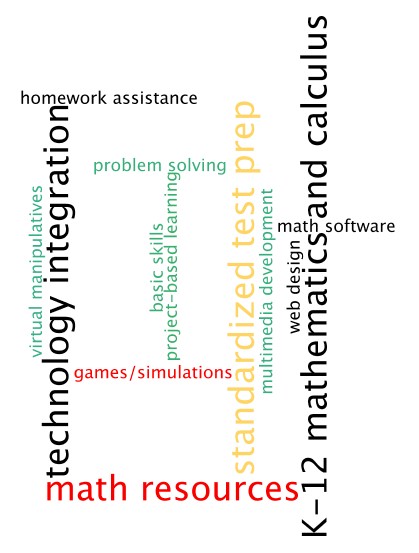
The CT4ME word cloud was created using Wordle: http://www.wordle.net (discontinued 2020). The "Love Math" image on this page is in the public domain and from https://commons.wikimedia.org/wiki/File:Love_math_1.jpg
Pixabay.com is also a source for images.
Note: Throughout this site, you will find links to books available on Amazon. CT4ME is "a participant in the Amazon Services LLC Associates Program, an affiliate advertising program designed to provide a means for us to earn fees by linking to Amazon.com and affiliated sites."
"As an Amazon Associate I earn from qualifying purchases."
 Thanks to the many educators, K-12 schools, professors,
universities, state departments of education, publishers, and other educational
organizations for listing CT4ME among your resources for teaching and learning.
See CT4ME Recognition for a few of the many who are finding our resources of
value.
Thanks to the many educators, K-12 schools, professors,
universities, state departments of education, publishers, and other educational
organizations for listing CT4ME among your resources for teaching and learning.
See CT4ME Recognition for a few of the many who are finding our resources of
value.
Common Core State Standards. (2010). Washington, DC: National Governors Association Center for Best Practices, Council of Chief State School Officers. https://www.thecorestandards.org/
Education Week. (2001). Quality counts 2001: A better balance. https://web.archive.org/web/20200809084046/https://secure.edweek.org/media/ew/qc/archives/QC01full.pdf Last accessed August 5, 2023.
Fatemi, E. (1999, September 23). Building the digital curriculum. https://web.archive.org/web/20201020082849/https://www.edweek.org/ew/articles/1999/09/23/building-the-digital-curriculum.html Last accessed August 5, 2023.
Fatemi, E. (2017, August 8 ). Building the digital curriculum. Education Week Special Report. https://www.edweek.org/education/building-the-digital-curriculum/2017/08 Last accessed August 5, 2023.
Learning First Alliance. (2008, August-September). Language for your back-to-school communications. http://web.archive.org/web/20210417092622/https://learningfirst.org/sites/learningfirst/files/assets/BacktoSchoolLanguage.pdf Last accessed August 5, 2023.
Peters, L. (2000, September). A third millennial challenge: Harness the power of educational technology to advance the standards movement. THE Journal, 28(2), 95-102.
Salpeter, J. (2002). Accountability: Meeting the challenge with technology. Technology & Learning, 22(6), 20-33.
U.S. Department of Education. (2000). e-learning: Putting a world class education at the fingertips of all children. Office of Educational Technology. https://files.eric.ed.gov/fulltext/ED444604.pdf
 Comments?
We'd love to hear from you.
Comments?
We'd love to hear from you.
Send us your favorite math resources and tips for success.
Contact Dr. Patricia Deubel: pdeubel@ct4me.net
Note: All essays included at CT4ME are written by Dr. Patricia Deubel.
To cite any page within CT4ME, use the following format:
Deubel, P. (year from last revised). Page title in italics. Computing Technology for Math Excellence. Retrieved Month, Day, Year, from page URL
CT4ME Author: Dr. Patricia Deubel
Copyright © 2001-2024 [CT4ME.net]. All rights reserved.
