
Math Topics
Learning Support
Professional

 Math Methodology is a three part series on instruction,
assessment, and curriculum. Sections contains relevant essays and
resources:
Math Methodology is a three part series on instruction,
assessment, and curriculum. Sections contains relevant essays and
resources:
Part 1: Math Methodology: Instruction
 The
Instruction Essay (Page 3 of 3) addresses the needs of students with
math difficulties and contains the following subsections:
The
Instruction Essay (Page 3 of 3) addresses the needs of students with
math difficulties and contains the following subsections:Part 2: Math Methodology: Assessment essay and resources
Part 3: Curriculum: Content and Mapping and resources
Students can experience math difficulties for a variety of reasons. Teachers need to be able to identify the source of the problem. Difficulties might stem from the nature of instruction itself, if for example the teacher relies too heavily on rote memorization or if instruction is different from that experienced in prior years. The curricular materials themselves might not be spiraled to build conceptual understanding over time, or the content might not be appropriate for the student's ability level or experiences. Words that have special meaning in math might confuse them. Students might not have a growth mindset and believe their ability to learn math is not in their control. They might not have developed adequate thinking skills to help them remember and recall previous learning. They might be easily distracted and unable to focus on tasks with several steps and procedures. Students might also have a learning disability, which is a life-long condition that manifests itself "by significant difficulties in acquisition and use of listening, speaking, reading, writing, reasoning, or mathematical abilities, or of social skills" (Kenyon, 2000, Definition section).
According to Brodesky, Parker, Murray, and Katzman, students' success in mathematics will depend on their strengths and needs related to cognitive processing, language, visual-spatial processing, organization, memory, attention, psycho-social, and fine-motor skills (2002). For elementary and middle schools, Gersten, Beckmann, Clarke, Foegen, Marsh, Star, and Witzel (2009) recommended that all students be screened to identify those at risk for potential mathematics difficulties and that interventions be provided to students identified as at risk (p. 6).
Parents also can become aware of signs indicating potential trouble with math. Some problems result from physical, cognitive, sensory, and learning disabilities in general, which have been diagnosed by professional staff and relayed to the teacher so that appropriate accommodations and/or assistive technologies can be used. Other problems might not have been diagnosed and the teacher observes those after working with students for a period of time.
Teachers might be alerted to potential math or learning disabilities from the following examples provided by Rochelle Kenyon (2000) and at Misunderstood Minds where you can also experience the difficulties yourself with the examples provided:
Inability to recall basic number facts, or easily forgetting rules, procedures, formulas, or where they are or what they are doing when solving problems.
Computational weaknesses. These might also arise because students are not writing numerals clearly, are misreading operation signs in a problem. They might be writing numbers backwards. They might have difficulty keeping score in a game.
Inability to connect abstract or conceptual representations with concrete representations or reality.
Inability to make connections of math to real life experiences. For example, they might know a number but not see its relation to an actual quantity. They might have difficulty telling time.
Difficulty with the language, such as with math terms that do not fit their everyday language, or following directions, or reading the math textbook.
Difficulty comprehending the visual-spatial and perceptual aspects of math (e.g., perceptions of changes when objects are moved from one place to another, or working with 2-D representations of 3-D geometric objects).
Problems with organization, such as when working with multi-step problems, identifying relevant information in word problems, losing sight of the final goal in problem solving, appreciating the reasonableness of a solution, inability to copy problems correctly, or overload when too many problems are presented at one time on a page to solve. (Kenyon, 2000)
 Silver, Strong, and Perini,
authors of The strategic teacher:
Selecting the right research-based strategy for every lesson (2007), indicated lack of attention to
learning styles (mastery, understanding, interpersonal, and self-expressive)
also may lead to math difficulties, and these might be overcome by varying and
using multiple instructional strategies. Mastery learners like drills,
lectures, demonstrations, and practice. They "may experience difficulty
when learning becomes too abstract or involves open-ended questions."
Understanding learners appreciate logic, debate, and inquiry and value research
projects and independent study and reading. They "may experience
difficulty when there is a focus on the social environment of the classroom
(e.g., cooperative learning)." Interpersonal learners would value the
social environment with cooperative learning, group experiences, discussion, and
role playing and may experience difficulty with "independent seat work or when
learning lacks real world application." Finally, self-expressive learners
like creativity, "open-ended and nonroutine problems" and examining what ifs.
For them, difficulties may arise with "drill and practice and rote problem
solving" (Part One: Introduction section, Figure C). The key here is to
strike a balance in a selecting instructional strategies, as students can work
in all four styles.
Silver, Strong, and Perini,
authors of The strategic teacher:
Selecting the right research-based strategy for every lesson (2007), indicated lack of attention to
learning styles (mastery, understanding, interpersonal, and self-expressive)
also may lead to math difficulties, and these might be overcome by varying and
using multiple instructional strategies. Mastery learners like drills,
lectures, demonstrations, and practice. They "may experience difficulty
when learning becomes too abstract or involves open-ended questions."
Understanding learners appreciate logic, debate, and inquiry and value research
projects and independent study and reading. They "may experience
difficulty when there is a focus on the social environment of the classroom
(e.g., cooperative learning)." Interpersonal learners would value the
social environment with cooperative learning, group experiences, discussion, and
role playing and may experience difficulty with "independent seat work or when
learning lacks real world application." Finally, self-expressive learners
like creativity, "open-ended and nonroutine problems" and examining what ifs.
For them, difficulties may arise with "drill and practice and rote problem
solving" (Part One: Introduction section, Figure C). The key here is to
strike a balance in a selecting instructional strategies, as students can work
in all four styles.
Dyscalculia is the term applied to learning disabilities involving math. Visual-spatial difficulties and language processing difficulties are major areas contributing to dyscalculia. A math learning disability varies among those who have it and affects people differently at different stages of life. Common characteristics include difficulty with counting, learning number facts, doing math calculations, measurements, telling time, counting money, estimating, mental math, and problem solving (Cortiella & Horowitz, 2014).
Consider the following books:
|
Dyscalculia: Action plans for successful learning in mathematics, 2nd ed by Glynis Hannell (2013) provides a comprehensive overview of dyscalculia based on research. It includes proven intervention strategies (i.e., practical action plans) and examples of why particular math difficulties arise. |
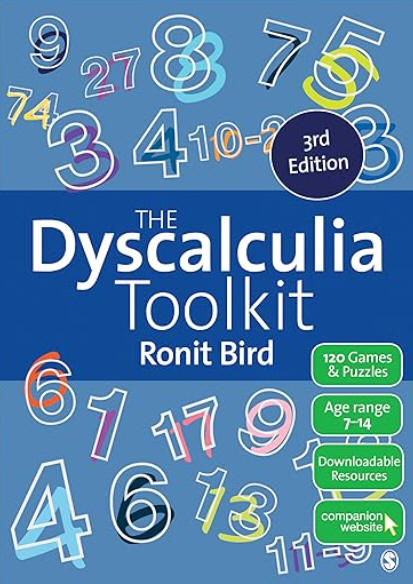
The Dyscalculia Toolkit: Supporting Learning Difficulties in Maths, 4th ed by Ronit Bird (2021) is written to help teachers learn more about dyscalculia and provide instruction for learners ages 6-14 who have difficulty with math and numbers. A variety of activities and games is included. |
Part 1: Addressing the needs of students with disabilities in math (2008, June 19).
In part 1, I present the nature of accommodations and assistive technologies that might be needed in math classes and resources for expanding your knowledge on inclusion, teaching strategies, and products appropriate for individuals with disabilities.
Part 2: Students with disabilities: Software and learning support for math (2008, June 26).
In part 2, I delve further into specific math software and learning support materials and tools for individuals with visual, pencil, cognitive, learning, and hearing impairments. The software is not necessarily restricted for use by particular groups of learners with specific disabilities. When developed according to principles of universal design noted at CAST, the programs would be appropriate considerations for all learners. Several vendors noted have software and appropriate hardware for other subject areas. These and the additional resources provided, including databases of software, hardware, and other assistive technology and checklists for software accessibility, make this snapshot of value to all K-12 educators and parents.
Read Myths and Facts Surrounding Assistive Technology Devices and Services from the U.S. Department of Education (2024, January). "This document is designed to increase understanding of the Individuals with Disabilities Education Act’s (IDEA’s) assistive technology (AT) requirements, dispel common misconceptions regarding AT, and provide examples of the use of AT devices and services for children with disabilities and to highlight the different requirements under Part C and Part B of IDEA" (p. i). For example:
"Accessible technology and AT are not the same. Accessible technology is a term used to describe technology that is designed in a way to support many different users, while AT is a term that describes a piece of technology that is selected to perform a specific task for an individual child with a disability" (p. 8).
The National Center on Accessible Educational Materials from CAST is a valuable resource to "increase the availability and use of accessible educational materials and technologies for learners with disabilities." There is numerous information on designing for accessibility, accessibility of documents, STEM, video, websites, social media posts, and more. See Teaching with Accessible Math, which notes products such as Equatio, Microsoft OneNote, MathType, and Desmos. Also of value is Procuring Accessible Digital Materials and Technologies for Teaching and Learning: The What, Why, Who, and How by Cynthia Curry, Diana Carl, and Luis Pérez (2018).
There are many forms of assistive technologies. For example, there are alternative input devices, Braille embossers, keyboard filters, light signaler alerts, on-screen keyboards, reading tools and learning disabilities programs, refreshable Braille displays, screen enlargers or screen magnifiers, screen readers, speech recognition or voice recognition programs, text-to-speech or speech synthesizers, talking and large-print word processors, and TTY/TDD conversion modems. Note: TTY stands for TeleTYpewriter; TDD stands for Telecommunications Device for the Deaf.
Augsburg University in Minnesota has a list of free or low cost assistive technology tools organized into categories: reading and literacy, writing, notetaking, dictation/speech-to-text/speech recognition, mindmapping and brainstorming, study skills and aids, organization and task management, focus/distraction free and time tracking, research tools, stress management and relaxation, vision, hearing and auditory, communication, and built-in accessibility. Anyone can benefit.
Wisconsin Assistive Technology Initiative (WATI): WATI produced a resource manual for school district teams. The complete version of Assessing Students' Needs for Assistive Technology (2009) is available online for free. Chapter 8 addresses Assistive Technology for Math---of interest is that CT4ME (p. 23) is listed among resources for virtual manipulatives.
New Meridian includes a section on Accessibility and how it is incorporating universal design and accessibility features and accommodations into assessments. New Meridian took over management of PARCC's testing business in 2017.
SBAC Summative Assessments: Read about the Accessibility and Accommodations that outline the kinds of testing supports and tools that are available to meet the needs of diverse learners.
 Lynn Fuchs and Douglas Fuchs (2001)
said that prevention of math difficulties in this
country is generally ineffective for all students, including the learning
disabled (p. 85). Part of the problem might lie with textbooks used, which form
the basis for the majority of instruction that takes place in classrooms. Texts
might not adhere to important instructional principles that affect learning.
For example, those principles include: “providing clear objectives, teaching 1
new concept or skill at a time, reviewing background knowledge, providing
explicit explanations, structuring the use of instructional time efficiently,
providing adequate practice, structuring appropriate review, and organizing
effective feedback” (p. 85).
Lynn Fuchs and Douglas Fuchs (2001)
said that prevention of math difficulties in this
country is generally ineffective for all students, including the learning
disabled (p. 85). Part of the problem might lie with textbooks used, which form
the basis for the majority of instruction that takes place in classrooms. Texts
might not adhere to important instructional principles that affect learning.
For example, those principles include: “providing clear objectives, teaching 1
new concept or skill at a time, reviewing background knowledge, providing
explicit explanations, structuring the use of instructional time efficiently,
providing adequate practice, structuring appropriate review, and organizing
effective feedback” (p. 85).
However, there is research on intervention providing evidence of methods to prevent and treat math difficulties. Fuchs and Fuchs (2001) discussed Principles for the Prevention and Intervention of Mathematics Difficulties at three levels. In essence, primary prevention focuses on universal design; secondary prevention (i.e., prereferral intervention) focuses on adaptations within the regular classroom; and tertiary prevention (i.e., intervention) focuses on highly individualized intensive and explicit contextualization of skill-based instruction.
According to the National Mathematics Advisory Panel (2008):
Explicit systematic instruction typically entails teachers explaining and demonstrating specific strategies and allowing students many opportunities to ask and answer questions and to think aloud about the decisions they make while solving problems. It also entails careful sequencing of problems by the teacher or through instructional materials to highlight critical features. (p. 48)
After its review of 26 high-quality studies related to teaching low achieving students and students with learning disabilities, mostly using randomized control designs, the National Mathematics Advisory Panel (2008) concluded that explicit methods of instruction are effective with both groups of students. In particular, "Explicit systematic instruction was found to improve the performance of students with learning disabilities in computation, solving word problems, and solving problems that require the application of mathematics to novel situations" (p. 48). Although the Panel recommended some explicit systematic instruction, "This kind of instruction should not comprise all the mathematics instruction these students receive" (p. 49).
Universal Design for Learning from CAST calls for students to have multiple means of expression, representation, and engagement in their learning. Instructional media should provide those elements and have scaffolds built in (Deubel, 2003). Within a universal design framework, Fuchs and Fuchs (2001, pp. 86-87) presented four principles of primary prevention that can be used with all students, including learning disabled:
There are three principles for secondary prevention of math difficulties within the classroom: adaptations cannot be disruptive to the target learner, must be unobtrusive for others in the class, and must be feasible for the teacher to implement within the normal classroom routine. At this stage, the teacher might benefit from additional structure and instructional strategies from special educators, school psychologists, collaboration with fellow teachers, or student-support groups (Fuchs & Fuchs, 2001). However, Lynn Fuchs (2008) indicated that six instructional principles must be incorporated at the secondary prevention level of a multi-tier prevention system:
Per the National Center on Intensive Intervention (2016), any implementation of explicit, systematic instruction should include six components: an advance organizer (i.e., lesson objective and its relevance to everyday life), assessment of background knowledge (i.e., prerequisite skills needed to be successful with the new concept), modeling, guided practice with the bulk of instruction occurring here, independent practice, and maintenance. Maintenance involves distributed practice assessments on a specific skill, strategy, or concept at regularly scheduled intervals, and may include cumulative practice (pp. 3-4).
Secondary prevention strategies that might work at this level include goal setting, self-monitoring of task completion and work quality, computer-assisted instruction, concrete representations of numbers and number concepts, and reinforcement. However, unresponsive students might yet need the tertiary level of intervention (Fuchs & Fuchs, 2001).
Primary and secondary preventions have not been successful for the group of students needing tertiary prevention. This level, also known as intervention, is typically performed by special educators who employ a broader range of instructional strategies that might not be feasible within a regular classroom setting. Intervention is characterized by three principles (Fuchs & Fuchs, 2001, pp. 91-93):
To help all students learn math, a primary step in assessing mathematics learning needs is to conduct screening. "Early and systematic screening for both cognitive and mental health related math challenges can help teachers intervene more effectively with struggling students" (Sparks, 2025).
According to Kristine Augustyniak, Jacqueline Murphy, and Donna Phillips in Psychological Perspectives in Assessing Mathematics Learning Needs (2005), the current emphasis on targeted interventions for students makes it important for educators to refine their knowledge of the different learning disabilities and how they might be manifested in children. The federal government’s current classification system includes reading, language arts, and mathematics as three specific areas of deficit. The government presumes the disabilities are associated with a central nervous system dysfunction.
Research in developmental, cognitive, social, and neuro-psychology has shed light on factors related to learning mathematics and the nature of math learning disability (MLD). Typically, students with MLD require over-learning to retain skills required in math.
Developing numerical skills involves specialized arithmetic language, comprehension of quantity, reasoning, and an ability to convert words (verbal or written) and visual forms into symbols and vice-versa. A visual-spatial impairment “is often evidenced as problems in discriminating between similar letters, copying shapes and figures, using computerized answer sheets, making sense of graphs and charts, and lining up numbers in math problems.” Those with spatial acalculia might rotate or omit numbers, misread arithmetic signs, have difficulty with lining up numbers in columns and placing of decimals (Augustyniak, Murphy, & Phillips, 2005, p. 279).
Cognitive skill development relates to learners’ abilities to perceive, sustain attention, organize, remember, and monitor information such as distinguishing between essential and non-essential details. However, one should not assume that deficits can be attributed to a specific learning disability. There is great variability in normal development of those skills. Math performance might be impeded because the student’s higher order cognitive skills are just underdeveloped. Thus, an assessment of specific neuropsychological abilities is potentially unreliable. Yet when paired with assessments of academic skills, both can inform an intervention (Augustyniak, Murphy, & Phillips, 2005). Development of cognitive skills in math is closely aligned with Jean Piaget's theory of cognitive development. Readers might be interested in David Moursund's (2016) six-level, Piagetian-type, math cognitive development scale. The scale examines math development from birth to becoming a true mathematician. You can also learn more about math learning disorders.
As an intervention for developing cognitive skills, educators might consider BrainWare Safari. This award-winning software program develops 41 cognitive skills in six areas: attention, memory, sensory integration, visual processing, auditory processing, and logic/reasoning. It has an entertaining and motivating video-game format with a jungle theme. According to its developer, Brainware Learning Company (2017), "By improving students’ underlying mental processing skills, it enables them to be more successful across the curriculum, whether in reading, math or other subject matter. BrainWare Safari benefits all students, not just those with special needs" (para. 1).
Social aspects of learning math are influenced by students’ beliefs about how math is learned (e.g., memorization, only one correct way to solve a problem, quick solutions), beliefs about oneself in relation to math, and beliefs about the social context of math learning and problem solving. Problems are manifested in emotions and behaviors such as frustration, lack of motivation, and poor problem solving strategies. A constructivist approach to teaching and learning is recommended that includes making math relevant to real-life situations, hands-on involvement, and exploration within a flexible learning environment. (Augustyniak, Murphy, & Phillips, 2005).
Russell Gersten and Benjamin Clarke (2007) presented evidence-based practices that have been shown to be consistently effective in teaching students who have difficulties in mathematics, including special education students and other low-achievers. From their review of studies, they also concluded that the "principles that emerged from the research seem appropriate for instruction in a variety of situations and possible settings."
Witzel and Blackburn (2021) recommended 2 Key Math Strategies for Students with Disabilities: the concrete-visual-abstract sequence of instruction (CVA) and schema-based problem-solving instruction (SBI), both of which are research-supported. They describe them as follows:
The IRIS Center at Vanderbilt University provides the steps in explicit, systematic instruction.
The National Institute for Direct Instruction includes a list of programs in multiple content areas that use direct instruction and research on this topic. You'll also find an online tutorial: Implementing Direct Instruction Successfully.
A tiered approach to teaching mathematics is most likely the most effective method to addressing the issues of math difficulties that exist among learners in the same classroom.
According to David Suarez (2007), underperforming students might be bored or overwhelmed by a single approach to learning. "Through tiered instruction, students at different ends of the ability spectrum find success in math class" (p. 60). His approach consists of thematic units. Learners choose from green, blue, and black levels of difficulty in both instructional materials and assessments, and can vary their choices from unit to unit. A green level designates foundational and meets grade level standards for proficiency, blue is intermediate, and black is advanced offering the greatest level of challenge sometimes requiring learners to tackle unfamiliar tasks. Learners find choices motivational and provide experience taking charge of their own learning. This tiered instruction has a theoretical foundation in the works of Lev Vygotsky's zone of proximal development, Mihaly Csikszentmihalyi's perspective on how to create joyful concentration, Eric Jensen's work on how stress affects learning, and William Glasser's choice theory. Suarez maintains a blog, Challenge by Choice, on tiered instruction in math, where he elaborates on this method and offers videos, examples, and results from his implementation with a colleague at the Jakarta International School in Indonesia.
For more on eight steps for creating a tiered lesson, read Tiered Lessons: One Way To Differentiate Mathematics Instruction by Rebecca L. Pierce and Cheryll M. Adams (2004).
In Using Tiered Instruction to Maximize Student Outcomes, posted at Kodable Education, author Harry Wahl (2023, May 18) elaborated on what it is, benefits to students and teachers, components, implementing, assessment and monitoring, collaboration with parents and teachers, and much more. There's also a FAQ section.
Augustyiak, Murphy, and Phillips (2005) proposed several teaching strategies that may prove helpful for learners with hypothesized primary skill deficits in mathematics. Their suggested strategies are summarized in Table 1.
| Table 1: Teaching Strategies for Hypothesized Primary Skill Deficits in Math | |
| Numerical Skills Deficits | |
| Use scaffolding for building computational and conceptual skills, frequent teacher questioning, and student response. Increase exposure to basal math curriculums. | Individualize instruction using small groups. Here teachers can simplify language and instructions for those who need it. Similar students can also make and/or add to their own math dictionaries. These might contain the terms reviewed prior to new lessons for further practice and reinforcement. |
| Use daily 2-3 minute long timed tests to review and monitor progress. The immediate feedback helps teachers to adjust instruction for the day. | Rather than using traditional worksheets, consider drill and practice using board games, Math Jeopardy, puzzles, dot-to-dots, color by numbers where numbers are obtained by computing math problems. |
| Visual Spatial Deficits | |
| Provide students with copies of problems to compute that are already written out for them. | Use visual aids so that students receive both auditory and visual reinforcement of concepts. |
| Scaffold learning of place value and lining up numbers by having students use grid paper, or turning lined paper sideways to create columns. | Use manipulatives. |
| Underdeveloped Higher Order Cognitive Skills | |
| Review terms before new instruction or testing. | Teach students to highlight key words in problem solving. |
| Write or illustrate critical information and directions to focus attention on key concepts. | When working on a series of problems, it is helpful to call attention to changes in operations. Students might first highlight each operation in a different color to call attention to those changes. |
| Use the computer for drill and practice; monitor student performance; preview software for its appropriateness and level of difficulty for the student/ | MLD students might need extra time to process information and respond. Rather than just call on them, a private agreed-upon signal between the teacher and student might build confidence. For example, a raised hand with closed fist might mean “I’m thinking and want to participate.” When the hand opens, the teacher would know to call on the student. |
| Social Cognition—Beliefs about abilities to do math | |
| Make math relevant to real-life. When developing word problems, use familiar names and places. | Use cooperative learning and encourage students to take on different roles within the group. |
| Have students create their own problems individually or within a group. | |
| Adapted from: Augustyniak, K., Murphy, J., & Phillips, D. (2005). Psychological perspectives in assessing mathematics learning needs. Journal of Instructional Psychology, 32(4), 277-286. Available: https://go.gale.com/ps/i.do?p=HRCA&u=googlescholar&id=GALE%7CA140412139&v=2.1&it=r&sid=bookmark-HRCA&asid=1647d6d4 | |
As one examines Table 1 above, you observe that using drill and practice and related software is included among those recommendations, as is the use of manipulatives. The National Mathematics Advisory Panel (2008) also "recommends that high-quality computer-assisted instruction (CAI) drill and practice, implemented with fidelity, be considered as a useful tool in developing students’ automaticity (i.e., fast, accurate, and effortless performance on computation), freeing working memory so that attention can be directed to the more complicated aspects of complex tasks" (p. 51). Further:
"Research has demonstrated that tutorials (i.e., CAI programs, often combined with drill and practice) that are well designed and implemented can has a positive impact on mathematics performance, particularly at the middle and high school levels. CAI tutorials have been used effectively to introduce and teach new subject-matter content. Research suggests that tutorials that are designed to help specific populations meet specific educational goals have a positive impact. However, these studies also suggest several important caveats. Care must be taken to ensure that there is evidence that the software to be used has been shown to increase learning in the specific domain and with students who are similar to those who will use the software. Educators should critically inspect individual software packages and the studies that evaluate them. Furthermore, the requisite support conditions to use the software effectively (sufficient hardware and software; technical support; adequate professional development, planning, and curriculum integration) should be in place, especially in large-scale implementations, to achieve optimal results." (p. 51)
In terms of using manipulatives, the National Center on Intensive Intervention (2016) reminded educators:
"It is important to note that although students may demonstrate proper use of a manipulative, this does not mean that they understand the concepts behind use of the manipulative. Explicit instruction and student verbalizations, such as explaining the concept or demonstrating use of the manipulative while they verbally describe the mathematical procedure, should accompany all manipulative use." (p. 5)
Gersten et al. (2009) made additional recommendations for elementary and middle school students who receive math interventions:
Instructional materials for students receiving interventions should focus intensely on in-depth treatment of whole numbers in kindergarten through grade 5 and on rational numbers in grades 4 through 8. These materials should be selected by committee.
Instruction during the intervention should be explicit and systematic. This includes providing models of proficient problem solving, verbalization of thought processes, guided practice, corrective feedback, and frequent cumulative review.
Interventions should include instruction on solving word problems that is based on common underlying structures.
Intervention materials should include opportunities for students to work with visual representations of mathematical ideas and interventionists should be proficient in the use of visual representations of mathematical ideas.
Interventions at all grade levels should devote about 10 minutes in each session to building fluent retrieval of basic arithmetic facts.
Monitor the progress of students receiving supplemental instruction and other students who are at risk.
Include motivational strategies in interventions. (p. 6)
In terms of frequent assessments, teachers and their school districts might consider adaptive testing software, which can be easily administered several times a school year to determine individual needs and to give a measure of class growth on state standards benchmarks. The National Center on Intensive Intervention (NCII) has six tools charts addressing academics and behavior. Academic charts include information about screening tools, progress monitoring tools (e.g. Acadience Math from Acadience Learning, ClassWorks Progress Monitoring from Curriculum Advantage, and Star Math from Renaissance Learning, etc.) and intervention tools. Per NCII, the charts are meant to "to assist educators and families in becoming informed consumers who can select academic and behavioral assessment tools and interventions that meet standards for technical rigor and address their specific needs."
Response to Intervention (RTI) is typically a three-tiered method for early identification of students who may be at risk for learning disabilities or difficulties. Briefly per MDRC (2017), Tier 1 instruction is provided generally to an entire class, Tier 2 to students requiring some additional help and might be in small groups for tutoring, and Tier 3 to students requiring the most help and individualized attention.
Note: The majority of states are now using the term Multi-Tiered Systems of Support (MTSS) rather than RTI to refer to a tiered system of support. Tessie Rose Bailey (2019) provided possible rationales for the shift. RTI needed rebranding as it "became synonomous with special education." MTSS "integrates academic and behavior tiered models" and "is more comprehensive than RTI." There is a "preference for MTSS in federal guidance and messaging."
Evidence for ESSA includes research-based math programs for students that have been rated for their effectiveness for tutoring. The following are among those and rated as "strong."
|
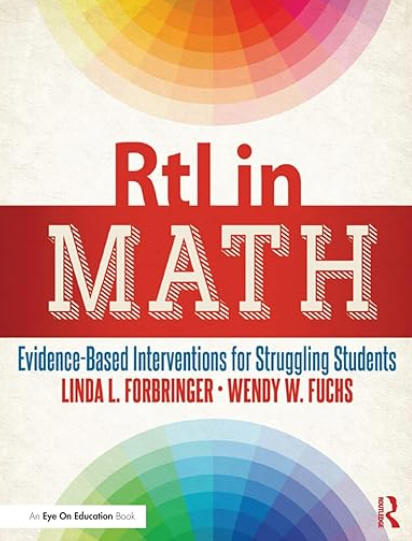
K-8 math educators will value RtI in Math: Evidence-Based Interventions for Struggling Students by Linda Forbringer and Wendy Fuchs (2014). The authors address evidence-based interventions found in the recommendations from the Institute of Education Sciences Practice Guide, Assisting students struggling with mathematics: Response to Intervention (RtI) for elementary and middle schools. |
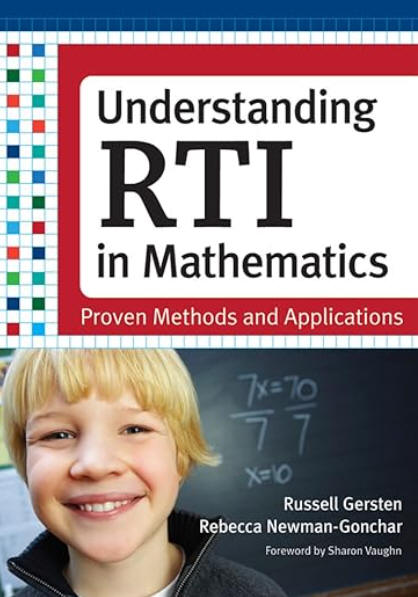
In Understanding RTI in Mathematics: Proven Methods and Applications, Russell Gersten and Rebecca Newman-Gonchar, editors, (2011) with contributions from numerous experts on RtI in math from around the country combine evidence-based strategies with practical guidelines for implementing RtI in K-12. Learn what RtI is, why it works, and how to use it. |
|
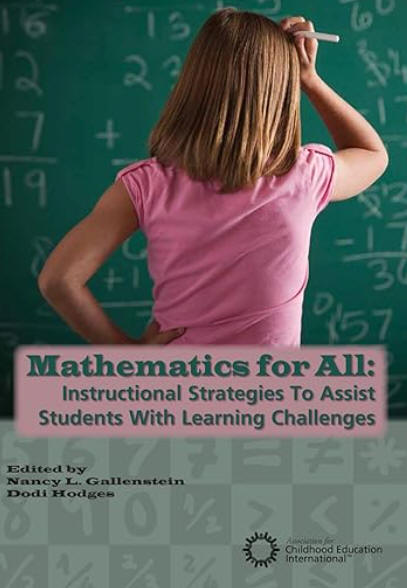
Mathematics for All: Instructional Strategies To Assist Students With Learning Challenges, edited by Nancy L. Gallenstein and Dodi Hodges (2011), is a publication of Childhood Education International. |
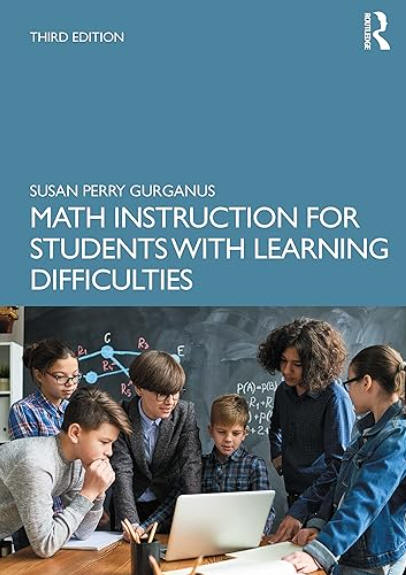
Math Instruction for Students with Learning Difficulties, 3rd edition, by Susan Perry Gurganus (2022) is research-based. This book references NCTM and Common Core math standards and addresses teacher and student attitudes towards math, language issues, specific math disabilities, prior experiences, and cognitive and metacognitive factors. Chapters on assessment and instruction precede strands that focus on critical concepts. There are suggestions for class activities and field extensions. Multi-tiered systems of support for mathematics instruction is addressed. |
|
|
|
Fuchs, L.S., Newman-Gonchar, R., Schumacher, R., Dougherty, B., Bucka, N.,
Karp, K.S., Woodward, J., Clarke, B., Jordan, N. C., Gersten, R., Jayanthi, M.,
Keating, B., & Morgan, S. (2021). Assisting Students Struggling with
Mathematics: Intervention in the Elementary Grades (WWC 2021006). Washington,
DC: National Center for Education Evaluation and Regional Assistance (NCEE),
Institute of Education Sciences, U.S. Department of Education.
https://ies.ed.gov/ncee/wwc/PracticeGuide/26
In this practice guide, Fuchs and colleagues elaborated on six recommendations with tier 1 strong evidence
for implementation:
- Systematic Instruction: Provide systematic instruction during intervention to develop student understanding of mathematical ideas.
- Mathematical Language: Teach clear and concise mathematical language and support students’ use of the language to help students effectively communicate their understanding of mathematical concepts.
- Representations: Use a well-chosen set of concrete and semi-concrete representations to support students’ learning of mathematical concepts and procedures.
- Number Lines: Use the number line to facilitate the learning of mathematical concepts and procedures, build understanding of grade-level material, and prepare students for advanced mathematics.
- Word Problems: Provide deliberate instruction on word problems to deepen students’ mathematical understanding and support their capacity to apply mathematical ideas.
- Timed Activities: Regularly include timed activities as one way to build fluency in mathematics. (p. 3, Table 1)
NOTE: The Institute of Education Sciences has developed a free professional development course to help educators in grades 3-6 to implement the recommended strategies indicated in this practice guide. See the Mathematics Intervention Toolkit.
Gersten, R., Beckmann, S., Clarke, B., Foegen, A., Marsh, L., Star, J. R., & Witzel, B. (2009, April). Assisting students struggling
with mathematics: Response to Intervention (RtI) for elementary and middle schools
(NCEE 2009-4060). Washington, DC: National Center for Education
Evaluation and Regional Assistance, Institute of Education Sciences, U.S.
Department of Education.
https://ies.ed.gov/ncee/wwc/PracticeGuide/2
The authors' "goal in this practice guide is to
provide suggestions for assessing students’ mathematics abilities and
implementing mathematics interventions within an RtI framework, in a way that
reflects the best evidence on effective practices in mathematics interventions"
(p. 4). Eight recommendations are included, along with a list of 12
examples of math problems to illustrate concepts.
Guskey, T. R., & Jung, L. A. (2011). Response-to-intervention and
mastery learning: Tracing roots and seeking common ground. The
Clearing House: A Journal of Educational Strategies, Issues, and Ideas,
84(6), 249-255.
https://tguskey.com/wp-content/uploads/Mastery-Learning-4-RTI-and-Mastery-Learning-.pdf
In this article, Guskey and Jung "draw parallels between defined
critical features of response-to-intervention (RTI) and the mastery learning
approach described in the general education literature by Benjamin S. Bloom.
[They] posit that these two processes include many common elements but that each
incorporates unique elements that could potentially complement and strengthen
the other. Finally, [they] outline the specific advantages a synthesis of these
two processes offer both special educators and general educators in their
efforts to enhance the effectiveness of instructional programs for all students"
(Abstract section).
MDRC. (2017, May). Tiered systems of support: Practical
considerations for school districts.
https://www.mdrc.org/sites/default/files/Tiered_Support_practical_considerations.pdf
This Issue Focus outlines six practical considerations for schools that
wish to implement a tiered system: scheduling, duration and intensity,
curriculum, staffing, intervention content, and balancing tier 2 and tier 3.
Nickow, A. J., Oreopoulos, P., & Quan, V. (2020). The impressive
effects of tutoring on preK-12 learning: A systematic review and meta-analysis
of the experimental evidence. (EdWorkingPaper: 20-267). Annenberg
Institute at Brown University:
https://doi.org/10.26300/eh0c-pc52
Nickow, Oreopoulos, and Quan summarized findings from 96 experimental
research studies since 1980 on preK-12 tutoring interventions of all types.
Per the Abstract, tutoring was defined as "one-on-one or small-group instructional programming by teachers,
paraprofessionals, volunteers, or parents." They found "tutoring programs
yield consistent and substantial positive impacts on learning
outcomes, with an overall pooled effect size estimate of 0.37 SD. Effects are
stronger, on average, for teacher and paraprofessional tutoring programs than
for nonprofessional and parent tutoring. Effects also tend to be strongest among
the earlier grades. While overall effects for reading and math interventions are
similar, reading tutoring tends to yield higher effect sizes in earlier grades,
while math tutoring tends to yield higher effect sizes in later grades. Tutoring
programs conducted during school tend to have larger impacts than those
conducted after school."
The following will help you to learn more on this process and also provide you with some companies offering RTI, MTSS, and assessment software.
Acadience Learning: Acadience Math is an assessment used to measure the acquisition of basic math skills (numeracy, computation, problem solving) of K-6 learners. It "provides reliable and valid universal screening to identify students who may be at risk for mathematics difficulties. These measures also help identify the skills to target for instructional support. Acadience Math also provides progress monitoring measures for at-risk students while they receive additional, targeted instruction to close achievement gaps" (Why Use section). It is also aligned to Common Core Math Standards.
Advocacy Institute includes A Parent's Guide to Response-to-Intervention among its resources. The guide was written by the Advocacy Institute for the National Center for Learning Disabilities.
American Speech-Language-Hearing Association: What is Response to Intervention?
Ascend Math provides Tier 2/Tier 3 math intervention for learners principally in grades K-8, including progress monitoring. It can also be used with special education learners and ELL/ESOL learners (it includes Spanish and English video based lessons), gifted/talented, and used for algebra readiness. It supports Common Core and state standards.
Branching Minds provides a MTSS platform with multiple features. It includes universal screeners and benchmarking exams to help identify struggling learners, and evidence-based interventions matched to a student's needs. You can create collaborative intervention plans and track progress. The site also offers an AI-powered meeting assistant and options for onsite or remote professional development.
Center on Multi-Tiered System of Supports at the American Institutes for Research supports implementation of the MTSS framework, which has "four essential components: screening, progress monitoring, multi-level prevention system, and data-based decision. Depending on state law, MTSS data may also support identification of students with learning or other disabilities." The Center provides an Academic Screening Tools Chart among resources, which contains a list of products to assist educators and families in selecting a tool that meets individual needs.
Evidence for ESSA is a free website from the Center for Research and Reform in Education at Johns Hopkins University, which began in 2017. It's purpose is to provide educators with the most up-to-date and reliable information regarding K-12 programs (e.g., in math and reading) that meet the strong, moderate, and promising evidence criteria per the Every Student Succeeds Act of 2015. See Evidenced-Based Math Programs at the ESSA website.
FastBridge from Illuminate Education provides "Research-based universal screening and progress monitoring for academics and social-emotional behavior (SEB) with intervention recommendations" per its description. FastBridge Math Assessments for K-12 "combine research-based Computer Adaptive Tests (CAT) for universal screening and highly sensitive Curriculum-Based Measures (CBM) for progress monitoring."
Intervention Central: RTI Resources Intervention Central "is committed to the goal of making quality Response-to-Intervention resources available to educators at no cost. The site was created in 2000 by Jim Wright, a school psychologist and school administrator in central New York State. Visit to check out newly posted academic and behavioral intervention strategies, download publications on effective teaching practices, and use tools that streamline classroom assessment and intervention."
National Center on Intensive Intervention supports "implementation of data-based individualization in reading, mathematics, and behavior for students with severe and persistent learning and/or behavioral needs" (About Us section). The academic progress monitoring tools are of particular value to math educators.
Panorama includes an intervention management system. It helps "Streamline your MTSS [Multi-Tiered System of Supports] or RTI process. Panorama makes it easy to identify students in need of intervention, manage and track tiered interventions, and understand whether interventions are working" (What is MTSS? section).
Pearson: aimswebPlus is a RTI solution, which provides universal screening, progress monitoring, and data management for K-12. Per Pearson, it includes "assessments for fundamental reading, math, spelling, and writing skills for grades K-8, as well as norms for K-12."
Sourcewell Technology: Spring Math is a web-based K-8 math intervention program assessing approximately 130 skills in numeracy through pre-algebra. It will also benefit high school learners to remedy skill gaps. This MTSS (multi-tiered system of supports) solution includes tools for assessment, reporting, and intervention to help students get back on track and close gaps in math skills. Per its description: "Spring Math aligns to and addresses student needs by pairing dynamically-generated screenings and robust progress monitoring to prescribed, customized, individual, and classwide interventions."
U.S. Department of Education, Office of Special Education Programs: IDEA website
Wrightslaw: What You Need to Know about IDEA 2004 Response to Intervention (RTI): New Ways to Identify Specific Learning Disabilities has numerous articles and links to other web sites on this topic.
Back to top | Math Methodology Instruction Essay: Page 1 | 2 | 3
114th Congress of the United States. (2015). Every Student Succeeds Act. https://www.ed.gov/laws-and-policy/laws-preschool-grade-12-education/every-student-succeeds-act-essa
Augustyniak, K., Murphy, J., & Phillips, D. (2005). Psychological perspectives in assessing mathematics learning needs. Journal of Instructional Psychology, 32(4), 277-286. https://go.gale.com/ps/i.do?p=AONE&u=googlescholar&id=GALE|A140412139&v=2.1&it=r&sid=AONE&asid=7888ceb2
Bailey, T. S. (2019, September 20). Is MTSS the new RTI? Depends on where you live [Blog post]. https://mtss4success.org/blog/mtss-new-rti-depends-where-you-live
Brainware Learning Company. (2017). BrainWare Safari and students with special needs. https://mybrainware.com/wp-content/uploads/2017/06/BWS-and-Students-with-Special-Needs.pdf
Brodesky, A., Parker, C., Murray, E., & Katzman L. (2002). Accessibility strategies toolkit for mathematics. Newton, MA: Education Development Center, Inc. http://mathreaduncc.pbworks.com/f/strategiesToolkit%5B1%5D.pdf
Cortiella, C., & Horowitz, S. (2014). The state of learning disabilities: Facts, trends and emerging issues. New York: National Center for Learning Disabilities. Available: https://www.advocacyinstitute.org/resources/2014StateofLD.pdf
Deubel, P. (2003). An investigation of behaviorist and cognitive approaches to instructional multimedia design. Journal of Educational Multimedia and Hypermedia,12(1), 63-90. https://www.learntechlib.org/primary/p/17804/ Also available at this site: https://www.ct4me.net/multimedia_design.htm
Dynarski, M. (2015, December 10). Using research to improve education under the Every Student Succeeds Act. https://www.brookings.edu/articles/using-research-to-improve-education-under-the-every-student-succeeds-act/
Fuchs, L. (2008). Mathematics intervention at the secondary prevention level of a multi-tier prevention system: Six key principles. RTI Action Network: https://web.archive.org/web/20100626085332/http://www.rtinetwork.org/essential/tieredinstruction/tier2/mathintervention Available: https://counselor1stop.org/wp-content/uploads/2017/10/Specific-Mathematics-Intervention-at-the-Secondary-Prevention-Level-of-a-Multi.docx
Fuchs, L., & Fuchs, D. (2001). Principles for the prevention and intervention of mathematics difficulties. Learning Disabilities Research & Practice, 16(2), 85-95. https://journals.sagepub.com/doi/pdf/10.1111/0938-8982.00010
Gersten, R., Beckmann, S., Clarke, B., Foegen, A., Marsh, L., Star, J. R., & Witzel, B. (2009, April). Assisting students struggling with mathematics: Response to Intervention (RtI) for elementary and middle schools (NCEE 2009-4060). Washington, DC: National Center for Education Evaluation and Regional Assistance, Institute of Education Sciences, U.S. Department of Education. https://ies.ed.gov/ncee/wwc/PracticeGuide/2
Gersten, R., & Clarke, B. (2007). Effective strategies for teaching students with difficulties in mathematics [Research Brief]. Reston, VA: National Council of Teachers of Mathematics. https://www.nctm.org/Research-and-Advocacy/Research-Brief-and-Clips/Effective-Strategies-for-Teaching-Students-with-Difficulties/
Kenyon, R. (2000, September). Accommodating math students with learning disabilities. Focus on Basics, 4(B). https://www.ncsall.net/index.html@id=325.html
Moursund, D. (2016). Math maturity: Overall math cognitive development scale. In IAE-pedia [Information Aged Education wiki]. http://web.archive.org/web/20211122202843/http://iae-pedia.org/Math_Maturity#Overall_Math_Cognitive_Development
National Center on Intensive Intervention. (2016). Principles for designing intervention in mathematics. Washington, DC: Office of Special Education, U.S. Department of Education. https://intensiveintervention.org/resource/principles-designing-intervention-mathematics
National Mathematics Advisory Panel. (2008). Foundations for success: The final report of the National Mathematics Advisory Panel. Washington, DC: U.S. Department of Education. hhttps://files.eric.ed.gov/fulltext/ED500486.pdf
Silver, H., Strong, R., & Perini, M. (2007). The strategic teacher: Selecting the right research-based strategy for every lesson. Arlington, VA: ASCD. https://amzn.to/41Roq3r
Sparks, S. (2025, May 5). 5 Research-backed ways to help students catch up in math. Education Week. https://www.edweek.org/teaching-learning/5-research-backed-ways-to-help-students-catch-up-in-math/2025/05
Suarez, D. (2007). When students choose the challenge. Educational Leadership, 65/(3), 60-65. https://www.ascd.org/el/articles/when-students-choose-the-challenge
Witzel, B., & Blackburn, B. (2021, December 6). 2 key math strategies for students with disabilities. MiddleWeb. https://www.middleweb.com/46245/2-key-math-strategies-for-students-with-disabilities/
Back to top | Math Methodology Instruction Essay: Page 1 | 2 | 3
 See
other Math Methodology pages:
See
other Math Methodology pages:
Instruction--Resources, Assessment and Curriculum: Content and Mapping

Comments? Are you finding resources at CT4ME of value? Contact CT4ME
Recommend this site to your friends and colleagues. Link to CT4ME, too.
To cite this page, use the following format:
Deubel, P. (year from last revised). Math methodology: Instruction essay: Addressing needs of students with math difficulties. Computing Technology for Math Excellence. Retrieved Month, Day, Year, from https://www.ct4me.net/math_methodology 3.htm
CT4ME Author: Dr. Patricia Deubel
Copyright © 2001-2026 [CT4ME.net]. All rights reserved.

 In
In