
Math Topics
Learning Support
Professional

 This
section on curriculum is part 3 of the Math Methodology series on instruction,
assessment, and curriculum design.
This
section on curriculum is part 3 of the Math Methodology series on instruction,
assessment, and curriculum design.
The short essay that follows, Curriculum and Curriculum Mapping, is part 3 of the essay, Teaching and Math Methodology. It includes:
Part 1: Math Methodology: Instruction
Part 2: Math Methodology: Assessment essay and resources
Part 3: Curriculum and Curriculum Mapping
 Curriculum
and Curriculum Mapping Essay (Page 1 of 2) on this page contains the following subsections:
Curriculum
and Curriculum Mapping Essay (Page 1 of 2) on this page contains the following subsections:
Peter Oliva (2005) defined curriculum as “a plan or program for all the experiences that the learner encounters under the direction of the school. In practice, the curriculum consists of a number of plans, in written form and of varying scope, that delineate the desired learning experiences. The curriculum, therefore, may be a unit, a course, a sequence of courses, the school’s entire program of studies—and may take place outside of class or school when directed by the personnel of the school” (p. 7).
Content is not curriculum, as some might believe. Although it is a component of it, curriculum consists of learning goals, methods, materials, and assessments, all of which are highly interrelated. Per the National Center on Universal Design for Learning (2014):
Goals "represent the knowledge, concepts, and skills all learners should master, and are generally aligned to standards. ... Methods are generally defined as the instructional decisions, approaches, procedures, or routines that expert teachers use to accelerate or enhance learning. ... Materials are usually seen as the media used to present learning content and what the learner uses to demonstrate knowledge. .... Assessment is described as the process of gathering information about a learner’s performance using a variety of methods and materials in order to determine learners’ knowledge, skills, and motivation for the purpose of making informed educational decisions" (What is meant by the term curriculum? section).
 Hence, curriculum actually has multple layers. According to Angela Di Michelle
Lalor (2016), author of Ensuring high-quality curriculum: How to design,
revise, or adopt curriculum aligned to student success:
Hence, curriculum actually has multple layers. According to Angela Di Michelle
Lalor (2016), author of Ensuring high-quality curriculum: How to design,
revise, or adopt curriculum aligned to student success:
CAST advocates developing curriculum based on universal design for learning (UDL) principles, which stem from research into how individuals learn and process information through the recognition, strategic, and affective networks of the brain. According to CAST, a universally-designed curriculum offers multiple means of representation, engagement, and expression. The "UDL framework guides the design of instructional goals, assessments, methods, and materials that can be customized and adjusted to meet individual needs" (CAST, 2023).
To this end, addressing accessibility in curriculum development is essential to meet the needs of all learners. CAST Tips and Free Resources will help developers to learn more about Universal Design for Learning and accessibility, as will its monthly podcast series, The Accessible Learning Experience. Episodes feature national, state, and local leaders who "share their top tips and strategies for implementing accessibility best practices in a variety of settings."
Historically, educators have been challenged to develop curriculum to best address standards, as multiple organizations, including national associations, states, and provinces, have established content standards for what students should know and be able to do. In many cases, there have been just too many standards identified, which has led to a surface covering of many without the depth required for true understanding. Because of so many standards, many educators have relied the order of content presented in a textbook to specify the curriculum and content they teach. In doing so, one might find topic area gaps in instruction. Some educators might leave out areas they don't feel comfortable teaching, such as statistics, probability, and data analysis in mathematics. Their own knowledge might have a gap. In other cases, teaching to the text might lead to too many content-overlaps for students.
If a textbook is a primary source of content for instruction, "Finding the best textbooks for standards-based teaching and learning is possible only after the district has determined the grade levels and sequence in which critical standards are to be taught" (O'Shea, 2005, p. 37). This latter process involves many individuals. However, the rise of open education resources has led to a decline in relying on textbooks, which in turn has created another difficulty for teachers who now are faced with finding their own internet resources. This adds to the difficulty of creating a unified curriculum for all learners at each grade level. As one teacher lamented, "With no textbooks, every teacher becomes an improvisational curriculum designer, which they try to do on--the--fly while also teaching their classes every day" (Norris & Soloway, 2017, online p. 3).
Norris and Soloway (2017) reinforced that "curriculum is a product of an active design process" (online p. 1). Adequate planning among educators is essential and an ongoing process for effective teaching. Identifying the learning progression toward mastery of any topic is not easy. James Popham (2007) pointed out that "with few exceptions, there is no single, universally accepted and absolutely correct learning progression underlying any given high-level curricular aim" (p. 83). Task analyses by different educators will yield different progressions; however, the important point is "any carefully conceived learning progression is more likely to benefit students than teachers' off-the-cuff decision making" (p. 83).
A number of documents have been developed to assist districts with curriculum and implementing standards.
There have been recommended changes in terms of curriculum for mathematics due to the Common Core State Standards (2010). According to David Conley (2011):
To reach the new levels envisioned in the common standards and assessments, students must actively participate in their own learning. Curriculum that includes interesting problems, investigations, debates, simulations, games, Socratic questioning, presentations, projects, and other forms of learning that demand engagement will help maximize retention of key content and concepts. (p. 20)
Educators should not wait to incorporate Conley's recommendation. Note: See the Common Core Toolkit, which includes resources for implementing the standards and the Common Core Video Series. Also see the status of the adoption of the Common Core standards in your state as of 2024.
 Angela
Di Michele Lalor (2022) offered
5 Elements of a Relevant Curriculum: Practices, Deep Thinking,
Social-Emotional Learning (SEL), Civic Engagement, and Equity. She
elaborated on those in her 2021 book:
Making Curriculum Matter: How to Build SEL, Equity, and Other Priorities Into
Daily Instruction. She stated:
Angela
Di Michele Lalor (2022) offered
5 Elements of a Relevant Curriculum: Practices, Deep Thinking,
Social-Emotional Learning (SEL), Civic Engagement, and Equity. She
elaborated on those in her 2021 book:
Making Curriculum Matter: How to Build SEL, Equity, and Other Priorities Into
Daily Instruction. She stated:
- "Practices are used by students to apply an idea, a belief, or a method to construct understanding" (e.g., modeling in mathematics)." ... "In curricula, the specific practices that will be taught and assessed in a unit should be listed alongside the content standards" (e.g., authentic tasks).
- "Deep thinking occurs when thinking moves from a general understanding of content and concepts to the application, extension, and creation of new ideas. A curriculum that addresses deep thinking will include curriculum-embedded performance assessments like project-based learning, place-based learning, and service learning."
- "SEL includes the skills and strategies for understanding and managing oneself, appreciating and developing relationships with others, and making responsible decisions." These should be "integrated into content curriculum and instruction where they are needed most." ... "In curriculum, units of study can be organized around essential questions and big ideas that examine the SEL competencies." This element helps learners to develop metacognitive skills.
- "Civic engagement is active participation as a local, state, national, or global community member. In the classroom, it occurs when the community serves as an authentic audience for student work." It begins with discourse.
- "Equity is recognizing and honoring the individualized attributes of students (culture, race, ethnicity, religion, disability status, class, sexual orientation, and gender identity) and eliminating practices that prevent students from reaching their full potential." ... "The equity lens focuses on providing students with a “mirror and window” on the world. Students need to see themselves in what they are learning (the mirror) and learn more about those whose lives and experiences are different than their own (the window)." (Lalor, 2022)
Academic Social and Emotional Learning (SEL) and Mathematics Curriculum Materials is a SEL tool from the Charles A. Dana Center at the University of Texas at Austin. Use it "to determine if your mathematics instructional materials support students’ understanding and application of widely accepted social and emotional learning (SEL) competencies." Further, students "also need direct instruction in each of the SEL competencies, and teachers need specific training in the SEL competencies and how to incorporate them into daily instructional practice" per the tool's description.
Bhuttah, T. M., Xiaoduan, C., & Ullah, H. (2019, May). Analysis of curriculum development stages from the perspective of Tyler, Taba and Wheeler. European Journal of Social Sciences, 58(1), 13-22. https://www.researchgate.net/publication/349835298_Analysis_of_Curriculum_Development_Stages_from_the_Perspective_of_Tyler_Taba_and_Wheeler
Bhuttah, Xiaoduan, and Ullah's study is freely available for download. The authors compare "the stages of curriculum development of Tyler as deductive, Hilda Taba as inductive and Wheeler’s model as a cyclical model of curriculum development." They elaborated on each model and indicated "These three models play a crucial and different role in the process of curriculum development." (Abstract section)
Confrey, J., & Krupa, E. (2010). Curriculum design, development, and implementation in an era of common core state standards: Summary report of a conference. https://files.eric.ed.gov/fulltext/ED535220.pdf
The Center for the Study of Curriculum Policy (CSC) at Michigan State University, founded in 2012, "focuses on research related to curricular issues in K-12 schooling, assessment theory, and the effects of curriculum on academic achievement. A special focus concerns the Common Core State Standards for Mathematics, teacher education and preparation, and student achievement. Other research topics include educational policy related to mathematics, science education, and testing in general" (Description, para 1).
Glossary of Curriculum Terms from the Government of British Columbia.
Hess' Cognitive Rigor Matrix & Curricular Examples: Applying Webb’s Depth-of-Knowledge Levels to Bloom’s Cognitive Process Dimensions – Math/Science will help educators who are developing curriculum and associated assessments to determine the level of rigor being applied. Norman Webb's Depth of Knowledge (DOK) levels include recall and recognition, skills and concepts, strategic thinking and reasoning, and extended thinking. Hess relates those four levels to Bloom's Revised Taxonomy (remember, understand, apply, analyze, evaluate, and create) and provides specific math and science examples to illustrate. Also see the DOK definitions for mathematics at each level of the framwork, posted at Web Align.
 Linda
Button (2021) wrote
Curriculum
Essentials: A Journey, which is an open-educational resource.
There are 16 chapters presented within four parts:
Linda
Button (2021) wrote
Curriculum
Essentials: A Journey, which is an open-educational resource.
There are 16 chapters presented within four parts:
*Note: There are other models of curriculum design beyond those that Button included. For example, the Backward Design Model promoted by Grant Wiggins and Jay McTighe.
 Heidi Jacobs and Allison Zmuda (2023) wrote
Streamlining the Curriculum: Using the
Storyboard Approach to Frame Compelling Learning Journeys. Jacobs and
Zmuda say that streamlining the curriculum "makes the curriculum more effective,
engaging, purposeful, timely, and connected" (Prologue section, p. 5).
Their chapters on how to create and implement curriculum storyboards are
particularly relevant. They noted the following five recurring themes in their book:
Heidi Jacobs and Allison Zmuda (2023) wrote
Streamlining the Curriculum: Using the
Storyboard Approach to Frame Compelling Learning Journeys. Jacobs and
Zmuda say that streamlining the curriculum "makes the curriculum more effective,
engaging, purposeful, timely, and connected" (Prologue section, p. 5).
Their chapters on how to create and implement curriculum storyboards are
particularly relevant. They noted the following five recurring themes in their book:
"Moving from cumbersome and officious formats and templates to more streamlined versions."
"Moving from making curriculum content in pacing guides the focus of learning to making curriculum decisions based on learner roles."
"Moving from “covering” the curriculum to developing a narrative approach to writing curriculum storyboards across the school year."
"Moving from detailed instructional plans written in teacher-facing language to a narrative approach to writing learning sets on the level of the lesson plan."
"Moving from a rigid, static, and calcified curriculum to a revitalized curriculum that captures emergent learning." (Prologue section, pp. 6-7)
For examples see the math curriculum storyboards at their website.
Students need both quality instruction and quality curriculum. However, typical instruction in schools has suffered from the "twin sins" of "activity-focused teaching and coverage-focused teaching." In both cases, "there are no explicit big ideas guiding the teaching and no plan for ensuring the learning" (McTighe & Wiggins, 2005, p. 3). McTighe and Wiggins provide the Understanding by Design (UBD) framework for curriculum mapping.
The essence of curriculum mapping is that it is "an approach to curriculum and instruction designed to engage students in inquiry, promote transfer of learning, provide a conceptual framework for helping students make sense of discrete facts and skills, and uncover the big ideas of content" (McTighe & Wiggins, 2005, p. 4). Maps can help educators identify gaps in instruction, places where repetitions occur, and places where content might be integrated across subject areas. Maps help educators to decide what should stay and what should be cut from instructional units to best address essential standards. They can assist with pacing and differentiating instruction.
 A
successful mapping program as described by Heidi Jacobs (2004) in
Getting Results with Curriculum Mapping
will help to ensure "measurable improvement in student performance in targeted areas" and a
"process for ongoing curriculum and assessment review" for schools and districts
(p. 2). A long-range map serves as a horizontal and vertical
alignment mechanism for operational curriculum within a district or school.
All teachers benefit from short-range unit curriculum maps and year-long
curriculum maps because the curriculum map is like a blueprint for aligning
content and skills to be taught, and assessments (Jacobs, 2004).
A
successful mapping program as described by Heidi Jacobs (2004) in
Getting Results with Curriculum Mapping
will help to ensure "measurable improvement in student performance in targeted areas" and a
"process for ongoing curriculum and assessment review" for schools and districts
(p. 2). A long-range map serves as a horizontal and vertical
alignment mechanism for operational curriculum within a district or school.
All teachers benefit from short-range unit curriculum maps and year-long
curriculum maps because the curriculum map is like a blueprint for aligning
content and skills to be taught, and assessments (Jacobs, 2004).
The curriculum we teach should revolve around enduring understandings that we wish all learners to have about mathematics and any other disciplines. In the words of Carol Ann Tomlinson and Jay McTighe (2006), this will help "uncover" the content standards deemed essential. Understanding by Design (UbD) is a model of curriculum development that focuses on what to teach and how, and the assessment evidence to collect. It is the companion to differentiated instruction. McTighe and Grant Wiggins (2004) defined the model, which is often called “Backwards Design,” as a three stage process: Desired Results, Assessment Evidence, and Learning Plan. Alignment is a key word. The model is useful for both short range and long range planning.
Stage 1, Desired Results, includes writing goals linked to state and national standards, identifying enduring understandings (the "Big Ideas") framed as full sentences, writing essential questions tied to those understandings, and identifying what students will know and be able to do (skills). Enduring understandings cannot be read in a book. They are abstract and require “uncovering.” The understandings need to complete the stem, "Students will understand that..." The essential questions need to be provocative and engaging enough to serve as a hook for students; good essential questions will lead to retention and transfer. Foundational knowledge and skills need to be a comprehensive list of facts and skills to underpin the unit (McTighe & Wiggins, 2004).
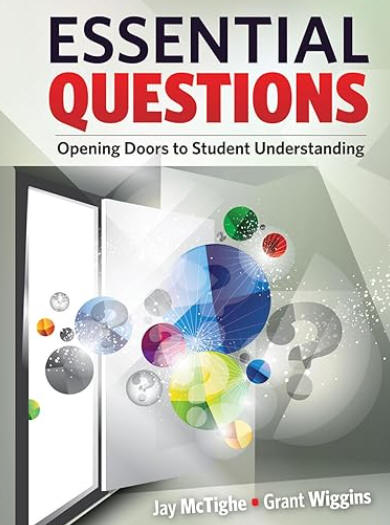 Jay McTighe
and Grant Wiggins (2013) provided seven characteristics of an essential question in
Essential Questions: Opening Doors to Student Understanding.
An essential question is open-ended, thought-provoking and
intellectually stimulating, calls for higher-order thinking and
"cannot be effectively answered by recall alone." It "points toward
important, transferable ideas within (and sometimes across) disciplines,"
raises additional questions, requires support and justification, and "can and
should be revisited again and again" (p. 3).
Jay McTighe
and Grant Wiggins (2013) provided seven characteristics of an essential question in
Essential Questions: Opening Doors to Student Understanding.
An essential question is open-ended, thought-provoking and
intellectually stimulating, calls for higher-order thinking and
"cannot be effectively answered by recall alone." It "points toward
important, transferable ideas within (and sometimes across) disciplines,"
raises additional questions, requires support and justification, and "can and
should be revisited again and again" (p. 3).
What students know and will be able to do are closely tied together, but are not the same. Jane Pollock (2007) distinguished between declarative (content mastery) and procedural (skill mastery) knowledge. "In a curriculum document, the statements of declarative knowledge (facts, concepts, generalizations and principles) are identified by the words understands or knows" (p. 35) that "serve as placeholders for active verbs, which translate into activities and experiences that help students organize declarative knowledge." For procedural knowledge, a statement of student learning would begin with "a verb that describes the steps that need to be practiced to attain automaticity such as add, compose, sing, draw, or graph" (p. 36). The latter requires extensive repetition and practice.
In terms of differentiated instruction, the established goal (content standard), understandings and essential questions should not be differentiated. Knowledge and skills may be differentiated (Tomlinson & McTighe, 2006, p. 36).
Stage 2, Assessment Evidence, includes development of performance tasks and providing other evidence of learning. "A performance ability lies at the heart of understanding" and is linked to a real work task that an adult might typically do. It is the "evidence of being able to transfer what we know" (McTighe & Wiggins, 2005, p. 7).
Performance tasks can be constructed by completing stem statements associated with the GRASPS model. Not every task needs to be formed using GRASPS, although McTighe and Wiggins (2005) proposed at least one task be developed this way for assessing understanding in a major unit or course (p. 158). Representative stems follow, as selected from McTighe and Wiggins (2004, p. 172):
McTighe provided GRASPS design sheets at his website, which include an example for constructing a task scenario for mathematics, a fill-in page with a set of stem statements to help construct a scenario for a performance task, possible student roles and audience, possible products and performances (written, oral, visual) to provide evidence of understanding and/or proficiency.
Performance assessments should involve meaningful, authentic, and engaging tasks. Such tasks "are better suited to assess more complex concepts and 21st century skills, such as mathematical reasoning, scientific investigations, issues analysis, creative problem solving, oral communications, and technology applications" and should "include both content specific and interdisciplinary performances." Teachers should implement them "as part of the curriculum at designated time periods during the school year" (McTighe & Wiggins, 2011, p. 17).
Rubrics, which are criterion-based scoring tools, should be included by which you and learners can assess their products or performances. They should have point values attached to assessment criteria, with the traits specified from greatest to least strengths. For example, a four-point scale (high to low) might include criteria for exceeding expectations, meeting expectations, almost meeting expectations, and not meeting expectations. Care should be taken that the rubric is easy to use. Other evidence of learning should include opportunities for student self-assessment and self-adjustment based on feedback (McTighe & Wiggins, 2004).
In terms of differentiated instruction, performance tasks and other types of assessment evidence may be differentiated. Response modes might have been orally, visually, or in writing. However, key criteria for evaluating should not be differentiated, as they are linked to content goals (Tomlinson & McTighe, 2006, p. 35).
Results from performance tasks and rubrics as well as content specific tests and local assessments might be placed in a Student Standards Folder, as part of a "systematic collection of assessment evidence related to Core Standards and other important educational goals" (McTighe & Wiggins, 2011, p. 17).
Stage 3, Learning Plan, involves planning learning activities and an action plan that engages learners. Learning activities should be organized and well-sequenced. They should align with enduring understandings, essential questions, and standards. The action plan follows a WHERETO model. Strategies suggested in Tomlinson and McTighe (2006, pp. 120-126) follow steps in the model. The learning plan should be differentiated (p. 36):
W indicates that you are helping learners to know where the unit is headed and what is expected from them. You are also determining what their prior knowledge is. Strategies: Provide rubrics with examples from prior student work tied to different levels of the rubric.
H stands for the need to hook the learners and hold their interest. Strategies: Hooks might take the form of "provocative essential questions, counterintuitive phenomena, controversial issues, authentic problems and challenges, emotional encounters, and humor" (Tomlinson & McTighe, 2006, p. 123).
E is equipping learners to succeed, enabling them to experience key ideas and explore issues. Strategies: Provide a balance of constructivist learning experiences, structured activities, and direct instruction.
R is providing opportunities for learners to rethink and revise their work and understandings. Strategies: Rethinking and revision might be encouraged by "playing the devil's advocate, presenting new information, conducting debates, establishing peer-response groups, and requiring regular self-assessment" (Tomlinson & McTighe, 2006, p. 124).
E, again, allows students to evaluate their work and set future goals. Strategies: Provide regular opportunities for students to develop metacognitive skills of self-evaluation, self-regulation, and reflection.
T stands for tailoring to accommodate the diverse needs, interests, and abilities of learners, including those with special needs who might have individual education plans. Strategy: Provide options for assignments with levels of difficulty associated with learners' knowledge levels, interests, and abilities.
O stands for organization to sustain engagement and the learning process.
Those who have experienced this process might conclude that it is not so “backward” after all, in that by identifying goals and enduring understandings at Stage 1, educators can complete a unit development aligned with those understandings and thus avoid instruction that does not focus on those outcomes.
 Closely
tied to short range curriculum mapping is Thomas Guskey's (2005) suggestion that
teachers create a table of specifications, which helps them to move students
toward mastery of standards. This table might also assist teachers
in developing classroom assessments. According to Guskey, teachers need to
translate standards into specific classroom experiences and ensure that
classroom assessments measure that learning. Breaking down standards into
components is key. Essential questions are "What must students learn to be
proficient at this standard?" (p. 34) and "What must students be able to do with
what they learn?" (p. 35). The development of these tables for a unit of
study is closely linked to Bloom's Taxonomy of Educational Objectives, as the
specifications progress from knowledge of basic facts and terms to the highest
cognitive levels of analysis and synthesis. The following is his general
format for such a table:
Closely
tied to short range curriculum mapping is Thomas Guskey's (2005) suggestion that
teachers create a table of specifications, which helps them to move students
toward mastery of standards. This table might also assist teachers
in developing classroom assessments. According to Guskey, teachers need to
translate standards into specific classroom experiences and ensure that
classroom assessments measure that learning. Breaking down standards into
components is key. Essential questions are "What must students learn to be
proficient at this standard?" (p. 34) and "What must students be able to do with
what they learn?" (p. 35). The development of these tables for a unit of
study is closely linked to Bloom's Taxonomy of Educational Objectives, as the
specifications progress from knowledge of basic facts and terms to the highest
cognitive levels of analysis and synthesis. The following is his general
format for such a table:
|
TABLE OF SPECIFICATIONS |
|||
| Knowledge of | |||
| Terms | Facts | Rules & Principles | Processes & Procedures |
| New Vocabulary: Words Names Phrases Symbols |
Specific Information: Persons Events Data Operations |
Relations Guidelines Organizational Cues |
Patterns Sequences Order of events or operations Steps |
| Ability to Make Translations | Ability to Make Applications | Skill in Analysis & Synthesis | |
| Identify Describe Recognize Distinguish Compute |
Use Illustrate Solve Demonstrate |
Compare Contrast Explain Infer Combine Construct Integrate |
|
|
Source: |
|||
Jane Pollock (2007) discussed the TSML model for designing daily lessons. There are six components with feedback of varying types (verbal, non-verbal or written), voices (self-reflection, peer, and teacher), and opportunities being a floating step incorporated throughout (p. 64):
Set the learning goal/benchmarks or objectives (GO). Identify the benchmark(s) as declarative or procedural, and break it down into the daily objective(s).
Access prior knowledge (APK). Strategies include non-linguistic representations, advance organizers, and cooperative learning, for example.
Acquire new information--declarative or procedural (NI). The difficulty is selecting of the type of strategy that helps learners retain each type of knowledge. Lecturing is one way. However, learners might be involved with "note-taking, using a thinking skill as a scaffold organizer, creating a graphic organizer," questioning, and cooperative learning (e.g., pair/sharing) (p. 71). Multimedia presentations also help acquire new information.
Apply thinking skills or real-world situation (APP). Pollock indicated, "When planning for the application of declarative knowledge, thinking skills (e.g., comparison, analysis, persuasion) can help learners organize and reorganize facts, leading to longer retention...and how to use the information in a constructive manner" (p. 68). Acquiring procedural knowledge might take about 24 practices for competency. Modeling helps students become more comfortable with applying procedures.
Generalize or summarize back to the objective/benchmark (GEN). Students should be involved with closure to a lesson. Strategies that might be used during the last 5-7 minutes of a class include "writing to a prompt, sharing aloud with a partner, summarizing using a strategy, or briefly drawing a pictograph depicting the gist of the topic for that lesson" (p. 69). Here's where a reflective journal might be a tool.
Assign homework, if necessary (HW).
Both the instructional plan and the assessment plan should address thinking skills, evidenced by verbs within Bloom's Taxonomy (knowledge, comprehension, application, analysis, synthesis, and evaluation). Students should know the benchmarks associated with each lesson or unit of study, although for young learners they might need rephrasing in more kid-friendly terms, and have resources so that they can track their own mastery of the benchmarks.

Glossary of Education Reform is a comprehensive resource that describes key school improvement terms, strategies, and concepts. There are at least 500 terms and 150 in-depth entries. "Each entry includes a general definition of the term, a discussion about how the concept or strategy intersects with efforts to improve school performance or student achievement, and an overview of related debates, including the major arguments for or against particular reforms." (About section). For example, popular terms include curriculum, scaffolding, assessment, standardized test, 21st century skills.
Multimedia provides the multiple means of representation, engagement, and expression to customize learning.
Curriculum Mapper is a tool to align curriculum to standards and school improvement goals. It was originally developed by Collaborative Learning and is Curriculum Technology.
Eduplanet21 is software that is "focused on providing a comprehensive approach to curriculum mapping – from Course Management to Unit Design to Lesson Planning" per its description. Features include the use of the Understanding by Design 2.0 template, built in alignment check, curriculum analysis, and more. Standards are available and customizable. Pricing options are included.
TeacherEase provides standards-based curriculum mapping on the web. State standards are pre-loaded, but districts can add their own standards, too. The product has other features to help teachers manage their instruction, including lesson planning, gradebook, report cards, and parent access. There is a fee.
Common Core Problem Based Learning Curriculum Maps for grades 3-8, integrated math for grades 9-11, algebra 1, geometry, and algebra 2 are provided by emergent math. Each unit of study has multiple problems and tasks mapped to the associated Common Core math standards.
Mathematics Georgia Standards of Excellence includes a curriculum map for each of its math courses in K-12 and associated units of study based on the Understanding by Design framework. A unit has standards, big ideas, essential questions, formative assessment lessons, tasks and performance tasks, and technology resources. These are provided within three math sections: K-5, 6-8, and 9-12.
North Adams Public Schools (MA): Curriculum Maps for math.
 A
Guide to Curriculum Mapping: Planning, Implementing, and Sustaining the Process by Janet Hale
(2007) is a step-by-step guide, which examines the stages of contemplating, planning, and implementing
curriculum mapping initiatives that can improve student learning and
create sustainable, systemic change. Heidi Jacobs contributed the foreword.
A
Guide to Curriculum Mapping: Planning, Implementing, and Sustaining the Process by Janet Hale
(2007) is a step-by-step guide, which examines the stages of contemplating, planning, and implementing
curriculum mapping initiatives that can improve student learning and
create sustainable, systemic change. Heidi Jacobs contributed the foreword.
Galileo Educational Network: Creating Essential Questions by Pat Clifford and Sharon Friesen, who explain the key components.
Morehead, P., & LaBeau, B. (2007, Apr. 12). Beyond curriculum mapping; Using technology to delve deeper into inquiry learning. THE Journal. https://thejournal.com/articles/2007/04/12/beyond-curriculum-mapping-using-technology-to-delve-deeper-into-inquiry-learning.aspx
Pamela Morehead and Barbara LaBeau discussed how staff at an elementary school used curriculum mapping, study groups, and an onsite technology coach as their model for professional development. Staff used a self-study process to evaluate their use of technology in the classroom and a district technology integration initiative called Project 2000.
McTighe, J. (2021, March 2). It's time for curriculum mapping 3.0 [Blog post]. https://www.solutiontree.com/blog/its-time-for-curriculum-mapping-3-0/
Jay McTighe reviewed the first two curriculum mapping generations, then proposed a third. Curriculum Mapping 1.0 was characterized as diary-mapping by teachers; Curriculum Mapping 2.0 has been standards-based mapping. Both "approaches focused on identifying curriculum “inputs”—typically lists of topics or grade-level standards—mapped on a calendar to specify what teachers will teach." He proposed a curriculum mapping that focuses on outputs. That is, Curriculum Mapping 3.0 calls for mapping performances. His conclusion is that "a modern curriculum should be directed toward preparing students for transfer—to be able to apply their learning to the new opportunities and challenges they will face in an increasingly complex, interconnected, and unpredictable world. Accordingly, we can map the curriculum by identifying the key transfer performances that honor the standards, involve 21st century skills, and provide evidence of deep learning."
Back to top | Math Methodology: Curriculum Page 1 | 2
CAST. (2023). About universal design for learning. Lynnfield, MA: Author. https://www.cast.org/what-we-do/universal-design-for-learning/
Common Core State Standards. (2010). Standards for Mathematical Practice. Washington, DC: National Governors Association Center for Best Practices, Council of Chief State School Officers. https://www.thecorestandards.org/Math/Practice/
Conley, D. T. (2011). Building on the common core. Educational Leadership, 68(6), 16-20. https://www.ascd.org/el/articles/building-on-the-common-core
Guskey, T. (2005). Mapping the road to proficiency. Educational Leadership, 63(3), 32-38 . https://www.ascd.org/el/articles/mapping-the-road-to-proficiency
Jacobs, H. H. (Ed.). (2004). Getting results with curriculum mapping. Arlington, VA: ASCD. Available: https://amzn.to/3NYcJlD
Jacobs, H. H., & Zmuda, A. (2023). Streamlining the curriculum: Using the storyboard approach to frame compelling learning journeys. Arlington, VA: ASCD. Available: https://amzn.to/3t5oBuV
Lalor, A. (2016). Ensuring high-quality curriculum: How to design, revise, or adopt curriculum aligned to student success. Arlington, VA: ASCD. Available: https://amzn.to/3R7e7Dn
Lalor, A. (2021). Making curriculum matter: How to build SEL, equity, and other priorities Into daily instruction. Arlington, VA: ASCD. Available: https://amzn.to/3P7pZ7d
Lalor, A. (2022, July 27). 5 Elements of a relevant curriculum. Educational Leadership. https://www.ascd.org/el/articles/5-elements-of-a-relevant-curriculum
McTighe, J., & Wiggins, G. (2004). Understanding by design: Professional development workbook. Arlington, VA: ASCD. Available: https://amzn.to/3Rv2gjN
McTighe, J., & Wiggins, G. (2005). Understanding by design: Expanded 2nd edition. Arlington, VA: ASCD. Available: https://amzn.to/46MvbnG
McTighe, J., & Wiggins, G. (2011, Spring). Do we need an assessment overhaul? Baltimore, MD: John Hopkins University, Better: Evidence-based Education, 16-17. https://jaymctighe.com/wp-content/uploads/2011/04/Do_We_Need_an_Assessment_Overhaul1.pdf
McTighe, J., & Wiggins, G. (2013). Essential questions: Opening doors to student understanding. Arlington, VA: ASCD. Available: https://amzn.to/3TTyuGZ
National Center on Universal Design for Learning. (2014). UDL and the curriculum: What is meant by the term curriculum? https://web.archive.org/web/20140714220137/http://www.udlcenter.org/aboutudl/udlcurriculum
National Council of Teachers of Mathematics. (2006). Curriculum focal points for prekindergarten through grade 8 mathematics: A quest for coherence. Reston, VA: Author. https://www.nctm.org/store/Products/Curriculum-Focal-Points-for-Prekindergarten-through-Grade-8-Mathematics-A-Quest-for-Coherence/
National Council of Teachers of Mathematics. (2009). Focus in high school mathematics: Reasoning and sense making. Reston, VA: Author. https://www.nctm.org/store/Products/Focus-in-High-School-Mathematics--Reasoning-and-Sense-Making/
National Council of Teachers of Mathematics. (2011). Making it happen: Common Core standards. Reston, VA: Author. https://www.nctm.org/Store/Products/Making-It-Happen--Executive-Summary-(Book-and-eBook-Bundle)/
Norris, C., & Soloway, E. (2017, January 3). Memo to OER purveyors: Teachers don't want content, teachers want curriculum! THE Journal. https://thejournal.com/Articles/2017/01/03/Memo-to-OER-Purveyors.aspx
Oliva, P. F. (2005). Developing the curriculum (6th ed.). New York, NY: Allyn & Bacon. Available: https://amzn.to/3Nfxwku
O'Shea, M. (2005). From standards to success: A guide for school leaders. Arlington, VA: ASCD. Available: https://amzn.to/3RutQNZ
Pollock, J. E. (2007). Improving student learning one teacher at a time. Arlington, VA: ASCD. Available: https://amzn.to/3CXzaW1
Popham, J. (2007). All about accountability/ The lowdown on learning progressions. Educational Leadership, 64(7), 83-84. https://www.ascd.org/el/articles/the-lowdown-on-learning-progressions
Tomlinson, C., & McTighe, J. (2006). Integrating differentiated instruction & Understanding by Design. Arlington, VA: ASCD. Available: https://amzn.to/3uGP1DA
Back to top | Math Methodology: Curriculum Page 1 | 2
 See
other Math Methodology pages:
See
other Math Methodology pages:

Are you finding resources at CT4ME of value? Contact CT4ME
Recommend this site to your friends and colleagues. Link to CT4ME, too.
To cite this page, use the following format:
Deubel, P. (year from last revised). Math methodology: Curriculum and curriculum mapping essay and related resources. Computing Technology for Math Excellence. Retrieved Month, Day, Year, from https://www.ct4me.net/curriculum.htm
CT4ME Author: Dr. Patricia Deubel
Copyright © 2001-2026 [CT4ME.net]. All rights reserved.