Math Topics
Learning Support
Professional


 Our
collection of Math Resources has multiple pages designed for
teaching within specific grade bands. You'll also find
valuable collections of support and enrichment resources that will
benefit all learners.
Our
collection of Math Resources has multiple pages designed for
teaching within specific grade bands. You'll also find
valuable collections of support and enrichment resources that will
benefit all learners.
Math Resources (Page 1): K-8 Basic Mathematics and Skills Development, plus apps for mobile devices
Math Resources (Page 2): High School Subject Specific Resources, including apps for mobile devices: Algebra and Pre-Algebra, Geometry, Statistics, Probability, Trigonometry, Precalculus and Calculus
Math Resources (Page 3): K-12 Supplementary Collections: Miscellaneous Math Collections; Practical Applications--Math in Careers, Daily Life, and Across the Curriculum; and Problem Solving
 Math
Resources (Page 4): Enrichment and Extra Help
Math
Resources (Page 4): Enrichment and Extra Help
Math Resources (Page 5): Lesson Plans and Worksheets, Design and Manage Your Own Lesson Plans, and Publishers' Textbook Support Sites
Math Resources (Page 6): Resources for Podcasts and Videos, the Flipped Learning Model, and Whiteboards, including tips on using the flipped learning model, creating better instructional videos, and using whiteboards
 Actuarial
Foundation features two competitions. In
Modeling the Future Challenge "junior and senior high school students are
challenged to develop and present their own mathematical models of how a new
technology or industry might change the future. Registration is free, and
students have a chance to win $60,000 worth of scholarship prizes." The
Hardest Math
Problem Student Contest for grades 6-8 is an annual contest that challenges
"students to solve multistep, grade-specific math problems with real-world
situations and engaging characters."
Actuarial
Foundation features two competitions. In
Modeling the Future Challenge "junior and senior high school students are
challenged to develop and present their own mathematical models of how a new
technology or industry might change the future. Registration is free, and
students have a chance to win $60,000 worth of scholarship prizes." The
Hardest Math
Problem Student Contest for grades 6-8 is an annual contest that challenges
"students to solve multistep, grade-specific math problems with real-world
situations and engaging characters."
American Mathematical Society has a section of mathematical opportunities, which can be filtered for a list of math camps and contests and competitions.
American Mathematics Competitions (AMC) from the Mathematical Association of America "are a series of examinations and curriculum materials that build problem-solving skills and mathematical knowledge in middle and high school students." AMC 8 promotes development of problem-solving skills in the middle school curriculum and has 25 multiple choice questions to complete in 40 minutes. AMC 10 is for students in grade 10 and below and AMC 12 is for students in grade 12 and below. Each have 25 multiple choice questions to complete in 75 minutes. Calculus is not addressed in AMC 12. The site includes test prep resources. Additional invitational contests are available for those who do well on the AMC 10/12.
HOT: Art of Problem Solving: Math Contests includes a global list that includes international, regional, and national (listed by country) competitions. You'll also find resources for mathematics competition preparation.
Conceptis Puzzles advance development of logic. Puzzles are divided into three main lines: Picture Logic, Number Logic and Kids Logic. Think of forms of Sudoku, which is also available. Math puzzles vary in levels of difficulty. For example, Calcudoku involves addition, subtraction, multiplication and division with a choice of one operation or various combinations of those operations and size of the square puzzle grid. These can be very addictive, offering hours of mental stimulation.
Consortium for Mathematics and Its Applications (COMAP) has annual contests for students. The Mathematical Contest in Modeling is an international contest for high school and undergraduate college students, which "challenges teams of students to clarify, analyze, and propose solutions to open-ended problems." The High School Mathematical Contest in Modeling "offers students the opportunity to compete in a team setting using mathematics to present solutions to real-world modeling problems" (Contest descriptions section).
Continental Math League has been in existence since 1980 and offers challenging math contents for students all over the U.S. in grades 2-9 and calculus. Tests are paper/pencil and meets are held three times a year for grades 2-3, five times for grades 4-9, and four times for calculus students. Each team per grade can have any number of students with exams taking about 30-40 minutes each. There are awards. A nominal fee is charged for participation.
Figure This! contains math challenges for middle school students and their families and is award winning, funded by the National Science Foundation and the U.S. Department of Education. Each challenge describes the math involved, where the math is used in the real world, a hint to get started, and complete solutions. There are a "Try This" section, additional related problems with answers, additional questions to think about, related math fun facts, and resources for further exploration. The math index categorizes challenges according to strands: algebra, geometry, measurement, number, and statistics and probability. Engaging cartoon characters illustrate features of at least 80 different challenges, such as Line Up, Beating Heart, Popcorn, and Don't Fall In.
KenKen is free and has a puzzle format similar to Sudoku, only with numbers. You can choose the math operation(s) for each puzzle and level of difficulty.
MATHCOUNTS is a national math enrichment, coaching & competition program that promotes middle school mathematics. Schools select students to compete individually or as part of a team in one of the more than 500 written & oral competitions held nationwide. Top students advance to the state, & ultimately, national level. MATHCOUNTS also has a problem of the week (see Resources) and an extensive archive of problems posed each year. Its Math Video Challenge is a free national contest that "gives students in grades 6-8 the opportunity to create an original video showing math in a real world setting." Note: As of 2023, MATHCOUNTS is "welcoming Math Video Challenge participants into the National Math Club as one program. Moving forward, MVC students will be able to explore math through video in the National Math Club and earn recognition through Gold Level Status and the Gold Level Honor Roll."
MATHmodels.org has contests and problems on math modeling for high school and undergraduate learners. “Mathmodels is COMAP’s new modeling forum. On this site, students and faculty will find a wide range of interesting contemporary modeling problems. Teachers can assign problems. Students can choose to work on problems based on math topic and application area” (About MATHmodels section). Note: This site has particular relevance, as math modeling is among mathematical practices included in the Common Core State Standards for mathematics.
Math Kangaroo in USA is "an international not-selective competition in mathematics for students in grades 1 through 12. The competition takes the form of a multiple choice test. Each participant is seen as a winner and receives recognition and gifts on the test day in March. Those who achieve the top results are awarded in May. The atmosphere of appreciation for the students' learning and the fun in each competition room across USA are the reasons why participants return year after year and bring their siblings and friends along" (Our History section). There is a nominal charge per student. Practice material is available.
Math League specializes in math contests designed to stimulate interest and confidence in mathematics for students in grades 4-12. Whether or not you choose to participate in a contest, educators will find the Help Facility for Grades 4-8 of value. This reference guide addresses math topics for grades 4-8, complete with examples, definitions, and explanations for whole numbers, decimals, using data and statistics, fractions, geometry, ratio and proportion, percent and probability, integers, measurement, introductory algebra, positive and negative numbers, and more.
Mathematical Olympiads for Elementary and Middle Schools (MOEMS) for grades 4-6 and 7-8 features five monthly contests (November-March) with five non-routine problems per contest, which can be completed at the participants' school. Each team can have up to 35 students. Prizes are awarded at the end of the fifth contest. There is also a problem of the month posted, along with the answer to the prior month's problem.
Mathschallenge.net contains a variety of puzzles and challenges suitable for grades 6-12, and adults. Problems are divided into appropriate levels: junior, senior, and advanced. There is a section for recreational mathematics dealing with number, code breaking, and geometry. Project Euler contains a series of challenging mathematical/computer programming problems.
MathWorks Math Modeling Challenge (M3Challenge) is an applied mathematics competition for teams of high school junior and senior students. Each team has 3-5 students and one teacher-coach. Per the site, students "tackle a real-world problem under time and resource constraints, akin to those faced by professional mathematicians working in industry." Winners receive scholarships totaling thousands of dollars for continuing education. The contest is sponsored by MathWorks and SIAM (Society for Industrial and Applied Mathematics). Resources include math modeling handbooks, math modeling videos (including teaching math modeling), tips and guidelines for teaching math modeling, and sample problems. The contest is internet based and has no registration or participation fees.
 Perennial Math: Tournaments.
This site features three types of competition for students in grades 3-12.
There is an online competition (grades 3-8) with two separate seasons to choose
from, live on-site tournaments hosted at colleges or schools (grades 3-8), and
WebEx Virtual tournaments for districts and classrooms (grades 3-12).
These latter are also used for National Championships. The online competition
is international. The site was created by award winning Dr. Sylvia Dean for
her involvement and coordination of math, robotics, and technology competitions (About Us section).
Perennial Math: Tournaments.
This site features three types of competition for students in grades 3-12.
There is an online competition (grades 3-8) with two separate seasons to choose
from, live on-site tournaments hosted at colleges or schools (grades 3-8), and
WebEx Virtual tournaments for districts and classrooms (grades 3-12).
These latter are also used for National Championships. The online competition
is international. The site was created by award winning Dr. Sylvia Dean for
her involvement and coordination of math, robotics, and technology competitions (About Us section).
Problems of the Week (PoW) (for NCTM members). NCTM provides weekly challenging problems for students in grade bands 3-12, higher ed, and preK-2 in nine categories: algebra, geometry, discrete mathematics, financial ed, primary, math fundamentals, pre-algebra, trigonometry/calculus, and tPOW (technology problems of the week).
Purple Comet! Math Meet! is "a free, on-line, international, team mathematics competition designed for middle and high school students conducted annually since 2003." A team has 1-6 members. The middle school competition has 20 problems of varied difficulty to be completed in 60 minutes; the high school competition has 30 problems of varied difficulty to be completed in 90 minutes. There are categories for teams and each must be supervised (Contest Information section). Old contests are available to help prepare. Winning teams are posted online. The contest has high participation from multiple countries around the world. Dr. Jonathan Kane and Dr. Titu Andreescu collaborate to design the contest and write the problems. The contest is run by AwesomeMath (FAQ section).
Rocket City Math League (RCML), sponsored by Mu Alpha Theta, is "a free, international, math contest that is open to all middle, high school, and two-year college students enrolled in pre-algebra through precalculus and above math courses." There are competition levels based on each math course. "All materials related to the Rocket City Math League, including test, solutions, and RCML guidelines, are emailed to each school or made available online." Copies of prior tests and sample tests are available. There are awards.
The Centre for Education in Mathematics and Computing at the University of Waterloo (Canada) features mathematics and computing contests for learners (grades 7-12) in and outside of North and South America. There's a small fee per participant. Past contests/solutions, a problem set generator, and other materials are available for contest preparation. The Centre also produces a problem of the week for students in grades 3 and up, presented for appropriate grade bands, and a problem of the month for upper level high school learners.
 The Math Contest
is powered by the Ole Miss School of Education. It was originally started
by David Rock and Doug Brumbaugh as the online Problem of the Week contest in
1996 at the University of Central Florida. You can submit your answer, and
if correct, your name can be posted at the site and you can win a T-shirt.
These are very engaging problems promoting interest in math at all age levels.
The Math Contest
is powered by the Ole Miss School of Education. It was originally started
by David Rock and Doug Brumbaugh as the online Problem of the Week contest in
1996 at the University of Central Florida. You can submit your answer, and
if correct, your name can be posted at the site and you can win a T-shirt.
These are very engaging problems promoting interest in math at all age levels.
USA Mathematical Talent Search (USAMTS) is a free mathematics competition open to all United States middle and high school students. Students can take up to a month to solve the problems and must submit their justifications. According to USAMTS, "Problems range in difficulty from being within the reach of most high school students to challenging the best students in the nation. Students may use any materials - books, calculators, computers - but all the work must be their own. The USAMTS is run on the honor system." There are prizes.
Visual Patterns contains nearly 500 patterns to encourage mathematical thinking. Those who try the patterns look for what the pattern would be at the 43 step and then determine an equation associated with the pattern.
|
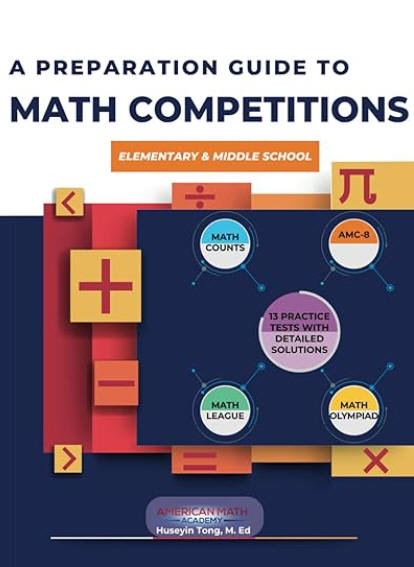
A Preparation Guide to Math Competitions for Elementary & Middle School: AMC-8, Math Counts, Math Olympiad, MathCON, and Math Leagues by the American Math Academy (2022) begins with the most important math key points. Then there are 13 practice tests with detailed solutions. |
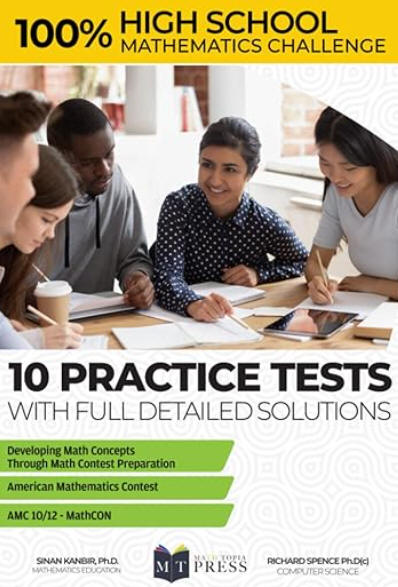
High School Mathematics Challenge: 10 Practice Tests for AMC 10-12 and Math Leagues Preparation by Sinan Kanbir and Richard Spence (2020) includes 250 problems with detailed solutions. The problems also help prepare for other contests, such as MathCON finals. |
 American
Mathematical Society maintains a list of summer math camps
and programs for high school students.
American
Mathematical Society maintains a list of summer math camps
and programs for high school students.
Mathnasium offers summer math camps at participating locations throughout the U.S.
MySummerCamps has an extensive list of math camps and other academic and pre-college camps in several states.
 Dr. Jo Boaler of Stanford University has a short, free course at
youcubed.org called "How
to Learn Math" for any student in all levels of mathematics.
There are six short lessons about 10 to 20 minutes each. You'll
get some key information on the brain and learning, and effective
strategies for learning math. Concepts include overcoming myths
about math, math and mindset, mistakes and speed; number flexibility,
math reasoning, and connections; number patterns and representations;
and math in life, nature, and work. The course also features
videos of math in action.
Dr. Jo Boaler of Stanford University has a short, free course at
youcubed.org called "How
to Learn Math" for any student in all levels of mathematics.
There are six short lessons about 10 to 20 minutes each. You'll
get some key information on the brain and learning, and effective
strategies for learning math. Concepts include overcoming myths
about math, math and mindset, mistakes and speed; number flexibility,
math reasoning, and connections; number patterns and representations;
and math in life, nature, and work. The course also features
videos of math in action.
The site also offers Online Teacher Courses, including How to Learn Math for Teachers and Mathematical Mindsets; however, these are not free. They include an interactive environment to explore new research on math teaching and student mindsets. You'll learn about new pedagogical strategies, high quality math tasks, questioning to promote understanding, messages to give students, and inspirational messages from thought leaders in education and more.
Daniel Willingham (2014) noted that typically learners use four study strategies. First, they read a chapter trying to understand individual sentences. Second, learners highlight what they perceive as important to remember. Third, they don't look at a chapter again until a day or two before a test. Fourth, to prepare for a test, they reread the chapter, focusing on previously highlighted content. However, those strategies do not work for long term retention of content. Rereading is a relatively weak strategy to boost memory, given that there are other more useful study techniques to support learning, which are supported by research. Willingham identified the following four good ways to learn.
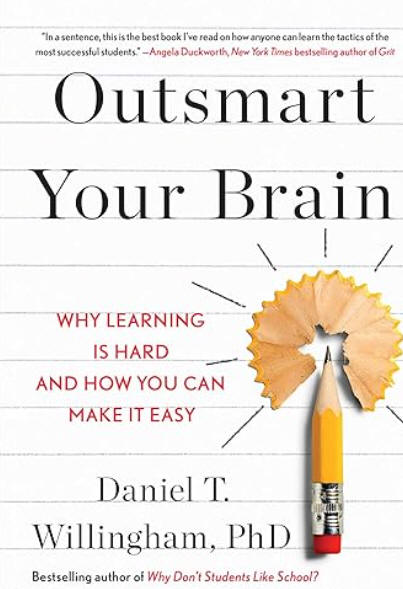 Daniel Willingham is the author of
Outsmart Your Brain: Why Learning is Hard and How You Can Make It Easy
(2023). This book provides a guide on how the brain learns, how to study
more effectively and efficiently, how to decrease stress over exams and more.
It is filled with tips and strategies you may not have used yet, but should be
willing to try. You will learn:
Daniel Willingham is the author of
Outsmart Your Brain: Why Learning is Hard and How You Can Make It Easy
(2023). This book provides a guide on how the brain learns, how to study
more effectively and efficiently, how to decrease stress over exams and more.
It is filled with tips and strategies you may not have used yet, but should be
willing to try. You will learn:
Best of all you can skip around and read chapters of interest. Teachers will also value this book as it has implications for the classroom.
How to Study is a video series on YouTube by Dr. Stephen Chew, Psychology professor at Samford University. He introduces 10 principles of effective studying in his introductory video, Developing a Mindset for Successful Learning. Then he elaborates on those in five short videos: Beliefs That Make You Fail...Or Succeed, What Students Should Understand About How People Learn, Cognitive Principles for Optimizing Learning, Putting the Principles for Optimizing Learning into Practice, and "I Blew the Exam, Now What?"
Study Skills for Students from Educationcorner.com includes three main sections: General Study Skills with topics such as time management, learning style, note taking, reading, math, vocabulary, writing, listening and more; Test Taking Guides such as for short answer, multiple choice, true/false, essay, oral, openbook, and standardized tests; and Study Skills Resources by Subject.
 Caution:
Students should be cautious about using AI to help with homework. Don't
use it at the expense of developing your own critical thinking skills. In
their survey research Schwartz and Diliberti (2026) found: "As of
December 2025, 67 percent of students endorsed the statement "The more
students use AI for their schoolwork, the more it will harm their
critical thinking skills" — up more than 10 percentage points from ten
months earlier."
Caution:
Students should be cautious about using AI to help with homework. Don't
use it at the expense of developing your own critical thinking skills. In
their survey research Schwartz and Diliberti (2026) found: "As of
December 2025, 67 percent of students endorsed the statement "The more
students use AI for their schoolwork, the more it will harm their
critical thinking skills" — up more than 10 percentage points from ten
months earlier."
That being said, sometimes seeing the steps in a solution to a problem can also help you solve similar problems. Do you need a video tutorial to help learn a concept or refresh your memory?
Brainly offers free "expert-verified" homework help and explanations personalized with artificial intelligence.
FactMonster.com is an award winning site that features an atlas, almanac, dictionary, encyclopedia, and individualized homework help. Students can get facts on a range of subjects including math, the world and news, U.S., science, sports, people, and more. There are games and quizzes also.
Free Math Help has lessons for algebra, geometry, trig, calculus, and some other subjects/topics. Enter your math problem and get step-by-step help for the solution. The site also provides text and video lessons to accompany many topics in those subjects.
Hotmath provides 24/7 help with homework in your pre-algebra, algebra 1 or 2, geometry, precalculus or calculus course. Choose your text from the major publishers, get hints and step-by-step tutorials for odd-numbered problems shown on your selected page.
MathCelebrity offers step-by-step math homework solutions for subjects in grade 2 through college. Step-by-step calculators are used. The calculators are free and there are paid options for tutoring and test prep.
HOT: Mathway is a free online problem solver, which uses AI for basic math, pre-algebra, algebra, trigonometry, precalculus, calculus, statistics, finite math, linear algebra, and graphing.
QuickMath, powered by Mathematica, is an automatic problem-solving site developed by Dr. B. Langton of Sydney, Australia. Secondary and college students and their instructors will benefit from the quick solutions to problems encountered with algebra, equations, inequalities, calculus (differentiation and integration), number concepts, and matrices. Graphing appearance can be user-modified. The only thing you will need to know to use the free service is how to enter expressions and equations. Highly recommended.
 Socratic
AI Math Helper is a free app available on iOS (App Store) and Android
(Google Play). It works on phones and tablets. You can take a
photo of your question, or type it in manually, and get explanations,
videos, and step-by-step help. Voice recognition is included.
When you pose a question, "the app will find the best online resources for you to learn the concepts."
The app primarily supports Math from basic math to university level problems and Science, but it can handle more
(e.g., literature). For example, the app supports elementary math, algebra,
geometry, trigonometry, statistics, calculus. It can help with exam prep,
too. Note: There is a premium paid version with extra features.
Socratic
AI Math Helper is a free app available on iOS (App Store) and Android
(Google Play). It works on phones and tablets. You can take a
photo of your question, or type it in manually, and get explanations,
videos, and step-by-step help. Voice recognition is included.
When you pose a question, "the app will find the best online resources for you to learn the concepts."
The app primarily supports Math from basic math to university level problems and Science, but it can handle more
(e.g., literature). For example, the app supports elementary math, algebra,
geometry, trigonometry, statistics, calculus. It can help with exam prep,
too. Note: There is a premium paid version with extra features.
Thinkster Math is a tutoring program for K-8, algebra 1, and geometry learners, designed for use on laptops, tablets, and desktops. It uses human interaction and artificial intelligence to customize programs for learners. The technology tracks step-by-step work to help learners understand where they went wrong and why they are correct. The program is aligned to Common Core standards and the learner's school curriculum. Tutorial videos are included for each worksheet. Progress reports are provided. The program is subscription based, but there is a free trial.
Tutor.com is not free (price is noted at the website), but it connects students to a professional tutor the moment they need help. Tutors are available 24/7 for one-to-one instructional support in math, science, English, and social studies. Tutoring is online in real time using interactive whiteboards and chat features.
Wolfram Alpha Enter a question requiring a factual answer or calculation, including one in which graphing is involved, and Wolfram Alpha uses its built-in algorithms and a growing collection of data to compute the answer. This resource, driven by AI, can be used by anyone, including K-20 learners, educators in the classroom, other professionals, and beyond. Multiple topics are included: math, engineering, physics, places and geography, dates and times, money and finance, units and measures, chemistry, health and medicine, foods and nutrition, colors, music, and much more. This is not a search engine, but Wolfram Alpha has sidebar links for doing web searches. Also see Wolfram Alpha for iPhone and iPad.
 Schools
are focusing on a "conceptual approach" to understanding mathematics,
rather than first introducing students to a "procedural approach," the latter of
which many parents were taught when they were in school. Thus, parents
become frustrated when trying to help their children with math because they are being taught differently. Some parents might also lack
confidence in their own abilities to do math and might impart some of their math
anxiety in their children. However, there are relevant resources they can
use to help children to learn math and succeed in school.
Schools
are focusing on a "conceptual approach" to understanding mathematics,
rather than first introducing students to a "procedural approach," the latter of
which many parents were taught when they were in school. Thus, parents
become frustrated when trying to help their children with math because they are being taught differently. Some parents might also lack
confidence in their own abilities to do math and might impart some of their math
anxiety in their children. However, there are relevant resources they can
use to help children to learn math and succeed in school.
In What do Alabama elementary school parents need to know about math?, Trisha Crain (2024) suggested that parents get some key information from teachers and principals on the following. The suggestions are appropriate for parents in all states.
How much time is spent daily on learning math (e.g., 60 minutes daily)? Per Crain, "You can also ask teachers how they are helping your student learn fluency, procedural skills, conceptual understanding, and different types of practice and adaptation."
What tests will your child take to identify a math deficiency and measure progress? Ask for the test name and how often your child will be tested. Note: In Alabama, all elementary students must be screened for any math deficiencies.
How will you know if your child is making progress? Ask for a report card to include any extra support that the teacher might be providing.
Parents should also ask what their child is supposed to learn in math at each K-5 grade level (e.g., state grade-level standards) and what materials the teacher will be using to teach math.
Ask how your child's teacher will provide extra support when needed. What interventions will be used?
Ask about summer math camps. Note: In Alabama, "Near the end of the school year, teachers will determine which students should go to summer math camp for additional help. All school districts have to offer summer math camp for elementary students. Summer math camp is taught by “highly effective” teachers." (Crain, 2024)
Mike Flynn of Mount Holyoke College (MA) produced the video "What Happened to Math Class?" (2020) to help educators and parents to understand the shifts in mathematics teaching and how to support their child's learning. Additional resources for K-8 (e.g., websites, games, articles, books) are provided.
The U.S. Department of Education has a booklet, Helping Your Child Learn Mathematics, with fun activities that parents can use with children from preschool age through grade 5 to strengthen their math skills and build strong positive attitudes toward math. You'll find activities for the home, the grocery store, just for fun, and for when you are "on the go." A glossary and information about effective math instruction are also included.
How to Help Your Kids Succeed in School by K5 Learning is a free e-book on this topic. It contains practical advice and suggests activities that parents can use with their children who are in preschool to grade 5.
The Council of the Great City Schools produced Parent Roadmaps to the Common Core Standards- Mathematics in 2012 and 2013 for grades K-8 and high school to help provide guidance to parents about what their children will be learning and how they can support that learning. The publications also include three-year snapshots showing how selected standards progress from year to year so that students will be college and career ready upon their graduation from high school.
PBS.org has an education section for parents that includes preK-2 math resources (games, tips for parents, activities, age-appropriate math milestones) to help them to instill early math skills in their children.
 Parents
can use Count Play Explore developed through the
California Early Math Project
to help their children learn math at home. There are books and
engaging activities arranged in age categories 0-3, 3-5, and 6-8.
The beauty of this resource for parents and teachers is that fun and
humor are embedded. Videos feature memorable characters. Resources
include articles on early math education.
Parents
can use Count Play Explore developed through the
California Early Math Project
to help their children learn math at home. There are books and
engaging activities arranged in age categories 0-3, 3-5, and 6-8.
The beauty of this resource for parents and teachers is that fun and
humor are embedded. Videos feature memorable characters. Resources
include articles on early math education.
Also consider the following book:
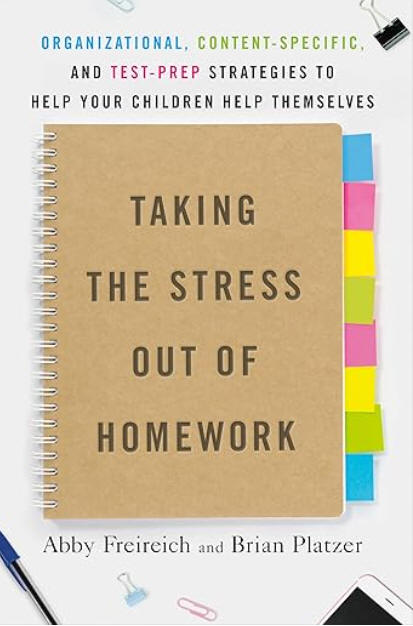 Taking the Stress Out of Homework: Organizational, Content-Specific, and
Test-Prep Strategies to Help Your Children Help Themselves by Abby Freireich
and Brian Platzer (2021). The authors "answer the most pressing questions
on every parent's mind: How much should I get involved, what does constructive
help look like, and how can I help my child work independently?"
Taking the Stress Out of Homework: Organizational, Content-Specific, and
Test-Prep Strategies to Help Your Children Help Themselves by Abby Freireich
and Brian Platzer (2021). The authors "answer the most pressing questions
on every parent's mind: How much should I get involved, what does constructive
help look like, and how can I help my child work independently?"
 To help parents, "make homework assignments as
straightforward and comprehensible as possible, so that parents can understand
them. More important than teaching a method and practicing a method
(especially one not familiar to families), is ensuring that a student selects
the method that makes sense to her and from which she can efficiently
and accurately reach a solution. Parents are then able to support the student
with methods they know. If the goal of the homework is to provide practice with
a new method, then teachers should support families by sending home
worked examples of new methods or providing online links that explain the
method, among other strategies" (Bay-Williams, Duffett, & Griffith,
2016, p. 44).
To help parents, "make homework assignments as
straightforward and comprehensible as possible, so that parents can understand
them. More important than teaching a method and practicing a method
(especially one not familiar to families), is ensuring that a student selects
the method that makes sense to her and from which she can efficiently
and accurately reach a solution. Parents are then able to support the student
with methods they know. If the goal of the homework is to provide practice with
a new method, then teachers should support families by sending home
worked examples of new methods or providing online links that explain the
method, among other strategies" (Bay-Williams, Duffett, & Griffith,
2016, p. 44).
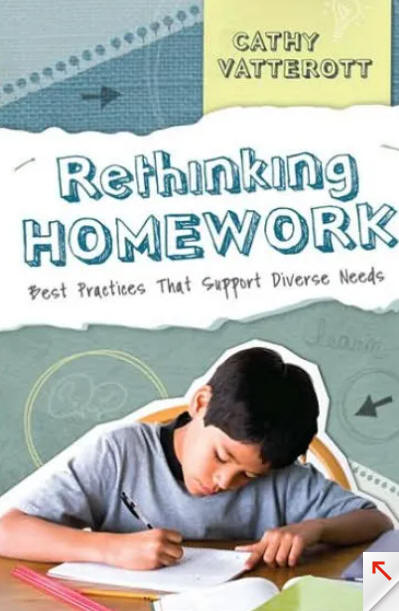 Teachers are always concerned about missed assignments,
particularly in math where homework is often assigned daily. Cathy
Vatterott (2009), author of Rethinking homework: Best practices that
support diverse needs advised:
Teachers are always concerned about missed assignments,
particularly in math where homework is often assigned daily. Cathy
Vatterott (2009), author of Rethinking homework: Best practices that
support diverse needs advised:
While some students choose not to do their homework, for others there might be understandable reasons why they don't always do it. Home circumstances per Vatterott (2009) might play a role. Younger children and teens might have considerable family related responsibilities, jobs, extensive extra curricular activities, and so on.
Giving zeroes for missing homework assignments is easy to do. An alternative of assigning 50% in the grade book instead of "0" might help keep students from giving up, but that solution does not measure learning, nor lead to it. Note: In a nationally represented survey of K-12 teachers, “Equitable” Grading Through the Eyes of Teachers. authors David Griffith and Adam Tyner (2025), noted that teachers have expressed that giving any partial credit for work not turned in leads to grade inflation and is harmful to academic engagement, as is having a no late penalties policy.
Trying to come up with an alternative solution to the problem of zeroes that works is more time consuming, but in this age of accountability, the effort is worth it. Consider reading Teaching Heroes: Toss the Zeroes by Cara Bafile (2008) at Education World. Bafile noted three alternatives and schools that use them:
 If so, check out these resources:
A Maths Dictionary for Kids by Jenny Eather includes an attention-getting, animated collection of over 630 terms found in K-8 math. Definitions with examples and interactive activities reinforce concepts. There's a non-interactive quick reference section with over 900 terms and words defined with examples. Jenny Eather also has a series of over 270 free printable math charts.
Coolmath's Online Math Dictionary
eCalc Math Help Reference Sheets for algebra, geometry, trigonometry (definitions, laws, identities), and calculus (derivatives, limits, integrals) provide a quick review. There are six reference sheets in all with key definitions, properties, operations, and formulas in each subject, all in one file.
Georgia Standards of Excellence K-12 Mathematics Glossary
 Illustrated Mathematics Dictionary:
Math Is Fun provides 1175 Definitions with 1140
Illustrated and 262 Animated, and links to learn more about each term.
Illustrated Mathematics Dictionary:
Math Is Fun provides 1175 Definitions with 1140
Illustrated and 262 Animated, and links to learn more about each term.
LearnAlberta: Mathematics Glossary (Canada) has definitions for mathematical terms for grades 1 through 12. The terms are organized by grade and alphabetically. Many definitions provide interactive animations and examples.
Mathematics Dictionary & Glossary is primarily for secondary and early tertiary students who are studying mathematics or math-related subjects. It contains over 2000 defined words, terms and concepts, all of which are cross-referenced with live linking. These have been written by ITS Education Asia and appropriately edited.
Mathwords: "This website is designed for math students who need an easy-to-use, easy-to-understand math resource all in one place. It is a comprehensive listing of formulas and definitions from Algebra I to Calculus. The explanations are readable for average math students, and over a thousand illustrations and examples are provided," according to developer Bruce Simmons, who teaches math.
Platonic Realms for secondary and post-secondary students features a "must-see" interactive mathematics encyclopedia, which can be browsed at elementary and advanced levels. Topics include basic mathematics, algebra, analysis, biography, calculus, discrete math, history, economics, geometry, graph theory, number theory, statistics, trigonometry, and math quotes.
Visual Mathematics Dictionary includes math vocabulary available by grades K-2, 3-5, 6-8, and K-12.
Wolfram MathWorld is a comprehensive and interactive mathematics encyclopedia for students (grades 7-12, post-secondary), educators, math enthusiasts, and researchers. This award winning site, hosted by Wolfram Research, Inc., makers of Mathematica, has been assembled over the past decade by E. Weisstein with assistance from the mathematics and internet communities. Subjects indexed include algebra, applied math, calculus and analysis, discrete math, foundations of math, geometry, history and terminology, number theory, probability and statistics, recreational math, and topology. Explanations include mathematical exposition and illustrative examples.
Back to top | Math Resources: Page 1 | 2 | 3 | 4 | 5 | 6
 See
Additional Libraries, Enyclopedias, and Dictionaries
Online in our section on Journals.
See
Additional Libraries, Enyclopedias, and Dictionaries
Online in our section on Journals.
Bafile, C. (2008, August 18). Teaching heroes: Toss the zeroes. Education World. https://www.educationworld.com/a_admin/admin/admin531.shtml
Bay-Williams, J., Duffett, A., & Griffith, D. (2016, June). Common core math in the K-8 classroom: Results from a national teacher survey. Washington, D.C.: Thomas B. Fordham Institute. https://fordhaminstitute.org/national/research/common-core-math-k-8-classroom-results-national-teacher-survey
Crain, T. (2024, August 5). What do Alabama elementary school parents need to know about math? https://www.al.com/educationlab/2024/08/what-do-alabama-elementary-school-parents-need-to-know-about-math.html
Griffith, D. & Tyner, A. (2025, August). “Equitable” grading through the eyes of teachers. Washington, D.C.: Thomas B. Fordham Institute. https://fordhaminstitute.org/national/research/equitable-grading-through-eyes-teachers
Schwartz, H. L., & Diliberti, M. K. (2026, March 17). More students use AI for homework, and more believe it harms critical thinking. Selected findings from the American Youth Panel. https://www.rand.org/pubs/research_reports/RRA4742-1.html
Vatterott, C. (2009). Rethinking homework: Best practices that support diverse needs. Arlington, VA: ASCD. Available: https://amzn.to/4aON8Fz
Willingham, D. (2014). Strategies that make learning last. Educational Leadership, 72(2), 10-15. https://www.ascd.org/el/articles/strategies-that-make-learning-last
Back to top | Math Resources: Page 1 | 2 | 3 | 4 | 5 | 6
See
related topics: Math Manipulatives
and Standardized Test
Preparation.

Comments? Are you finding resources at CT4ME of value? Contact CT4ME
Recommend this site to your friends and colleagues. Link to CT4ME, too.
To cite this page, use the following format:
Deubel, P. (year from last revised). Math resources: Math contests, competitions, challenges, and camps; study skills, homework help; math dictionaries, glossaries, and encyclopedias. Computing Technology for Math Excellence. Retrieved Month, Day, Year, from https://www.ct4me.net/math_resources_4.htm
CT4ME Author: Dr. Patricia Deubel
Copyright © 2001-2026 [CT4ME.net]. All rights reserved.