
Math Topics
Learning Support
Professional

 Math
Methodology is a three part series on instruction,
assessment, and curriculum. Sections contains relevant essays and
resources.
Math
Methodology is a three part series on instruction,
assessment, and curriculum. Sections contains relevant essays and
resources.
This page continues part 2 on Assessment, providing Assessment Resources.
Part 1: Math Methodology: Instruction
Part 2: Math Methodology: Assessment
 Assessment
Resources (Page 2 of 2)
Assessment
Resources (Page 2 of 2)
Part 3: Curriculum: Content and Mapping
 SETDA has been a leader in providing guidance for technology
requirements. Even with a sufficient technology infrastructure, educators need
additional assistance implementing digital learning. SETDA implemented a project called
Transformative Digital Learning: A Guide to Implementation.
It is a free web-based resource with six topic areas: planning, operations, professional learning,
instructional materials, equity & access, and stakeholders. Each topic’s
section includes an overview, key considerations for implementation, and
related resources.
SETDA has been a leader in providing guidance for technology
requirements. Even with a sufficient technology infrastructure, educators need
additional assistance implementing digital learning. SETDA implemented a project called
Transformative Digital Learning: A Guide to Implementation.
It is a free web-based resource with six topic areas: planning, operations, professional learning,
instructional materials, equity & access, and stakeholders. Each topic’s
section includes an overview, key considerations for implementation, and
related resources.
December 4, 2012: SETDA released assessment readiness guidance in Technology Readiness for College and Career Ready Teaching, Learning and Assessment, which "is targeted to policymakers and K-12 school leaders interested in addressing school technology readiness needs for college and career ready teaching, learning and assessment." According to SETDA, the following is a primary consideration for teachers:
"Digital testing requires digital learning. Students using technology to take high--stakes tests must have significant opportunities to develop and demonstrate master of tested knowledge, skills and abilities via substantially similar technology prior to being tested. Teachers must be prepared to support this shift in instruction" (p. 1).
SETDA also addressed The Broadband Imperative. Among its recommendations is that schools target an external internet connection of "At least 100 Mbps per 1,000 students/staff" by the 2014-15 school year and "At least 1 Gbps per 1,000 students/staff" by 2017-18 (Fox, Waters, Fletcher, & Levine, 2012, p. 2).
SBAC released its Guide to Technology Readiness "intended to help school leaders better understand, plan for, and manage the technology necessary for successful administration of Smarter Balanced assessments" (SBAC Guide, 2017, p. 3).
When implementing online testing, focus on five steps to make a successful transition: conduct a needs analysis, develop a realistic transition strategy and plan, ensure interoperability, communicate proactively, and anticipate ongoing change. When selecting software, be sure to pilot test it before buying. EdTick provides A Guide to eAssessment and Online Exam Tools.
Test the speed and performance of your internet connection at Speedtest.net, a resource from Ookla.
Online testing might pose challenges to bandwidth and the network. When it fails and affects learner performance on those tests, including for learners with special needs and IEPs and for those whose performance might be tied to graduation requirements, there is the potential for legal issues. According to Justin Bathon (2013):
"Preparations might include reviewing contract language with wireless and bandwidth providers, having a device charging plan or policy to ensure access to an adequate charge for the exam, reviewing the district filtering policy for activities during test administration, strategizing for the administrative response in the event of a technical failure, and consulting with the district legal counsel in an effort to prepare all for potential eventualities" (p. 19).
The following resources are of value:
 Technology Skills for Computer Based Assessment
from the Rhode Island Department of Education (2018) includes a
list of skills with examples and notes for each. Skills
are in categories: general navigation skills, accessibility and
accomodations, general answering skills, and math tools.
In math, for example, students should know how to use tools for
creating bar graphs; plotting points/connecting lines, drawing
best fit lines, using legends/keys, using equation editors, and
online and/or hand-held calculators.
Technology Skills for Computer Based Assessment
from the Rhode Island Department of Education (2018) includes a
list of skills with examples and notes for each. Skills
are in categories: general navigation skills, accessibility and
accomodations, general answering skills, and math tools.
In math, for example, students should know how to use tools for
creating bar graphs; plotting points/connecting lines, drawing
best fit lines, using legends/keys, using equation editors, and
online and/or hand-held calculators.
 The University of Kentucky in collaboration with CAST created a
Technology Skills Checklist for Online Testing. As it
contains checkboxes, it can be used to monitor each student's
progress in demonstrating skills needed for the particular
online test he/she will be taking. Categories include
Basic Computer, Keyboarding, Word Processing,
Text-Reader/Screen-Reader, and Interaction with Online Assessment.
The University of Kentucky in collaboration with CAST created a
Technology Skills Checklist for Online Testing. As it
contains checkboxes, it can be used to monitor each student's
progress in demonstrating skills needed for the particular
online test he/she will be taking. Categories include
Basic Computer, Keyboarding, Word Processing,
Text-Reader/Screen-Reader, and Interaction with Online Assessment.
SBAC Student Tech Skills
Checklist includes several skills within basic operations
and using a mouse, word processing and keyboarding, navigation, and specific skills
related to assessments (e.g., drag and drop, creating graphs and
line segments, selecting/deselecting options, turning audio on/off).
Assessment for Learning Project is a "grant program and field-building initiative" of the Center for Innovation in Education, Next Generation Learning Challenges at Educause and design partner 2Revolutions. Its goal is to invite educators to rethink the role of assessment in advancing student learning and improving K-12 education. Learn more about performance assessment, formative assessment, capstone projects, portfolios, and exhibitions of learning, and community engaged success definitions.
Authentic Assessment Toolbox by Jon Mueller is a how-to text on creating authentic tasks, rubrics, portfolios and standards for measuring and improving student learning. The Toolbox also contains a glossary of terms associated with authentic assessment and examples. The site includes multiple examples of authentic tasks and rubrics for elementary, middle, high school, and university learners in multiple subjects.
Balanced Assessment in Mathematics was originally developed at the Harvard University Graduate School of Education. The library, now available at the Concord Consortium, contains over 300 assessment tasks for grades K-12, which you can use in your classroom for free. Tasks are categorized as primary (K-2), elementary (3-5), transition (5-7), middle school (6-8), high school basic, high school, high school advanced, and technology based (7-12). You will also find reports on how to assess mathematical understanding and skills effectively, scoring assessment tasks, and a spreadsheet to assist you with the scoring system for the tasks.
Diagnostic Questions is "a free formative assessment platform that contains more than 40,000 diagnostic multiple-choice math questions suitable for students ages 4 to 18. Questions can be used in the classroom to identify misconceptions and promote discussion, or can be used as quizzes through the platform, which immediately returns the results back to the teacher with actionable insights into the students’ understanding." The site is co-founded by Craig Barton, a math teacher in the UK. Note: the description of Diagnostic Questions is found in Barton's article On Formative Assessment in Math: How Diagnostic Questions Can Help, published in American Educator, summer 2018.
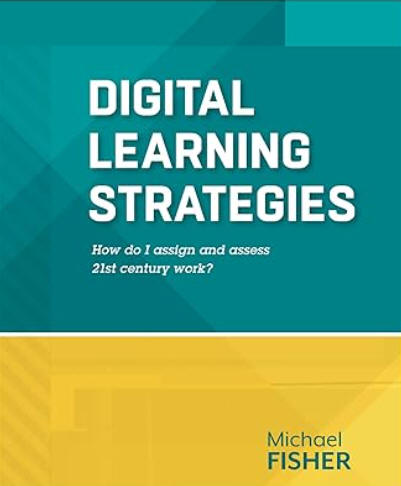 Digital Learning Strategies: How do I assign and assess 21st century work?
(2013) by Mike Fisher. You will also find multiple resources to accompany
this book posted on
LiveBinders.
Categories include: Think Immersive, Use What You've Got, New and Notable, Web
2.0 Tools, Collaborative Tools, Global Connections, Tutorials, Examples, Quality
Digital Media, Digital Portfolios, Rubrics, and Documents/Resources.
Digital Learning Strategies: How do I assign and assess 21st century work?
(2013) by Mike Fisher. You will also find multiple resources to accompany
this book posted on
LiveBinders.
Categories include: Think Immersive, Use What You've Got, New and Notable, Web
2.0 Tools, Collaborative Tools, Global Connections, Tutorials, Examples, Quality
Digital Media, Digital Portfolios, Rubrics, and Documents/Resources.
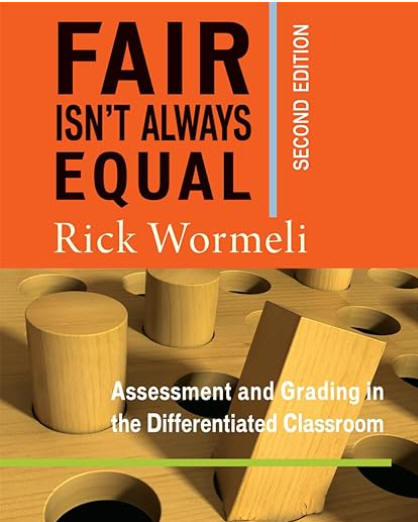 Fair Isn't Always Equal, 2nd edition: Assessment & Grading in the Differentiated Classroom
(2018) by Rick Wormeli will help middle and high school educators to make
decisions on differentiation and assessment on several topics. Section 1
provides a rationale for differentiated instruction and delves into acceptable
evidence of mastery. Section 2 addresses assessment in a differentiated
classroom, types of assessments, including self-assessments, tiering assessments,
rubrics, and creating good questions.
Section 3 on grading helps educators to decide if they should incorporate
effort, attendance, and behavior into academic grades; what approach they should
take to grade homework or allow learners to re-do assessments, and setting up grade
books and report cards for the differentiated classrooms. The last chapter
20 answers the question, "How do differentiating teachers
assess and grade differently?"
Fair Isn't Always Equal, 2nd edition: Assessment & Grading in the Differentiated Classroom
(2018) by Rick Wormeli will help middle and high school educators to make
decisions on differentiation and assessment on several topics. Section 1
provides a rationale for differentiated instruction and delves into acceptable
evidence of mastery. Section 2 addresses assessment in a differentiated
classroom, types of assessments, including self-assessments, tiering assessments,
rubrics, and creating good questions.
Section 3 on grading helps educators to decide if they should incorporate
effort, attendance, and behavior into academic grades; what approach they should
take to grade homework or allow learners to re-do assessments, and setting up grade
books and report cards for the differentiated classrooms. The last chapter
20 answers the question, "How do differentiating teachers
assess and grade differently?"
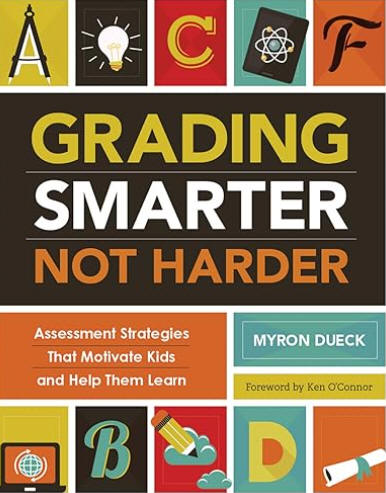 Grading Smarter, Not Harder: Assessment Strategies That Motivate Kids and Help Them Learn
by Myron Dueck (2014) addresses grading, homework, unit plans, retesting, and
creativity. It is filled with reproducible forms, templates, and examples
of grading solutions to allow students to demonstrate their learning.
Ensure that grades measure what students know without punishing them for factors
outside their control.
Grading Smarter, Not Harder: Assessment Strategies That Motivate Kids and Help Them Learn
by Myron Dueck (2014) addresses grading, homework, unit plans, retesting, and
creativity. It is filled with reproducible forms, templates, and examples
of grading solutions to allow students to demonstrate their learning.
Ensure that grades measure what students know without punishing them for factors
outside their control.
Hess' Cognitive Rigor Matrix & Curricular Examples: Applying Webb’s Depth-of-Knowledge Levels to Bloom’s Cognitive Process Dimensions – Math/Science will help educators who are developing curriculum and associated assessments to determine the level of rigor being applied. Norman Webb's Depth of Knowledge (DOK) levels include recall and recognition, skills and concepts, strategic thinking and reasoning, and extended thinking. Hess relates those four levels to Bloom's Revised Taxonomy (remember, understand, apply, analyze, evaluate, and create) and provides specific math and science examples to illustrate. Dr. Karin Hess' works also appear within publications of the National Center for the Improvement of Educational Assessment, Inc. Her website is https://www.karin-hess.com. Also see the DOK definitions for mathematics at each level of the framwork, posted at Web Align.
Michigan Assessment Consortium, as the name suggests, provides numerous resources on assessment such as a balanced assessment system, assessment literacy standards, purposes and uses, methods, policy and practice, developing/implementing assessments, technical concepts in assessment, and more. There's also a section on research and development.
Multiple
Choice Construction Checklist by Dr. Robert Runté (2001) contains tips for better multiple
choice questions, true/false questions, matching and completion tests. Reporting test results and item
analysis are also included in this set of checklists.
Test Accessibility and Modification Inventory (2008) is an evaluation tool designed to facilitate a comprehensive analysis of tests and test items, including analysis of computer-based tests. It was written by Peter Beddow, Ryan Kettler, and Stephen Elliott of Vanderbilt University. Analysis considers the passage/item stimulus, the item stem, visuals, answer choices, page/item layout, fairness, depth of knowledge level. Computer-based test analysis also considers the test delivery system, test layout, test-taker training, and audio.
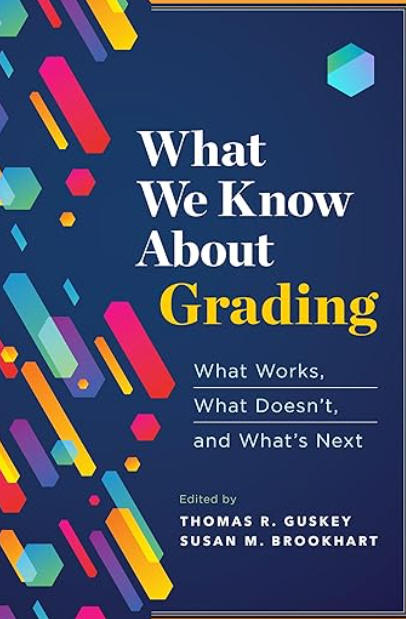 What
We Know About Grading: What Works, What Doesn't, and What's Next
edited by Thomas Guskey and Susan Brookhart (2019) presents a comprehensive
summary of 100-plus years of research on grading. Each of its eight chapters addresses a different
aspect of grading, including:
What
We Know About Grading: What Works, What Doesn't, and What's Next
edited by Thomas Guskey and Susan Brookhart (2019) presents a comprehensive
summary of 100-plus years of research on grading. Each of its eight chapters addresses a different
aspect of grading, including:
 Per Wiggins (2013/2014): "You haven't mastered a subject if you only
possess skills and facts in isolation and can only produce them on demand in
response to prompts" (p. 13).
Per Wiggins (2013/2014): "You haven't mastered a subject if you only
possess skills and facts in isolation and can only produce them on demand in
response to prompts" (p. 13).
"Mastery is effective transfer of learning in authentic and worthy performance. Students have mastered a subject when they are fluent, even creative, in using their knowledge, skills, and understanding in key performance challenges and contexts at the heart of that subject, as measured against valid and high standards." (p. 13)
Hence, performance assessments and tasks provide an ultimate means for a learner to demonstrate mastery.
If you are interested in creating your own performance tasks, the Performance Assessment Resource Bank has multiple resources for developing performance tasks and rubrics.
School leaders will benefit from the Quality Criteria for Systems of Performance Assessment for School, District, and Network Leaders (Quality Criteria) by Larkin Willis, Aneesha Badrinarayan, and Monica Martinez (2022, November 14) at the Learning Policy Institute. The tool is research based and "designed to support school, district, and network leaders in examining their existing systems for evidence of the policies, structures, and features that enable the use of performance-based assessment in service of deeper learning for all students. By using the criteria, indicators, and recommendations described in this resource, system leaders can assess their current context, identify high-leverage opportunities to further advance performance assessment systems, and design next steps to navigate their specific contexts" (Using This Resource section).
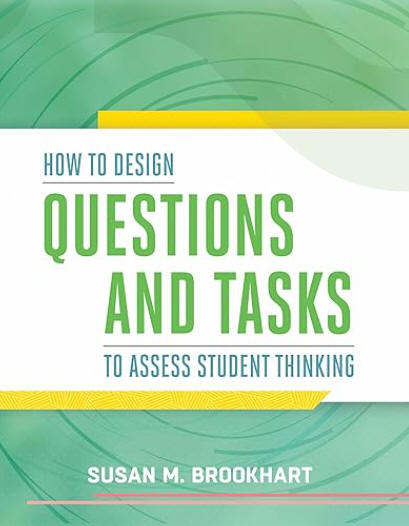 How
to Design Questions and Tasks to Assess Student Thinking
by Susan Brookhart (2014) provides guidance on how to assess higher-order
thinking and manage assessment of it, how to view assessment questions and tasks
as problems to solve, writing multiple choice question to assess higher-order
thinking, and using open-ended and close-ended questions. She delves into
performance assessment tasks: the basics, varying the amount of structure,
controlling cognitive level and difficulty, and provides an idea bank of
performance assessment tasks. Multiple examples from K-12 content areas
are included.
How
to Design Questions and Tasks to Assess Student Thinking
by Susan Brookhart (2014) provides guidance on how to assess higher-order
thinking and manage assessment of it, how to view assessment questions and tasks
as problems to solve, writing multiple choice question to assess higher-order
thinking, and using open-ended and close-ended questions. She delves into
performance assessment tasks: the basics, varying the amount of structure,
controlling cognitive level and difficulty, and provides an idea bank of
performance assessment tasks. Multiple examples from K-12 content areas
are included.
Defined Learning is a subscription service that provides project based learning, authentic performance tasks and non-fiction literacy tasks for Grades K-12 in math, science, ELA and social studies. Each cross-curricular task presents students with a real-world situation in a STEM career. The performance tasks follow the Understanding by Design Framework. Students complete the task using the G.R.A.S.P model in which the teacher presents the goal or big idea, then students are given their role and told who the audience is and the situtation they must solve. Ultimately they create a product (e.g. brochure, commercial, model)that solves the problem. There are also constructed responses geared toward students in K-6. A real-world video sets the stage for each lesson. Tasks are aligned to state and national standards including Common Core and C3. Rubrics are provided to help grade student work. A free trial is available.
HOT for CCSS: Exemplars: Performance Tasks for Math as described at the site include:
Exemplars is subscription-based; however, the site does offer free sample performance tasks.
HOT for CCSS: Illustrative Mathematics is a work in progress to produce illustrative tasks that students would be expected to do related to each of the Common Core State Standards for Mathematics. Sections address illustrations for the K-8 and High School standards. The project is an initiative of the Institute for Mathematics & Education and the Bill & Melinda Gates Foundation.
HOT for CCSS: Inside Mathematics: Performance Assessment Tasks from The Dana Center, University of Texas, includes performance tasks for grades 2-8 and high school. Tasks are aligned to the CCSS math standards.
HOT for CCSS: Mathematics Assessment Project (MAP) is funded by the Bill and Melinda Gates Foundation. A collaborative team from the University of California at Berkeley and University of Nottingham in the UK is developing assessments that will help educators to implement the Common Core State Standards (CCSS). At MAP you will find both summative tests or tasks and formative assessment lessons. Tasks available are for high school and middle school. Tasks are grouped into novice, apprentice, and expert levels and "variously ask students to use their mathematics in routine or non-routine situations to design, plan, estimate, evaluate and recommend, review and critique, investigate, re-present information, explain, define concepts, and show their skills in routine technical exercises." Further, "MAP thus provides a source of tasks for assembly into tests that teachers can use for periodic summative assessment during the school year and, where appropriate, in substantial end-of-year examinations. They also provide a model for designers of high-stakes tests who aim to develop valid assessments of the mathematics described in CCSS." (Summative assessment section)
HOT for CCSS: NCTM contains a Classroom Resources section with lesson plans, interactives and mobile apps, and problems in a searchable database. Items are also searchable by Common Core standards.
Performance Assessment Resource Bank is a project of the Understanding Language and Stanford Center for Assessment, Learning, and Equity and the Stanford Center for Opportunity Policy in Education in collaboration with the Council of Chief State School Officers Innovation Lab Network (About section). Free K-12 performance tasks are available for math, English/language arts, science, and history/social studies. Filter by type of task, subject, course, grade level.
Youcubed Tasks from Stanford University are searchable by grade level and topic. Topics include number sense, patters and generalizations; shape, space, and measures; data, probability, and statistics; and data science. They encourage visual math learning and enable learners to see the beauty in math and to be creative. Also see Youcubed Mathematical Mindset Algebra, a four-week unit curriculum unit that can be used at any grade level to introduce algebraic concepts.
WeTeachNYC includes a library of resources by the New York City Department of Education. You can search resources by grade level, subject area, educational use, audience, resource type, media type, program type, and standard (e.g., Common Core).
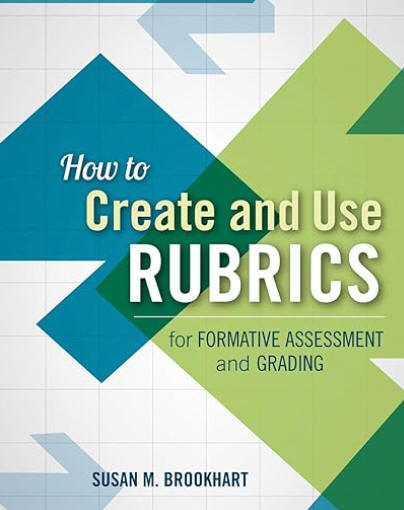 How
to Create and Use Rubrics for Formative Assessment and Grading
by Susan Brookhart (2013) includes two sections. In Section 1, Brookhart
lays out the basics of rubrics, explains their importance, discusses common
misconceptions, and how to write or select effective rubrics. She
identifies various kinds of rubrics and their essential components. In
Section 2, she explains how to use rubrics for formative assessment and grading.
How
to Create and Use Rubrics for Formative Assessment and Grading
by Susan Brookhart (2013) includes two sections. In Section 1, Brookhart
lays out the basics of rubrics, explains their importance, discusses common
misconceptions, and how to write or select effective rubrics. She
identifies various kinds of rubrics and their essential components. In
Section 2, she explains how to use rubrics for formative assessment and grading.
Creating and Using Rubrics for Assessment is an extensive collection of rubrics posted at the University of Wisconsin-Stoudt for assessing virtual learning in simulations/games, portfolios, cooperative learning, the research process, PowerPoint projects, podcasts, oral presentations, web pages, blogs, wikis, math/art/science/writing, and other projects. There are also rubrics for primary grades and resources for creating your own rubrics. Also see the collection of rubrics and assessment resources for additional articles on this topic.
Critical Thinking Rubrics for grades K-2, 3-5, and 6-12.are available at the Buck Institute for Education/ PBLWorks. They are research-based and were developed in collaboration with the National Center for Improvement of Educational Assessment (Center for Assessment).
 iRubric
from rCampus is a free comprehensive rubric design and assessment
tool for teachers and students to build simple or complex rubrics with multiple sections and a
flexible number of rows and columns. There is also a Rubric Gallery
with a collection of rubrics made my members, organized by subject
and type of rubric.
iRubric
from rCampus is a free comprehensive rubric design and assessment
tool for teachers and students to build simple or complex rubrics with multiple sections and a
flexible number of rows and columns. There is also a Rubric Gallery
with a collection of rubrics made my members, organized by subject
and type of rubric.
Math Assessment Rubrics from Exemplars include a Standards-Based Math Rubric based on the Common Core Standards.
Performance Based Assessment Rubrics from the New York Performance Standards Consortium are available for math, literature, social studies, experimental science, and engineering/design science.
Caution before implementing: As ensuring student privacy is important, Michael Gorman (2014) provided some sound advice to educators who wish to use free online formative assessment tools:
According to Guskey and Jung (2016), computerized grading systems are
appealing to educators because "they simplify record keeping and seem to
objectify grading" (p. 51). In spite of such advantages, however,
"teachers judgment has been shown to be more reliable" (p. 50).
Teachers need to consider if algorithms in such programs really are accurate
and reliable to describe what students have achieved, particularly for
determining a student's mastery of a particular objective.
The choice of which algorithm to use in computing summary grades is subjective. "Computerized grading programs typically offer the choice of several statistical algorithms for determining a student's summary grade. The most common algorithms include the mean (the average score); median (the middle score); mode (the most frequently appearing score); and the trend score (a score pattern analysis)" (Guskey & Jung, 2016, p. 51).
iGradePlus includes an online gradebook for individual teachers with free and premium options and a school management system. It is FERPA compliant and offers security features for data.
Jumprope includes an online standards-based gradebook in which teachers can write their own standards, use state standards, or align curriculum to the Common Core. Teachers can record attendance, track student behavior and character development. There are curriculum design tools based upon the principles of backwards planning. Jumprope also provides administrative tools for school-wide reporting. Plans are available for the classroom (sign up for free), school, or district.
Planboard is a free digital planbook for teachers. When creating lessons you can add files, photos, and videos, build lesson templates, connect standards, and view and edit your lessons on iOS and Android. The PowerTeacher Pro Gradebook features both standards-based and traditional grading. You can also customize the gradebook and create student progress reports.
TeacherEase is an online gradebook that is free for individual teachers. It enables traditional or standards-based grading and can also be used by teachers who don't use grades (e.g., primary teachers, special education teachers, etc.). Teachers can also keep attendance and behavior logs. You can also determine what parents can view, print progress reports, and send email.
ThinkWave includes a free online gradebook and a premium version with greater functionality. Features include ability to assign and collect homework online, password protected accounts for viewing data, mass emailing, and flexible grading options (e.g., all points, weighted grades, letter grades, check, check plus, and custom grades).
Capterra.com includes over 40 top gradebook software programs.
25 Time-Saving Grading Apps to Make Teachers' Lives Easier
AI Teaching Assistant Pro is a free app from Contact North | Contact Nord in Canada. Per its description, teachers can "generate multiple-choice quizzes and essay questions with scoring rubrics for any subject at any academic level." You can make lessons interactive and also create a syllabus. It works on smartphones, laptops, and desktops. It does not require a login or track users.
ClassMarker is online quiz making and grading software with several formats for developing questions. It uses artificial intelligence. Choose from two testing options: class-based or external testing. The standard account for class-based testing includes full functionality for creating and administering online quizzes and is free. External testing allows you to "embed tests within your website or link directly to them (optionally password protect your tests)" and there is also a free version. Free versions have limited features, however. Nominal fees are connected to the professional version for each option.
EasyTestMaker.com is an online test generator for multiple choice,
fill-in-the-blank, matching, short answer and true and false
questions. Insert instructions, create multiple sections and
alternative versions, and generate the answer keys. Free, Plus, and
Premium plans are available.
Flubaroo is a free tool for helping to quickly grade multiple-choice or fill-in-the-blank assignments. You can also get reports on results (e.g., average score on assignment or question, low-scoring questions, grade distribution graph) and send feedback to individual students.
Google Forms is a free online form creator that allows you to create quizzes using multiple question types, surveys, and other forms. For quizzes select "blank quiz" from the template gallery. You can setup a locked quiz, password protect a form, and link a form to a Google Sheet. The template gallery also includes a form for an exit ticket, assessment, worksheet, and course evaluation. You can analyze responses. For additional information, see What is Google Forms and How Can It Be Used By Teachers? by Luke Edwards (2020) at Tech & Learning.
ProProfs.com is an online quiz making service that uses AI and templates to help create quizzes and assessments. Free and paid options are available. There's a free trial. You can customize your quiz. Ready-to-use questions are available, and you can add images and videos. Share your quiz with others, post the quiz on any webpage, or link to it from any webpage. Multiple question types are available. Available features depend on your plan.
Quia for the Web from IXL Learning is a low-cost annual subscription service with a range of options for creating 16 types of games and learning activities, quizzes with any of 10 types of questions, and sharing your activities with others. There are over 2000 shared activities for math alone. You can create classes and track quiz results, create class pages for communicating with students, and maintain an online schedule and calendar. You can upload images and audio clips, and copy/modify any of Quia's activities to suit your own needs.
Quizalize is powered by ChatGPT and includes free and paid versions for creating quizzes for remote or face-to-face classes. Ready-made quizzes are available in multiple subjects, which you can also search by state standard and Common Core.
Quizizz is an online quiz tool that operates like a gameshow. It allows you to create and play multiplayer games for in class or home use. It works on all devices with a browser, including computers, tablets, and smartphones. There's a searchable database of quizzes made by others, as well. Free and paid options are available.
Quizlet uses artificial intelligence in its tools to enhance learning: practice tests, expert solutions in textbooks, step-by-step explanations, personalized AI tutoring. It allows you to make digital flashcards for free. You can import existing questions and answers on your computer or from a web site or type them in directly. There are several modes for students to interact with content. You can view quizlets created by others; there are multiple quizlets available in K-12 math. Quizlet also includes interactive diagrams, or you can create your own, which you can annotate to customize study material.
Testmoz includes both free and paid options for creating quizzes. Question types are multiple-choice, true/false, fill in the blank, and essay. The free version allows users to create up to 50 tests and to have 100 simultaneous responders per test, but you can delete results to allow more test takers. An auto-grading feature is included. Math equations can be included in questions and answers.
ASSISTments
is a free web-based tutoring program for grades 2 to high school, principally
with content for mathematics. The program was developed by Professor Neil
Heffernan at Worcester Polytechnic Institute (WPI) in Massachusetts and numerous
colleagues (e.g., at Carnegie Mellon and WPI students, faculty and staff as well
as many cooperating teachers) with funding and support from a variety of
sources, including grants from the US Department of Education and the National
Science Foundation. The word “ASSISTments” blends tutoring assistance with
assessment reporting to teachers. This gives teachers fine grained reporting on
skills that the system tracks. The developers identified skills using standards
from many states, and their observations of many state assessments. As a
formative assessment tool, math teachers assign problem sets to their students
to do on the computer, and students are tutored on the items they get wrong.
Teachers log on to the system and study detailed reports about their students’
difficulties and strengths. Teachers can use content developed at WPI or write
their own content.
Formative is a free online tool (Bronze level) for teachers and students that works with any internet connected device. Per the website, it is "optimized for any 1:1, BYOD, flipped or blended classroom." Create and upload online assessments, classwork, and homework; assign those to students; get live results and provide feedback. Students can type, draw to show their work, and submit images, so this tool goes beyond formative assessments in multiple choice format. Additional Silver and Gold pricing options are available.
Floop is an app designed to help teachers provide feedback to learners. It works on any browser and device. Students can photograph their work, including handwritten and/or typed work, and submit it when completed or when they just need extra help. Teachers can save their comments and reuse them as needed with multiple learners, which helps save time. Students can use it for anonymous peer reviews and to assess themselves. The basic plan is free and allows 10 active assignments. There is no limit to active assignments for the paid options. All options include such features such as image, pdf, and Google Doc uploads, audio and freeform comments, guided peer-review, co-teachers, bulk enrollment of students, and Schoology roster integration. Math teachers will appreciate that formatted math text can be included in comments.
Kahoot "is a game-based learning platform used by millions of people around the world every day to discover, create, play and share learning games." It "can be used for any subject, any age, and with any device" in class, for distance learning, or blended learning. Teachers have used it to introduce new topics, review content at class and home, run formative assessments, teach interactive lessons, collect student opinions, and more. (Teacher's Starter Guide to Kahoot, 2021, June). For more information, Luke Edwards (2024, January 5) at Tech & Learning discussed What is Kahoot! and How Does it Work for Teachers? Tips & Tricks. The basic option is free. Paid options are available. A paid option for teachers includes Kahoot's artificial intelligence question generator.
MasteryConnect from Instructure, Inc. is a K-12 digital assessment management system. You'll find standards-based formative and benchmark assessments, including multiple-choice, performance tasks, rigorous tests. Map standards along with your scope and sequence across the district with a common set of resources. MasteryTracker is also a feature for monitoring and reporting mastery. Per the site, "MasteryConnect provides academic standards for every state and national core, including every subject area and grade level. You can also create your own custom standards."
Mathematics Assessment Project: Classroom Challenges are "lessons that support teachers in formative assessment. There are 100 lessons in total, 20 at each grade from 6 to 8 and 40 for ‘Career and College Readiness’ at High School Grades 9 and above. Some lessons are focused on developing math concepts, others on solving non-routine problems."
Pear
Deck (formerly Edulastic) includes a free option for teachers,
and does include paid versions. It features high quality questions for
assessments aligned to Common Core and state standards, including performance
tasks. You can also create your own from over 50 different technology enhanced question types.
Pear Deck also helps to prepare learners for state standardized tests with
its "free practice tests with technology enhanced questions and actual
state-released items." Pear Deck also features AI in its
Question Generator and Assisted Rubrics, the latter of which will
generate rubrics.
iClicker: iClicker has introduced an AI question generator.
Slido: For tips and tricks, see What is Slido for Education? Best Tips and Tricks by Luke Edwards (2021, June 23) posted at Tech & Learning.
Socrative
"is a student response system that empowers teachers to engage their classrooms
through a series of educational exercises and games via smartphones, laptops,
and tablets" or a web-browser. Teachers can create quizzes that are
multiple-choice, true-false, or require one sentence responses. Socrative apps
are called Socrative Teacher and Socrative Student. Free and
paid options are available.
Echo360 is a source for response technology, commonly referred to as clickers, for the classroom and related software.
All of the following include math. Some feature other content areas beyond which is described below.
Carnegie Learning, Inc. publishes research-based math solutions for middle school, high school, and post-secondary students.
Curriculum Associates has K-12 solutions for math, RTI, test prep, and more. Its i-Ready Assessment system includes a reading and math diagnostic for K-12 and a dyslexia screener for K-3. Per the web site, i-Ready Standards Mastery for grades 2-8 will help districts and schools monitor mastery of specific standards in ELA and Math. In addition, i-Ready Classroom Mathematics for K-8 balances conceptual understanding with procedural fluency.
Edmentum (formerly known as Plato Learning) interventions for K-adult learners.
Houghton Mifflin Harcourt assessment solutions.
Imagine Learning Assessment solutions
Instructure offers several assessment options for K-12 schools, such as benchmark, formative, and college and career readiness assessments. Its Formative Assessment Item Bank includes assessment coverage for K-12 Math, English Language Arts, Science, and Social Studies. Assessments are aligned to state, Next Generation Science Standards, and Common Core standards. Item types include multiple choice, constructed response with rubrics, writing prompts with rubrics, and technology-enhanced items.
Kaplan Test Prep includes multiple levels and fields. You'll find ACT, SAT, AP exam test prep, GED, and much more.
Mastery Education includes diagnostic and practice tests geared to state and national standards and Common Core State Standards. There are online assessments in Measuring Up Live, for example.
McGraw-Hill Education publishes for pre-K through adult learning.
MetaMetrics: Quantile Framework for Mathematics is focused on improving teaching and learning in grades K–12 by enabling educators, librarians and parents to use students’ scores from classroom and state tests to link assessment with instruction. In describing this framewwork MetaMetrics stated:
"Quantile measures allow students and tasks, skills and concepts to be placed on the same scale. By providing a common scale on which the measurement of students’ math skills, as well as all math content can be placed, provides the critical link for supporting personalized learning in math. Quantile measures take the guesswork out of instruction for educators by describing which mathematical skills and concepts the student has learned and is ready to learn." (MetaMetrics About Us section)
There is a searchable "Math Skills Database for Quantile Skills and Concepts (QSCs) using your state standards. The database contains targeted, free resources appropriately matched to students by Quantile measure and math content."
New Meridian includes released test items among its resources. New Meridian indicates its item banks are aligned to the Common Core State Standards and compatible standards. Per its description, the company develops "statewide, beginning-of-year, end-of-year, and standards- and curriculum-aligned interim assessments." It took over management of PARCC's testing business in 2017.
Northwest Evaluation Association: Assessments include the Measures of Academic Progress (MAP) Suite for K-12 and Through-Year Assessment for grades 3-8. Per the site, "With through-year assessment, districts and states can measure fall-to-spring growth as well as annual changes in summative performance." A 2018 independent study found 97% of MAP Growth Items align to the Common Core. NWEA has provided practice tests for their MAP Growth product.
Pearson Assessments Note: Pearson's Next Generation Assessments initiative includes white papers that will help states design and deliver new online assessments. Pearson is also the developer of aimswebPlus, which screens and monitors reading and math skills in preK-12 learners.
Renaissance Learning: STAR Assessments, including Star Math for grades 1-12, for example.
Savvas Learning Momentum Screener and Diagnostic Math for grades K-8 will help uncover students' strengths and weaknesses and provide targeted recommendations including additional resources.
Turnitin: Gradescope administers and grades assessments. Per its description, "Gradescope supports variable-length assignments (problem sets & projects) as well as fixed-template assignments (worksheets, quizzes, bubble sheets, and exams)." Artificial intelligence assistance for grading some question types is available. Feedback is provided to help learners understand their responses. There's a free trial and then three pricing options.
Voyager Sopris Learning has math intervention products for grades K-9 and an algebra intervention. For example, math programs include, but are not limited to, VMath for struggling learners in grades 2-8, web-based VmathLive for grades K-8, and TransMath intervention curriculum for grades 5-10.
Each year you will be faced with interpreting test results
particularly for mandated state assessments, and explaining
those results to students and parents. It is a good idea to
have a working knowledge of key terms. The following resources should
help in this endeavor.
The Glossary of Education Reform created by the Great Schools Partnership provides clear explanations of school improvement terms, concepts, and strategies in everyday language. It's great to help parents and others understand the specialized language that educators use.
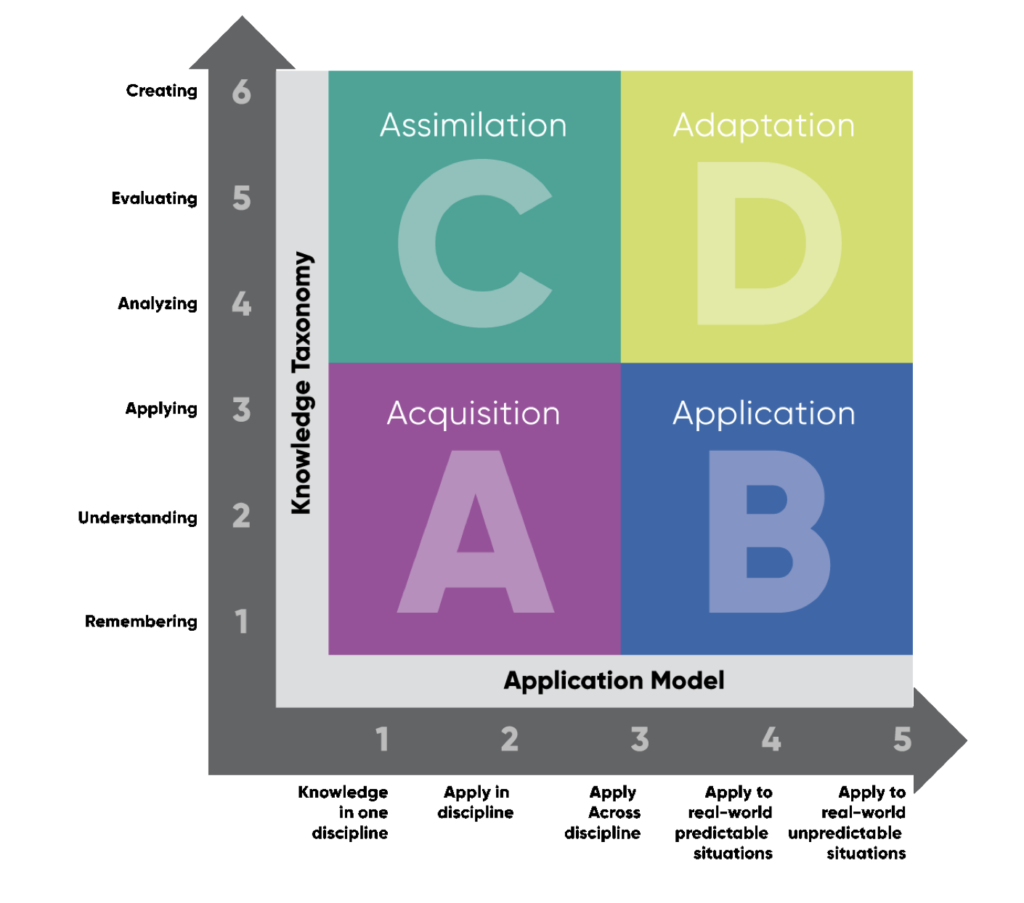
The International Center for Leadership in Education developed a Rigor/Relevance Framework to examine curriculum, instruction, and assessment. It has two dimensions of higher standards and student achievement organized in four quadrants: acquisition, application, assimilation, and adaptation. The first dimension is based on the six levels in Bloom's taxonomy. The second dimension is an Application Model with five levels based on action: knowledge in one discipline, applying in one discipline, applying across disciplines, applying to real-world predictable situations, and applying to real-world unpredictable situations. Teachers might find it very helpful in planning instruction and assessment activities.
Back to top | Math Methodology: Assessment Page 1 | 2
Bathon, J. (2013, July). For districts, online testing has legal liabilities. THE Journal, 40(7), 17-20. https://thejournal.com/Research/List/THE-Journal-Digital-Edition.aspx?Page=6
Fox, C., Waters, J., Fletcher, G., & Levin, D. (2012). The broadband imperative: Recommendations to address K-12 education infrastructure needs. Washington, DC: State Educational Technology Directors Association (SETDA). https://www.setda.org/priorities/equity-of-access/broadband-imperative/
Gorman, M. (2014, November 24). Free digital formative assessment tools... important thoughts before implementing. 21CenturyEdTech. https://21centuryedtech.wordpress.com/2014/11/24/free-digital-formative-assessment-tools-important-thoughts-before-implementing/
Guskey, T. R., & Jung, L. A. (2016). Grading: Why you should trust your judgment. Educational Leadership, 73(7), 50-54. https://www.ascd.org/el/articles/grading-why-you-should-trust-your-judgment
State Educational Technology Directors Association (2012). Technology Readiness for College and Career Ready Teaching, Learning and Assessment. https://www.setda.org/master/wp-content/uploads/2013/09/SETDA_TechnologyReadinessCollege.pdf
Wiggins, G. (2013/2014). How good is good enough? Educational Leadership, 71(4), 10-16. https://www.ascd.org/el/articles/how-good-is-good-enough
Willis, L., Badrinarayan, A., & Martinez, M. (2022). Quality criteria for systems of performance assessment for school, district, and network leaders. Learning Policy Institute. https://learningpolicyinstitute.org/product/quality-criteria-performance-assessment-systems-tool
Back to top | Math Methodology: Assessment Page 1 | 2
 See
other Math Methodology pages:
See
other Math Methodology pages:
Instruction--Essay, Instruction--Resources, and Curriculum: Content and Mapping
 Comments?
Are you finding resources at CT4ME of value?
Comments?
Are you finding resources at CT4ME of value?
Send us your favorite math resources and tips for success.
Contact Dr. Patricia Deubel: pdeubel@ct4me.net
To cite this page, use the following format:
Deubel, P. (year from last revised). Math methodology: Assessment resources. Computing Technology for Math Excellence. Retrieved Month, Day, Year, from https://www.ct4me.net/assessment_2.htm
CT4ME Author: Dr. Patricia Deubel
Copyright © 2001-2024 [CT4ME.net]. All rights reserved.